
- Catalogs
- Bruker Optics
- LUMOS II ILIM

LUMOS II ILIM
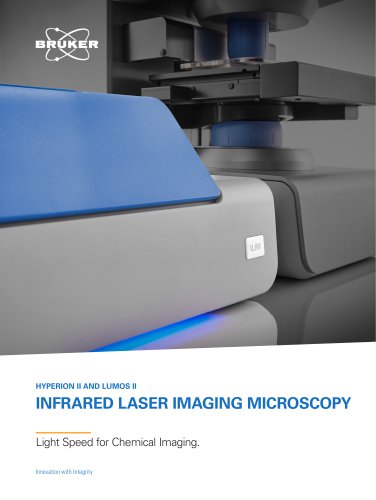
LUMOS II ILIM
HYPERION II and LUMOS II represent advancements in infrared laser imaging microscopy, offering significant improvements over traditional FT-IR imaging. This document outlines the technological innovations, specifications, and applications of these systems.
Technology Overview
Traditional FT-IR imaging uses a thermal source with low intensity, requiring sensitive detectors. In contrast, Infrared Laser Imaging (ILIM) employs a quantum cascade laser (QCL) that emits at discrete wavenumbers with higher intensity, allowing for faster and more efficient imaging without the need for cooled detectors.
Technical Specifications
- Source: FT-IR uses a thermal source, while ILIM uses a QCL.
- Data Collection: FT-IR collects all wavelengths simultaneously, whereas ILIM acquires sequential wavelengths.
- Spectral Range: FT-IR covers the full MIR range, while ILIM focuses on the MIR fingerprint.
Performance Comparison
ILIM significantly outperforms FT-IR in terms of speed and resolution. For example, ILIM can achieve imaging speeds of up to 270 mm² per minute, compared to FT-IR's 1.6 mm² per minute.
Applications and Benefits
ILIM is particularly beneficial in fields requiring rapid and detailed chemical imaging, such as cancer research, where it provides molecular contrast without staining. The technology's speed and field of view enhancements make it a game changer for large-scale tissue analysis.
Innovations
Bruker's patented "spatial coherence reduction" technology minimizes interference artifacts, enhancing image quality. This innovation allows for high-speed imaging without compromising on detail.
Application Workflows
Bruker offers dedicated workflows for various applications, including tissue, tablet, and particle analysis. These workflows integrate hardware and software for seamless operation and high throughput.
- TissuePlus™: High throughput tissue analysis with automated processes.
- TabletPlus™: Routine imaging of pharmaceutical tablets with machine-learning classification.
- ParticlePlus™: Efficient particle analysis using robust identification methods.
Conclusion
HYPERION II and LUMOS II, with their advanced ILIM technology, provide unprecedented speed and quality in infrared imaging. These systems are designed to meet the demands of modern research, offering flexibility and integration with existing analytical methods.
Catalog excerpts
INFRARED LASER IMAGING MICROSCOPY Light Speed for Chemical Imaging. Innovation with Integrity
Open the catalog to page 1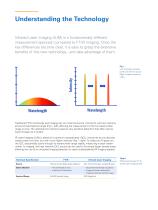
Infrared Laser Imaging (ILIM) is a fundamentally different measurement approach compared to FT-IR imaging. Once the key differences become clear, it is easy to grasp the extensive benefits of this new technology - and take advantage of them. Left: Schematic emission profile of a thermal source. Right: Tunable emission of a QCL. Wavelength Traditional FT-IR microscopy and imaging rely on a thermal source, that emits with low intensity across a broad spectral range (Fig.1, left), allowing the measurement of the full wavenumber range at once. The relatively low intensity requires very sensitive...
Open the catalog to page 2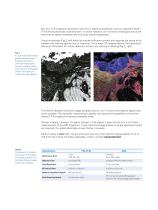
But why is IR imaging so powerful? And why is speed of acquisition such an important factor? The following example illustrates both. In cancer research, thin sections of biological tissue are examined to detect diseased cells and study cancer progression. Visual microscopy (Fig.2, left) does not provide sufficient contrast and requires the tissue to be treated with staining agents prior to inspection. In contrast, IR imaging delivers the neccessary chemical information for cancer detection without any staining or labeling (Fig.2, right). Fig. 2 A visual image (left) provides general information...
Open the catalog to page 3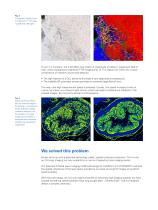
Fig. 3 Comparison of field of view of LUMOS II in FT-IR imaging (left) and ILIM (right). To put it in numbers: the ILIM offers two orders of magnitude increase in speed and field of view, when compared to traditional FT-IR imaging (Fig. 3). The reason lies within the unique combination of radiation source and detector: The high intensity of a QCL allows to illuminate a very large area simultaneously The widefield IR bolometer camera provides an extremely large field of view This way, ultra-high measurement speed is achieved. Usually, this speed increase comes at a price, as a laser is a coherent...
Open the catalog to page 4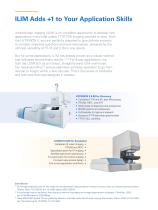
Infrared laser imaging (ILIM) is an incredible opportunity to develop new applications in any field where FT-IR FPA imaging seemed to slow. With the HYPERION II, you are perfectly prepared to give definite answers to complex analytical questions and new discoveries, powered by the ultimate versatility of FT-IR and ILIM in one device. But for some applications, ILIM has already proven as a robust method that delivered extraordinary results.[1,2,3] For those applications, we built the LUMOS II as an honest, straightforward ILIM workhorse. Our ApplicationPlus™ ensure seamless and easy operation...
Open the catalog to page 5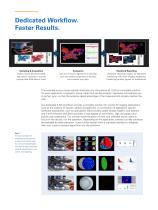
Dedicated Workflow. Faster Results. Sampling & Acquisition Follow robust and automated acquisition methods to acquire reproducible ILIM data at scale. Evaluation Use our AI driven algorithms or develop your own analysis pipelines to process and visualize your data. Results & Reporting Generate "teaching images" for seamless interfacing with other imaging modalities. Create high-quality figures for publications. This example using a tissue sample illustrates one thing above all: ILIM is a complete solution for every application it supports: tissue, tablet and particle analysis. Hardware and...
Open the catalog to page 6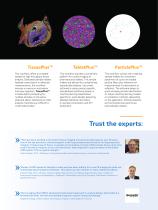
TissuePlus™ This workflow offers a complete toolset for high throughput tissue analysis. Dedicated sample holders facilitate transmission or reflection measurements, the workflow ensures a maximum automation and easy operation. TissuePlusTM includes batch-processing for multiple samples on the same slide and allows interfacing to other analysis methods (e.g. MALDI) in multimodal studies. TabletPlus™ This workflow provides a convenient platform for routine imaging of pharmaceutical tablets. The sample holders are tailored for a streamlined, reproducible analysis. Use smart software to setup product-specific,...
Open the catalog to page 7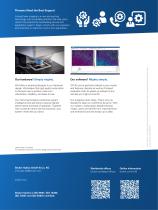
Pioneers Need the Best Support Our software? Mighty simply. We follow a simple philosophy in our hardware design. We believe that high-quality automation is the best way to achieve maximum robustness, reliability, and ease-of-use. OPUS can be perfectly tailored to your needs and features classical as well as AI-based evaluation tools to speed up analysis of any sample you might encounter. Our instruments feature extensive system intelligence and self-tests to assure highest performance and ease of operation. Together with customer-centric service solutions, your system never lets you down. Our...
Open the catalog to page 8All Bruker Optics catalogs and technical brochures
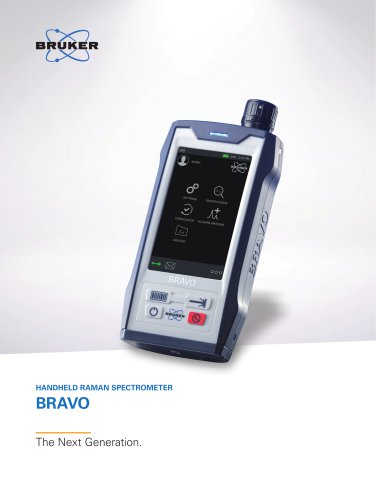 BRAVO
BRAVO12 Pages
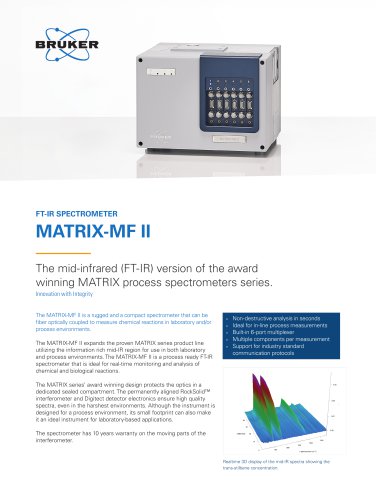 MATRIX-MF II
2 Pages
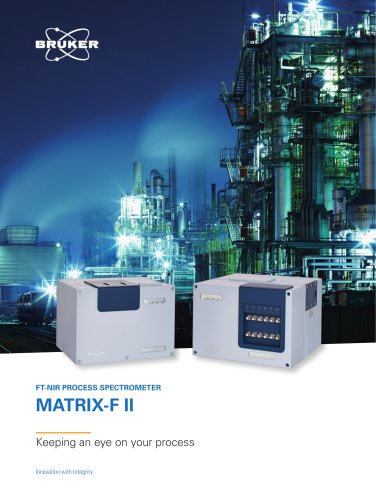 MATRIX-F II
16 Pages
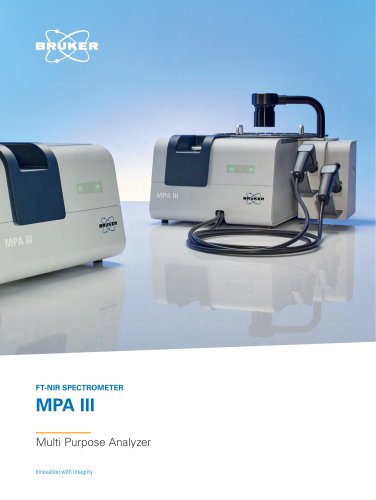 MPA III
7 Pages
 CONFOCHECK
8 Pages
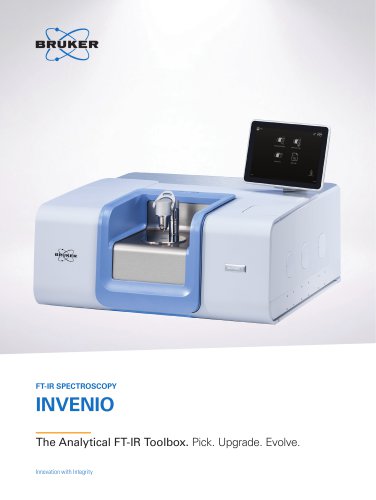 INVENIO
12 Pages
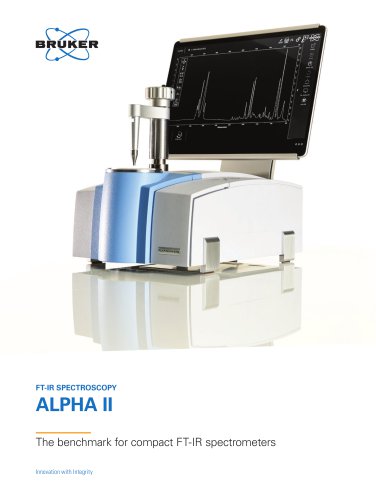 ALPHA II
12 Pages
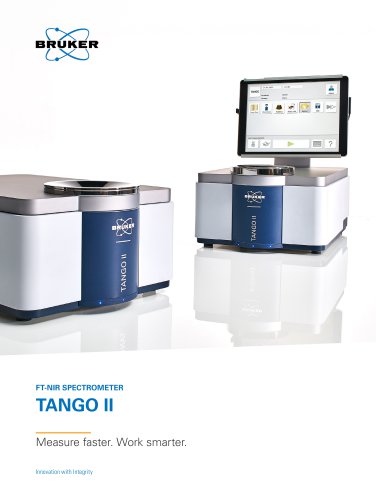 TANGO II
5 Pages
- Microscopy
- Laboratory microscope
- Desktop microscope
- BRUKER spectrometer
- Benchtop spectrometer
- Research microscope
- High-resolution microscope
- Medical microscope
- Research spectrometer
- Spectrometer for the pharmaceutical industry
- NIR spectroscope
- Environmental analysis spectrometer
- Confocal microscope
- Raman spectrometer
- Microscope for life sciences applications
- Laser microscope
- Infrared spectrometer
- Materials research microscope
- Microscope for the pharmaceutical industry
- Quality control spectrometer
- VirtualExpo Group
- Our Partners
- Recruitment
- Testimonials