
- Catalogs
- BTI Biotechnology Institute
- BTI - Solutions for Atrophic Maxillae


BTI - Solutions for Atrophic Maxillae

BTI - Solutions for Atrophic Maxillae
BTI Solutions offers innovative approaches for treating atrophic maxillae with less trauma and increased patient acceptance. The focus is on avoiding complex reconstructions and postoperative complications, thus enhancing rehabilitation without cost increases.
BTI's research highlights a 95% survival rate for short implants over 15 years. These implants address horizontal and vertical bone defects without invasive augmentation techniques, which many patients refuse. Short and narrow implants have shown survival rates comparable to standard implants.
- Expander Kit and Endoret® (PRGF®) Technology: Facilitates autologous and heterologous grafts for bone regeneration and uses fibrin membranes for graft coverage.
- 3.0 Implants: Designed for moderate bone volume cases, these implants avoid the need for bone augmentation. They are suitable for total and partial edentulisms.
- Ø 2.5 mm: For screw-retained multiple restorations, not for single or direct restorations.
- Ø 3.0 mm: Recommended for multiple restorations and specific single restorations.
- Ø 3.3 mm: Suitable for multiple and single restorations in occlusion.
Available in lengths of 4.5 to 7.5 mm, these implants are ideal for treating moderate atrophies without sinus lifts or nerve risks. They simplify surgical approaches for severe atrophies using Endoret® (PRGF®) technology.
Studies show that implant stress is distributed along the first three threads, decreasing apically. Increasing implant diameter reduces stress on adjacent bone by 20-30%. BTI recommends using short implants with the largest diameter possible for single restorations and increasing the number of narrow implants for multiple restorations.
BTI's narrow and short implants provide sufficient surface area for osseointegration, offering a viable solution for atrophic maxillae with reduced surgical complexity and improved patient outcomes.
Catalog excerpts
BTI SOLUTIONS FOR ATROPHIC MAXILLAE
Open the catalog to page 1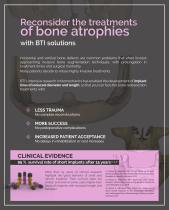
of bone atrophies with BTI solutions Horizontal and vertical bone defects are common problems that often involve approaching invasive bone augmentation techniques, with prolongation in treatment times and surgical morbidity. Many patients decide to refuse highly invasive treatments. BTI’s intensive research in biomechanics has enabled the development of implant lines of reduced diameter and length, so that you can face the bone reabsorption treatments with: LESS TRAUMA MORE SUCCESS INCREASED PATIENT ACCEPTANCE No delays in rehabilitation or cost increases CLINICAL EVIDENCE 95 % survival rate...
Open the catalog to page 2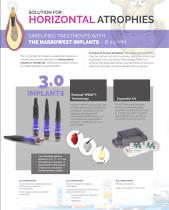
HORIZONTAL ATROPHIES SIMPLIFIED TREATMENTS WITH THE NARROWEST IMPLANTS – Ø 2.5 MM The 3.0 family of implants enable the treatment of total and partial edentulisms where bone volume is moderate, without previously having to undertake bone augmentation. In cases of severe atrophies, the expansion technique may be carried out less invasively, using the motorized expanders kit and Endoret Technology (PRGF) to achieve the adequate bone volume without having to resort to complex and less predictable surgeries. Endoret®(PRGF®) Technology Endoret® (PRGF®) technology with its high regenerative potential...
Open the catalog to page 3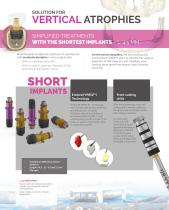
VERTICAL ATROPHIES SIMPLIFIED TREATMENTS WITH THE SHORTEST IMPLANTS – L: 4.5 MM Short implants enable the treatment of edentulisms with moderate atrophies in one surgical step: • With no maxillary sinus lifts With no risks in lower jaw because of the proximity to the dentary nerve For the severe atrophies, the front cutting drill and Endoret® (PRGF®) allow to simplify the surgical approach of the lower jaw and maxillary sinus (vertical bone growth technique, trans-alveolar sinus lift). SHORT IMPLANTS Endoret®(PRGF®) Technology Endoret® (PRGF®), technology with its high regenerative potential...
Open the catalog to page 4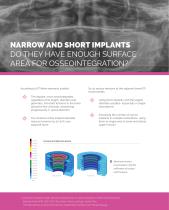
NARROW AND SHORT IMPLANTS DO THEY HAVE ENOUGH SURFACE AREA FOR OSSEOINTEGRATION? According to BTI finite elements studies1: So, to reduce tensions to the adjacent bone BTI recommends: The implant, once osseointegrated, regardless of its length, diameter and geometry, transmits tensions to the bone along the first 3 threads, decreasing progressively in apical direction. Using short implants with the largest diameter possible (especially in single restorations). Increasing the number of narrow implants in multiple restorations, using them as single only in lower and lateral upper incisors. The...
Open the catalog to page 5
B.T.I. Biotechnology Institute S.L. Parque Tecnológico de Álava Leonardo da Vinci ,14 01510 Miñano (Álava) SPAIN [email protected] Subsidiaries GERMANY www.bti-biotechnologyinstitute.com NOTE: consult your distributor for the availability of the product in the different markets. NEW PRODUCTS iPhone / smartphone version iPad / Tablets version (Customer
Open the catalog to page 6All BTI Biotechnology Institute catalogs and technical brochures
 BTI Root Extractor
4 Pages
 BTI UniCca® Surface
5 Pages
 BTI Surgical Instruments
48 Pages
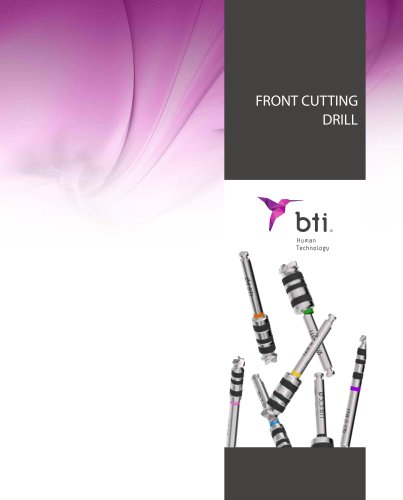 BTI Front Cutting Drill
6 Pages
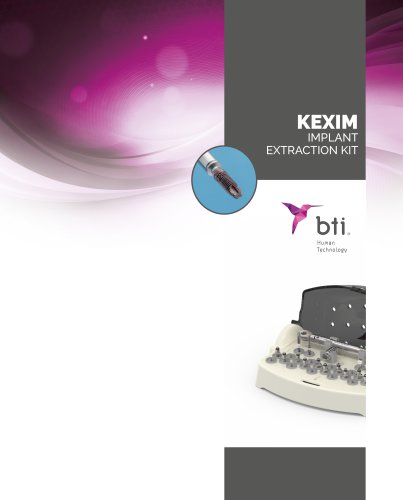 KEXIM Implant Extraction Kit
4 Pages
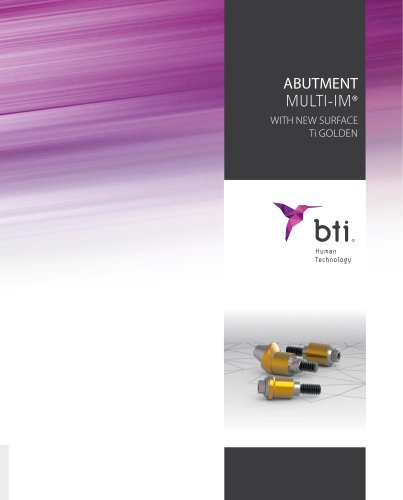 ABUTMENT MULTI-IM
6 Pages



Archived catalogs
 CAD/CAM DISC Blank
2 Pages

- Implant abutment
- Titanium implant abutment
- Straight implant abutment
- Dental surgery instrument kit
- Dental burr
- Dental implant
- Titanium dental implant
- Visualization software
- Diamond burr
- Straight dental implant
- Dental implant surgery instrument kit
- Diagnostic software
- Planning software
- Dental software
- Treatment software
- Internal dental implant
- Cylindrical dental implant
- Capture software
- Measurement software
- Surgery software