
- Catalogs
- CADstar GmbH
- Synthetic Wax Zenotec® Wax

Synthetic Wax Zenotec® Wax
Synthetic Wax Zenotec® Wax
Zenotec® Wax is a synthetic wax CAD/CAM blank designed for the manufacture of dental prostheses. It is produced by Wieland Dental + Technik GmbH & Co. KG, certified under DIN EN ISO 13485 and RL 93/42/ECC (CE 0483). This material offers a fast and cost-effective solution with exceptional functionality and fit accuracy.
Key Features
- Easy to mill with no material swelling.
- No residue upon burnout, making it cost-effective.
- Extremely high melting point.
- Produces very fine chips, preventing milling cutter sticking.
Indications
Zenotec® Wax is not for intraoral use. It is suitable for creating substructures for crown and bridge models, which can be used as lost wax molds in casting technology for dental restorations.
Processing Instructions
- Finishing: Milled substructures can be separated using tungsten carbide cutters or wax-suitable cutting discs.
- Applying Casting Channels: Follow rules based on the alloy or pressed ceramic used, with detailed instructions available in processing guidelines.
- Embedding: Line casting sleeves with ceramic fleece, mix in vacuum, and embed the compound. Follow instructions for the embedding material and alloy or pressed ceramic used.
- Disposal: Made of pure synthetic wax, residues can be reused or disposed of in household rubbish.
Chemical and Physical Properties
- Density: 0.97 g/cm³ at 20°C.
- Water Solubility: Insoluble (0.0 µg/mm³).
Thermal Properties
- Vicat Softening Temperature: 100 - 130°C (212 - 266°F).
Catalog excerpts

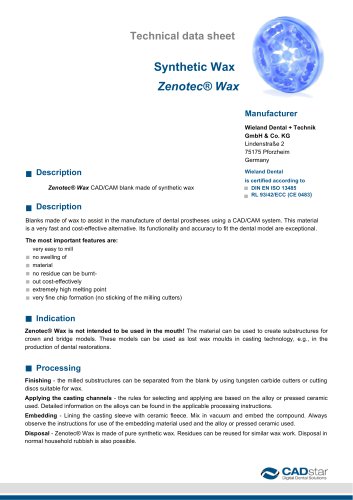
Technical data sheet Manufacturer Wieland Dental + Technik GmbH & Co. KG LindenstraGe 2 75175 Pforzheim Germany Zenotec® Wax CAD/CAM blank made of synthetic wax Wieland Dental Description Blanks made of wax to assist in the manufacture of dental prostheses using a CAD/CAM system. This material is a very fast and cost-effective alternative. Its functionality and accuracy to fit the dental model are exceptional. The most important features are: very easy to mill ■ no swelling of ■ material ■ no residue can be burnt-■ out cost-effectively ■ extremely high melting point ■ very fine chip formation (no sticking of the milling cutters) ■ Indication Zenotec® Wax is not intended to be used in the mouth! The material can be used to create substructures for crown and bridge models. These models can be used as lost wax moulds in casting technology, e.g., in the production of dental restorations. ■ Processing Finishing - the milled substructures can be separated from the blank by using tungsten carbide cutters or cutting discs suitable for wax. Applying the casting channels - the rules for selecting and applying are based on the alloy or pressed ceramic used. Detailed information on the alloys can be found in the applicable processing instructions. Embedding - Lining the casting sleeve with ceramic fleece. Mix in vacuum and embed the compound. Always observe the instructions for use of the embedding material used and the alloy or pressed ceramic used. Disposal - Zenotec® Wax is made of pure synthetic wax. Residues can be reused for similar wax work. Disposal in normal household rubbish is also possible. t CADstar Digital Dental Solutions
Open the catalog to page 1
Technical data sheet Synthetic Wax Zenotec® Wax Manufacturer Wieland Dental + Technik GmbH & Co. KG Lindenstraße 2 75175 Pforzheim Germany Wieland Dental is certified according to DIN EN ISO 13485 RL 93/42/ECC (CE 0483) Chemical composition Synthetic Wax Physical properties (guidelines) Density ρ (at 20°C) Thermal properties Vicat softening temperature (melting point) TV
Open the catalog to page 2All CADstar GmbH catalogs and technical brochures
 cadstar_cs_ultra_pro
6 Pages
 CS Ultra Orthodontics
5 Pages
 cs_ultra
6 Pages
- Dental material
- Dental restoration material
- Dental prosthesis dental material
- Dental crown material
- Dental bridge material
- Biocompatible dental material
- Ceramic dental material
- Software module
- 3D scanner
- 3D dental scanner
- Dental inlay material
- Dental software module
- Design software module
- Benchtop 3D scanner
- CAD software module
- Dental laboratory 3D scanner
- Orthodontic laboratory 3D scanner