

- Company
- Products
- Catalogs
- News & Trends
- Exhibitions
Calprotectin ELISA (ALP)
Calprotectin ELISA (ALP)
The document provides comprehensive instructions and specifications for the CALPROLAB® Calprotectin ELISA (ALP) kit, which is used to measure calprotectin levels in fecal samples. This measurement aids in diagnosing and monitoring inflammatory bowel diseases (IBD) such as ulcerative colitis and Crohn's disease.
The test is designed for in vitro diagnostic use to assess gastrointestinal tract diseases, evaluate disease activity, and monitor treatment responses.
Calprotectin is a protein associated with intestinal inflammation. Its elevated presence in feces indicates organic bowel diseases, distinguishing them from functional disorders like IBS.
The test involves extracting calprotectin from feces and using an ELISA procedure to measure its concentration through color intensity, which is read by an ELISA plate reader.
The kit includes reagents such as coated microtiter plates and buffers. Additional materials required are distilled water, extraction devices, pipettes, and a microplate reader.
Reagents are stable at 2–8°C until expiry. Opened reagents last up to three months, and working solutions last up to one month when stored properly.
Reagents and samples should reach room temperature before testing. Fecal samples should be collected and delivered within five days or stored frozen. The ELISA procedure involves sample incubation, washing, and absorbance measurement.
Faeces extracts should be diluted 1:100. The ELISA procedure includes sample dilution, incubation, washing, enzyme conjugate addition, and optical density reading at 405 nm.
Each run should include a new standard curve and positive controls. Ensure OD values for standards are within specified limits.
Calculate mean OD values, plot a standard curve, and determine calprotectin concentration. Normal values range from 5-50 mg/kg, with active IBD indicated by 200-40,000 mg/kg.
Precision studies show intra-assay CVs from 3.8% to 9.8% and inter-assay CVs from 6.0% to 14.6%. Recovery rates for feces are 85-105%.
Diagnosis should not rely on a single test result. False negatives may occur in certain conditions.
Follow all instructions strictly. Handle all materials as potentially infectious.
Dispose of chemical residues as hazardous waste according to local regulations.
Product Code: CALP0170. Manufactured by CALPRO AS, Norway.
For further inquiries, contact [email protected].
Catalog excerpts
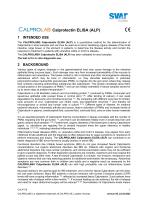
Calprotectin ELISA (ALP) 1 INTENDED USE The CALPROLAB® Calprotectin ELISA (ALP) is a quantitative method for the determination of Calprotectin in stool samples and can thus be used as an aid in identifying organic disease of the small intestine, large bowel, or the stomach in patients, to determine the disease activity and monitor the response to treatment in patients with ulcerative colitis or Crohn’s disease. The CALPROLAB® Calprotectin ELISA (ALP) has been validated for stool samples. The test is for in vitro diagnostic use. 2 BACKGROUND Various types of organic diseases in the gastrointestinal tract may cause damage to the intestinal epithelial lining (mucosa layer). Such damage may vary from increased permeability of the mucosa to inflammation and ulcerations. The bowel content is rich in bacteria and other microorganisms releasing substances which may be toxic or chemotactic, i.e. they stimulate leukocytes, in particular polymorphonuclear neutrophilic granulocytes (PMN), to migrate into the gut lumen where they release their contents including antimicrobial substances like Calprotectin. This protein constitutes about 60% of total proteins in the cytoplasm of PMNs 2) and can be reliably estimated in faecal samples stored for up to seven days at ambient temperature 3). Calprotectin is a 36 kilodalton calcium and zinc-binding protein 4), produced by PMNs, monocytes and squamous epithelial cells (except those in normal skin) 5,6). After binding of calcium, it can resist degradation by leukocytic and microbial enzymes 3,7). By competing with different enzymes for limited, local amounts of zinc, Calprotectin can inhibit many zinc-dependent enzymes 8) and thereby kill microorganisms or animal and human cells in culture 9,10). Different types of disease, for instance bacterial infections, rheumatoid arthritis and cancer, lead to activation of PMNs and increased levels of Calprotectin in plasma, cerebrospinal fluid, synovial fluid, crevicular fluid, urine or other human materials 1). It is an essential property of Calprotectin that the concentration in faeces correlates with the number of PMNs migrating into the gut lumen 11), and that it can be detected reliably even in small (less than one gram) random stool samples 3,12). Furthermore, organic diseases of the bowel give a strong Calprotectin signal, i.e. elevations are regularly five to several thousand times the upper reference in healthy individuals 3,13,14,15), indicating intestinal inflammation. Inflammatory bowel diseases (IBD), i.e. ulcerative colitis and Crohn’s disease, may appear from early childhood to late adulthood and the diagnosis is often delayed due to vague symptoms or reluctance to perform endoscopy and biopsy. The CALPROLAB® Calprotectin ELISA (ALP) can contribute to an earlier diagnosis of IBD since the test is usually positive in active IBD. Functional disorders like irritable bowel syndrome (IBS) do not give increased faecal Calprotectin concentrations, but organic abdominal disorders like IBD do. Patients with organic and functional abdominal disorders may have similar symptoms, and clinical examination alone may not be sufficient to give a specific diagnosis. Further diagnostic procedures are complex, expensive and may expose the patient to pain and other risks. A test for faecal Calprotectin is a simple, non-invasive, inexpensive and objective method that can help selecting patients for additional examination like endoscopy. Abdominal symptoms are very common both in children and adults and a negative result as measured by the CALPROLAB® Calprotectin ELISA (ALP) can with high probability rule out inflammatory bowel disorders 13). Mucosal healing is the optimal goal for IBD treatment, and a test for faecal Calprotectin can tell when this has been achieved. Many IBD patients in clinical remission with normal C-reactive protein (CRP) levels still have on-going inflammation 16), reflected by increased faecal Calprotectin. Such patients have increased risk of relapse within a few months 17). If mucosal healing can be achieved, the risk of relapse and need for major abdominal surgery will be reduced 18,19). Normalisation of Calprotectin levels means CALP170 CALPROLAB is a registered trademark of CALPRO AS, Lysaker, Norway
Open the catalog to page 1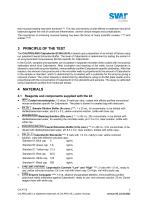
that mucosal healing has been achieved 20). The risk and severity of side effects to treatment should be balanced against the risk of continued inflammation, severe clinical relapse and complications. The importance of achieving mucosal healing has been the focus of many scientific reviews 21-29) and articles 30-35>. The CALPROLAB® Calprotectin ELISA (ALP) is based upon preparation of an extract of faeces using our patented Faecal Extraction Buffer. The level of Calprotectin is determined by testing the extract in an enzyme-linked immunoassay (ELISA) specific for Calprotectin. In the ELISA, samples...
Open the catalog to page 2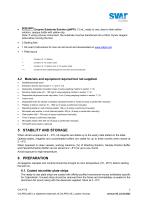
Enzyme Substrate Solution (pNPP): 13 mL, ready to use; clear to faint yellow solution, opaque bottle with yellow cap. Note: If using a Dynex instrument, the substrate must be transferred into a 25mL Dynex reagent tube before running the test. 1 Kit insert (Instructions for Use can be found and downloaded on www.calpro.no) Contains <0.1% sodium azide Contains <0.1 % Kathon and <0.1% sodium azide Contains 0.02% methylisothiazolone and 0.02% bromonitrodioxane • Distilled/deionised water • Extraction devices (see section 7.1.1 and 7.1.2) • Disposable, breakable inoculation loops (if using weighing...
Open the catalog to page 3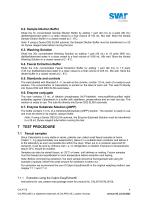
6.2. Sample Dilution Buffer Dilute the 5x concentrated Sample Dilution Buffer by adding 1 part (20 mL) to 4 parts (80 mL) distilled/deionised water in a clean vessel to a final volume of 100 mL. Mix well. Store the diluted Sample Dilution Buffer in a closed vessel at 2 – 8°C. Note: If using a Dynex DS2 ELISA automat, the Sample Dilution Buffer must be transferred to a 25 mL Dynex reagent tube before running the test. 6.3. Washing Solution Dilute the 20x concentrated Washing Solution by adding 1 part (50 mL) to 19 parts (950 mL) distilled/deionised water in a clean vessel to a final volume of...
Open the catalog to page 4All Calpro AS catalogs and technical brochures
 CALPROSMART
2 Pages
 CalproGold
2 Pages
 Calprotectin ELISA (HRP)
15 Pages
 EASY EXTRACT™
12 Pages
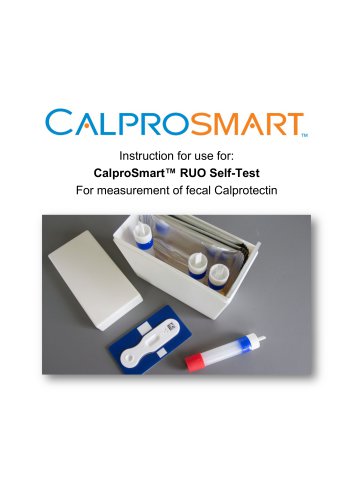 CalproSmart™ RUO Self-Test
10 Pages
 CalproSmart Office
16 Pages