

- Company
- Products
- Catalogs
- News & Trends
- Exhibitions
CTC TVT Product Information sheet
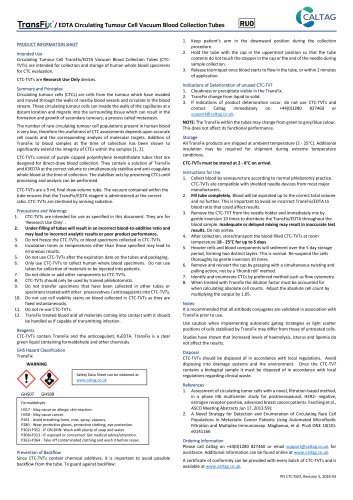
CTC TVT Product Information sheet
Circulating Tumour Cell TransFix/EDTA Vacuum Blood Collection Tubes (CTC-TVTs) are designed for collecting and storing human whole blood specimens for CTC evaluation. These tubes are for Research Use Only.
CTCs are tumour cells that circulate in the bloodstream and can lead to metastasis. The CTC-TVTs stabilize these cells for accurate analysis by using TransFix and K3EDTA, which preserve the cells until processing.
CTC-TVTs are 9 mL tubes with a vacuum to ensure the correct ratio of TransFix/EDTA to blood. They are sterilized by ionising radiation.
- For Research Use Only.
- Ensure correct blood-to-additive ratio by filling tubes completely.
- Do not freeze tubes or collected specimens.
- Use only before expiration date.
- Handle as potentially infectious material.
CTC-TVTs contain TransFix, a formaldehyde-based solution, and K3EDTA.
- Keep the patient's arm downward during collection.
- Hold the tube cap upwards to prevent contact with the needle.
- Release the tourniquet once blood flows into the tube.
- Cloudiness or solidification of TransFix.
- Contact Caltag if deterioration is observed.
Store CTC-TVTs at 2 - 8°C upon arrival.
- Collect blood using standard phlebotomy practices.
- Mix by gentle inversion 10 times immediately after collection.
- Store at room temperature for up to 5 days.
- Re-suspend cells by gentle inversion before analysis.
Dispose of CTC-TVTs according to local regulations for clinical waste.
Includes studies on CTC assessment and detection methods.
Contact Caltag for assistance or visit their website for more information.
TransFix contains formaldehyde, which may cause allergic reactions and cancer. Use protective equipment and follow safety guidelines.
Catalog excerpts
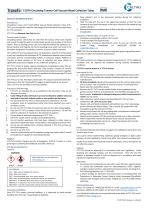
RUO Safety Data Sheet can be obtained at www.caltag.co.uk PRODUCT INFORMATION SHEET Circulating Tumour Cell TransFix/EDTA Vacuum Blood Collection Tubes (CTC-TVTs) are intended for collection and storage of human whole blood specimens for CTC evaluation. CTC-TVTs are Research Use Only devices. Circulating tumour cells (CTCs) are cells from the tumour which have invaded and moved through the walls of nearby blood vessels and circulate in the blood stream. These circulating tumour cells can invade the walls of the capillaries at a distant location and migrate into the surrounding tissue which can result in the formation and growth of secondary tumours; a process called metastasis. The number of rare circulating tumour cell populations present in human blood is very low, therefore the usefulness of CTC assessments depends upon accurate cell counts and the corresponding analysis of molecular targets. Addition of TransFix to blood samples at the time of collection has been shown to significantly extend the integrity of CTCs within the samples [1, 2]. CTC-TVTs consist of purple capped polyethylene terephthalate tubes that are designed for direct-draw blood collection. They contain a solution of TransFix and K3EDTA at the correct volume to simultaneously stabilise and anti-coagulate whole blood at the time of collection. The stabiliser acts by preserving CTCs until processing and analysis can be performed. CTC-TVTs are a 9 mL final draw volume tube. The vacuum contained within the tube ensures that the TransFix/EDTA reagent is administered at the correct ratio. CTC-TVTs are sterilised by ionising radiation. 1. CTC-TVTs are intended for use as specified in this document. They are for 'Research Use Only'.. 2. Under-filling of tubes will result in an incorrect blood-to-additive ratio and may lead to incorrect analytic results or poor product performance. 3. Do not freeze the CTC-TVTs, or blood specimens collected in CTC-TVTs. 4. Incubation times or temperatures other than those specified may lead to erroneous results. 5. Do not use CTC-TVTs after the expiration date on the tubes and packaging. 6. Only use CTC-TVTs to collect human whole blood specimens. Do not use tubes for collection of materials to be injected into patients. 7. Do not dilute or add other components to CTC-TVTs. 8. CTC-TVTs should only be used by trained phlebotomists. 9. Do not transfer specimens that have been collected in other tubes or specimens treated with other preservatives / anticoagulants into CTC-TVTs. 10. Do not use cell viability stains on blood collected in CTC-TVTs as they are fixed instantaneously. 12. TransFix treated blood and all materials coming into contact with it should be handled as if capable of transmitting infection. CTC-TVTs contain TransFix and the anticoagulant, K3EDTA. TransFix is a clear green liquid containing formaldehyde and other chemicals. GHS Hazard Classification TransFix H317 - May cause an allergic skin reaction. P261 - Avoid breathing fume, mist, spray, vapours. P280 - Wear protective gloves, protective clothing, eye protection. P302+P352 - IF ON SKIN: Wash with plenty of soap and water. P308+P313 - IF exposed or concerned: Get medical advice/attention. P362+P364 - Take off contaminated clothing and wash it before reuse. Since CTC-TVTs contain chemical additives, it is important to avoid possible backflow from the tube. To guard against backflow: 1. Keep patient's arm in the downward position during the collection procedure. 2. Hold the tube with the cap in the uppermost position so that the tube contents do not touch the stopper in the cap or the end of the needle during sample collection. 3. Release tourniquet once blood starts to flow in the tube, or within 2 minutes of application. Indications of Deterioration of unused CTC-TVT 1. Cloudiness or precipitate visible in the TransFix. 2. TransFix change from liquid to solid. 3. If indications of product deterioration occur, do not use CTC-TVTs and contact Caltag immediately on: +44(0)1280 827460 or NOTE: The TransFix within the tubes may change from green to grey/blue colour. This does not affect its functional performance. All TransFix products are shipped at ambient temperature (2 - 25°C). Additional insulation may be required for shipment during extreme temperature conditions. CTC-TVTs must be stored at 2 - 8°C on arrival. 1. Collect blood by venepuncture according to normal phlebotomy practice. CTC-TVTs are compatible with shielded needle devices from most major manufacturers. 2. Fill tube completely. Blood will be aspirated up to the correct total volume and no further. This is important to avoid an incorrect TransFix/EDTA to blood ratio that could affect results. 3. Remove the CTC-TVT from the needle holder and immediately mix by gentle inversion 10 times to distribute the TransFix/EDTA throughout the blood sample. Inadequate or delayed mixing may result in inaccurate test results. Do not vortex. 4. After collection, store/transport the blood filled CTC-TVTs at room temperature 18 - 25°C for up to 5 days. 5. Heavier cells and blood components will sediment over the 5 day storage period, forming two distinct layers. This is normal. Re-suspend the cells thoroughly by gentle inversion 10 times. 6. Remove and reinsert the cap by grasping with a simultaneous twisting and pulling action, not by a 'thumb roll' method. 7. Identify and enumerate CTCs by preferred method such as flow cytometry. 8. When treated with Transfix the dilution factor must be accounted for when calculating absolute cell counts. Adjust the absolute cell count by multiplying the output by 1.05. It is recommended that all antibody conjugates are validated in association with TransFix prior to use. Use caution when implementing automatic gating strategies as light scatter positions of cells stabilised by TransFix may differ from those of untreated cells. Studies have shown that increased levels of haemolysis, icterus and lipemia do not affect the results. CTC-TVTs should be disposed of in accordance with local regulations. Avoid disposing into drainage systems and the environment. Once the CTC-TVT contains a biological sample it must be disposed of in accordance with local regulations regarding clinical waste. 1. Assessment of circulating tumor cells with a novel, filtration-based method, in a phase IIIb multicenter study for postmenopausal, HER2- negative, estrogen receptor-positive, advanced breast cancer patients. Fasching et al., ASCO Meeting Abstracts Jun 17, 2013:591 2. A Novel Strategy for Detection and Enumeration of Circulating Rare Cell Populations in Metastatic Cancer Patients Using Automated Microfluidic Filtration and Multiplex Immunoassay. Magbanua, et al. PLoS ONE 10(10): e0141166 Ordering Information Please call Caltag on +44(0)1280 827460 or email [email protected] for assistance. Additional information can be found online at www.caltag.co.uk. A certificate of conformity can be provided with every batch of CTC-TVTs and is available at www.caltag.co.uk.
Open the catalog to page 1All Caltag catalogs and technical brochures
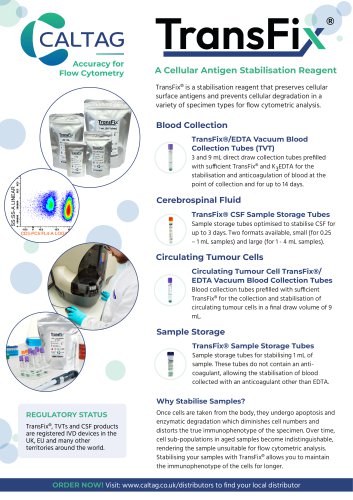 Transfix Flyer
2 Pages
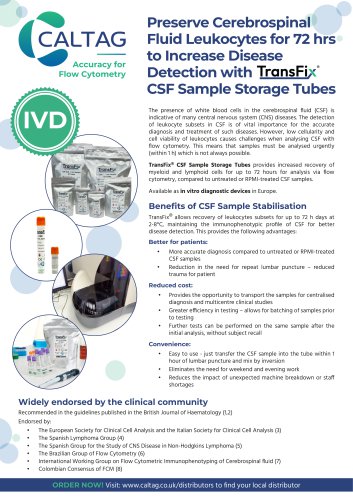 CSF SST Flyer
2 Pages
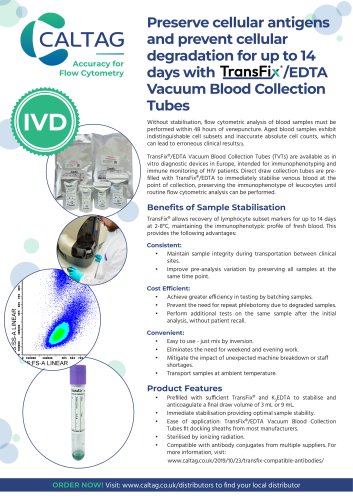 TVT Flyer
2 Pages
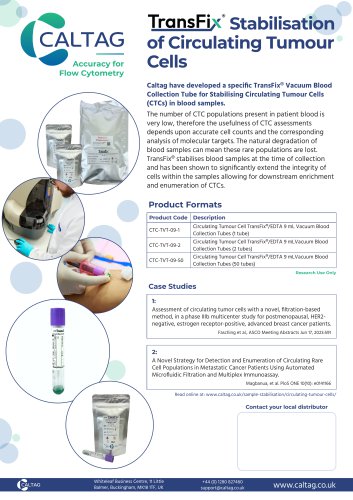 CTC TVT Flyer
1 Page
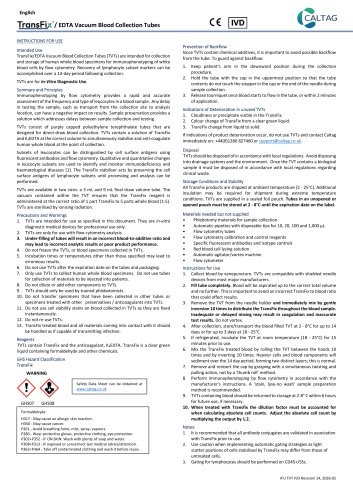
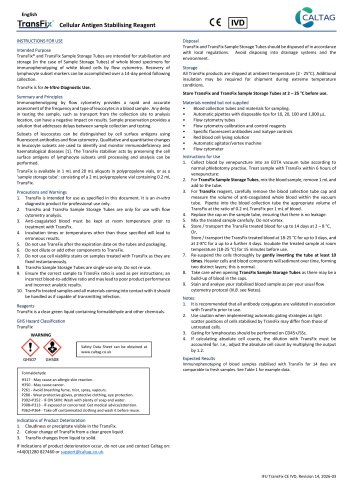 Transfix Instructions For Use
27 Pages
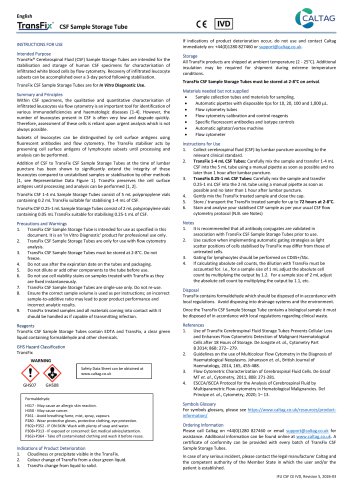 CSF SST Instructions For Use
40 Pages
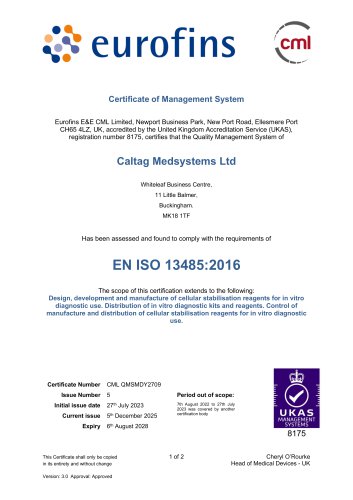 ISO 13485:2016 Certificate
2 Pages
- Solvent reagent
- Research reagent
- Laboratory reagent
- Diagnostic reagent
- Sample tube
- Cytology reagent
- Laboratory test tube
- Buffer solution reagent
- Medium reagent
- Clinical reagent
- Blood sample reagent
- Cylindrical collection tube
- Cleaner
- Collection tube with anticoagulant
- Laboratory collection tube
- Sample storage test tube
- Blood test tube
- Cleaning reagent