
- Catalogs
- Cambridge Sensotec
- 2100-FGA Forming Gas Analyser


2100-FGA Forming Gas Analyser

2100-FGA Forming Gas Analyser
- Easy calibration with user-selectable gases.
- Pure hydrogen mode and ultra O2 measurement down to 10E-30ppm.
- Type K thermocouple for temperature measurement up to 1250°C.
- 0-5V and 4-20mA outputs, Modbus RTU protocol, and pin code protection.
- OLED display with 20 x 4 characters and alarm relay circuits.
- Continuous online oxygen analysis with a response time of less than 4 seconds.
- Calculates H2O dewpoint using thermodynamic equations.
- Supply Voltage: 90-260VAC, 50/60Hz; Power Consumption: 30W max.
- Dimensions: 250mm x 263mm x 150mm; Weight: 3.5kg.
- Operating Conditions: 5°C to 35°C, 900–1100 mbar, 10-90% RH.
- O2 Sensor Range: 10E-30ppm to 30%, with a response time of approximately 4 seconds.
- Max Gas Temperature: 650°C, extendable to 1000°C with special probes.
- Sample Gas Flow Rate: 0.1 to 4 Litres per min.
- Max Working Pressure: 10 bar; Min Working Pressure: Vacuum tight to below 10E-4 Torr.
- Programmable alarm circuits and analogue outputs.
- RS232 & Modbus communications with data-logging software.
- Optional sensor extension cables up to 25 meters.
- Panel or wall mountable with IP65 weatherproof housing.
- Complies with EMC Directive 2004 / 108 / EC and UL/ETL Certification Number: UL-61010-1.
Catalog excerpts

2100-FGA Forming Gas Analyser The Rapidox 2100-FGA Forming Gas Analyser is a special variant of an existing zirconia oxygen analyser which allows fast and accurate oxygen analysis over the full oxygen range to extremely low levels commonly found in hydrogen forming gas. The sensor measurement range is extended down to 10E-30ppm O2 to cover the ultralow oxygen partial pressures in forming gas mixtures. The sensor is designed for high temperature operation which can be extended up to 1000°C when using one of the available insertion sample tubes. The Rapidox provides continuous on-line oxygen analysis, with a typical response time of less than 4 seconds for a 90% response to a step change in gas compositions. In addition to this the analyser performs complex thermodynamic equations to calculate the H2O dewpoint of the forming gas. These calculations have been verified by a resident thermodynamics expert at Cambridge University. The operator simply dials in the hydrogen content of the forming gas and the analyser does the rest. The dewpoint is then displayed simultaneously on-screen in either °Cdp or ppmV. The temperature is determined either from the sensor head (up to 660°C) or above this, the temperature is recorded using the type K thermocouple which is fitted as standard. The analyser is packed with features including programmable alarm circuits, programmable analogue outputs, easy calibration (user selectable gases), RS232 & Modbus communications and complete communications / data-logging software. Additional sensors may be attached via the auxiliary socket which will read most standard 4-20mA transmitters. Currently the Rapidox 2100-FGA can be configured to read pressure or vacuum. A vast array of special fittings, filters and manifolds are available for both oxygen and auxiliary sensors, to make this a completely versatile instrument that can be installed almost anywhere. Depending on the application, the sensors can be located up to 25 meters from the analyser using optional sensor extension cables. The instrument can be panel mounted (19") or supplied within a wall mountable, IP65 weatherproof housing. The oxygen sensor can then be positioned remotely, in either a separate cabinet or as a standalone sensor. A printer option is also available. All Rapidox analysers come with full Windows software that allows for remote configuration and monitoring of readings, as well as a full data-logging package that includes live-time graphing of each sensor channel. Finally, the Rapidox 2100-FGA complies with EMC Directive 2004 / 108 / EC. UL/ETL Certification Number: UL-61010-1. For customers requiring seamless Designed for forming gas applications Ultra O2 measurement down to 10E ppm Alarm relay circuits Please contact Cambridge Sensotec OLED display (20 x 4 characters) Modbus RTU language protocol Verified at Cambridge University
Open the catalog to page 1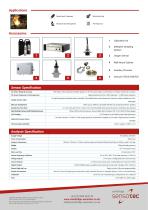
Applications Metal Heat Treatment Research & Development Oxygen Sensor Wall Mount Cabinet Multiplex Sampling System Auxiliary Pressure Sensor Specification O2 Sensor Range & Accuracy 10E-30ppm to 30% (special extended range) ±1% of the actual oxygen concentration or 0.5ppm whichever is greater O2 Sensor Response & Life Expectancy Oxygen Sensor Cable Approximately 4 sec for a 90% response > 17,500 hours operation 2m high temperature sheathed cable as standard. Fully shielded with a quick release plug. Extension cables available up to 25m total length 650°C (up to 1000°C is posisble with the use...
Open the catalog to page 2All Cambridge Sensotec catalogs and technical brochures
 Rapidox Gas Recovery
2 Pages
 5100 Multigas Analyser
3 Pages
- Medical sensor
- Laboratory testing system
- Temperature sensor
- Monitoring sensor
- Control analyser
- Gas sensor
- Temperature testing system
- O2 analyzer
- Pressure sensor
- Digital controller
- Medical device control panel
- Testing system with touchscreen
- Pressure testing system
- Calibration analyser
- Carbon dioxide analyzer
- Humidity sensor
- Flow control panel
- Miniature sensor
- Modular testing system