
- Catalogs
- CANDOR Bioscience
- BSA-Block

BSA-Block

BSA-Block
Catalog excerpts

Standard blocker for saturating free binding sites on plastic surfaces or other protein binding surfaces Storage: 2 – 8 °C or -15 to -30 °C (tolerates repeated freezing and thawing cycles) contains < 0.0014 % [w/w] reaction mass of CMIT/MIT (3:1) Expiry date when stored unopened: see label on the bottle For general laboratory use Instructions for use BSA-Block is ready-to-use. Please shake the buffer thoroughly before use. After immobilization of capture antibody or antigens, BSA-Block is added without dilution to wells or membranes. Incubate at room temperature for 1 - 4 hours or overnight. 1 hour is often sufficient. Note: The blocking time can be further reduced by shaking the plate at 600 - 900 rpm, depending on the application. The blocking time depends on the properties of the surface to be blocked and the ambient conditions and should therefore be tested. After blocking, the surface is washed to remove BSA-block. The surface (e.g. microtiter plate or blotting membrane) can then be used for the next steps. The suitability for the respective assay and the respective antibodies must be tested by the user. If background occurs due to non-specific binding despite the use of BSA-Block, we recommend the use of The Blocking Solution (article no. 110). For further information please visit www.candor-bioscience.com.
Open the catalog to page 1All CANDOR Bioscience catalogs and technical brochures
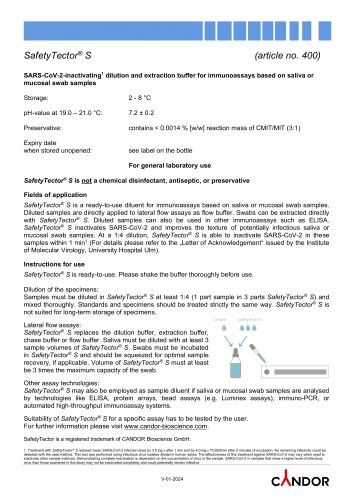 SafetyTector® S
1 Page
 Stripping Buffer
1 Page
 Coating Buffer 10x
1 Page
 Washing Buffer 10x
1 Page
 PlateBlock™
1 Page
 SmartBlock™
2 Pages
 ReadyTector
4 Pages
 BUFFERS AND SOLUTIONS
20 Pages
 The ELISA Experts
8 Pages
 AP-Protector®
1 Page
 HRP-Protector™
1 Page
 Antibody Stabilizer
1 Page
 Liquid Plate Sealer®
2 Pages
 Assay Defender®
2 Pages
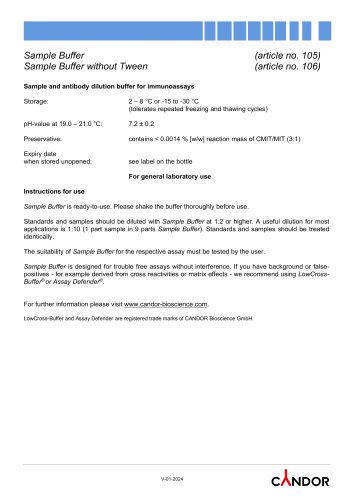 Sample Buffer
1 Page
 Blocker selection
3 Pages
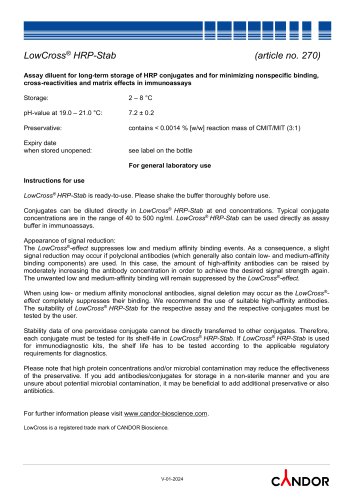 LowCross® HRP-Stab
1 Page
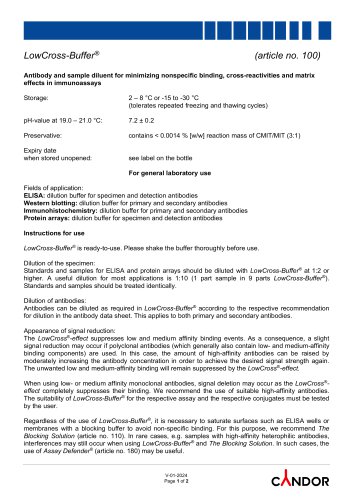 LowCross-Buffer®
2 Pages
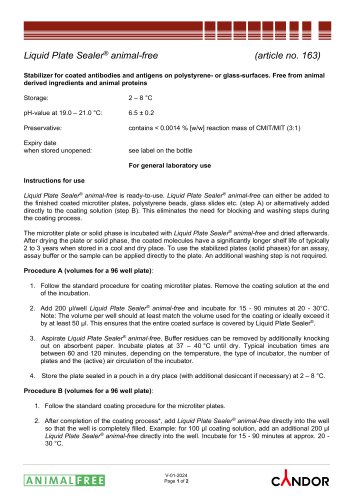
- Solvent reagent
- Molecular biology reagent
- Laboratory reagent
- Buffer solution reagent
- Immunoanalysis reagent kit
- Medical packaging
- Packaging box
- Immunohistochemistry reagent
- ELISA reagent kit
- Enzyme reagent
- Western blot reagent
- Veterinary laboratory reagent
- Reagent for antibodies
- Alkaline phosphatase reagent
- Dilution buffer reagent
- Chromatography reagent
- Washing buffer reagent
- Stabilizer solution reagent
- Blocking buffer reagent