
- Catalogs
- CANDOR Bioscience
- Coating Buffer 10x

Coating Buffer 10x
Coating Buffer 10x
Coating Buffer 10x is designed for the adsorptive immobilization of proteins and antibodies on plastic surfaces such as microtiter plates or other protein-binding surfaces. It is available in two pH variants: pH 7.4 (article no. 120) and pH 9.6 (article no. 121).
The buffer should be stored at temperatures between 2 – 8 °C or -15 to -30 °C and can withstand repeated freezing and thawing cycles. It is supplied without bactericidal or fungicidal additives to avoid interference with the immobilization process. The expiry date is indicated on the bottle label, and the working solution should be used immediately after preparation.
Before preparing the working solution, warm the Coating Buffer to room temperature to dissolve any precipitated salt crystals. Dilute the stock solution 1:10 with distilled or demineralized water and use it on the same day. Proteins or antibodies should be diluted with the working solution for immobilization, with typical concentrations for ELISA applications ranging from 0.5 µg/ml to 2 µg/ml.
Incubation times for immobilization vary based on the surface and type of proteins/antibodies and should be optimized by the user. The choice between Coating Buffer pH 9.6 and pH 7.4 depends on the protein/antibody, as pH affects their spatial structure and immobilization properties. For new assay development, testing both buffers is recommended.
For more details, visit the website at www.candor-bioscience.com.
Catalog excerpts
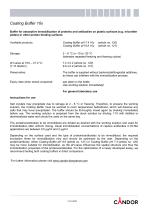
Coating Buffer 10x Buffer for adsorptive immobilization of proteins and antibodies on plastic surfaces (e.g. microtiter plates) or other protein binding surfaces Available products: Coating Buffer pH 7.4 10x (article no. 120) Coating Buffer pH 9.6 10x (article no. 121) Storage: 2 - 8 °C or -15 to -30 °C (tolerates repeated freezing and thawing cycles) pH-value at 19.0 - 21.0 °C: 7.4 ± 0.2 (article no. 120) Preservative: The buffer is supplied without bactericidal/fungicidal additives, as these can interfere with the immobilization process. Expiry date when stored unopened: see label on the bottle Use working solution immediately! For general laboratory use Instructions for use Salt crystals may precipitate due to storage at 2 - 8 °C or freezing. Therefore, to prepare the working solution, the Coating Buffer must be warmed to room temperature beforehand, which will dissolve any salts that may have precipitated. The buffer should be thoroughly mixed again by shaking immediately before use. The working solution is prepared from the stock solution by diluting 1:10 with distilled or demineralized water and should be used on the same day. The proteins/antibodies to be immobilized are diluted as desired with the working solution and used for immobilization after uniform mixing. Usual immobilization concentrations of capture antibodies in ELISA applications are between 0.5 pg/ml and 2 pg/ml. Depending on the surface used and the type of proteins/antibodies to be immobilized, the required incubation times for immobilization vary and should be optimized by the user. Depending on the protein/antibody, either Coating Buffer pH 9.6 (article no. 121) or Coating Buffer pH 7.4 (article no. 120) may be more suitable for immobilization, as the pH-value influences the spatial structure and thus the immobilization properties of the proteins/antibodies. For the optimization of a newly developed assay, we recommend testing both coating buffers in direct comparison. For further information please visit www.candor-bioscience.com.
Open the catalog to page 1All CANDOR Bioscience catalogs and technical brochures
 SafetyTector® S
1 Page
 Stripping Buffer
1 Page
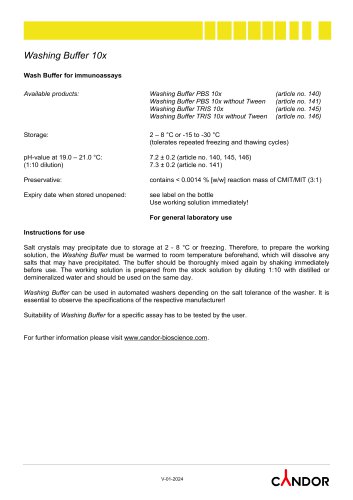 Washing Buffer 10x
1 Page
 PlateBlock™
1 Page
 BSA-Block
1 Page
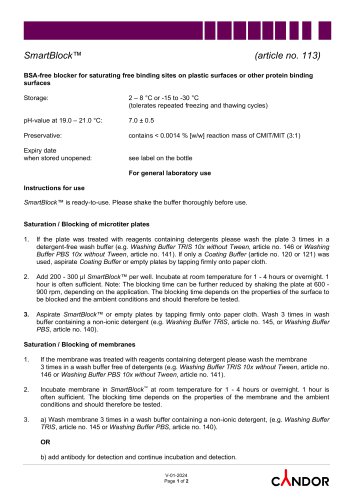 SmartBlock™
2 Pages
 ReadyTector
4 Pages
 BUFFERS AND SOLUTIONS
20 Pages
 The ELISA Experts
8 Pages
 AP-Protector®
1 Page
 HRP-Protector™
1 Page
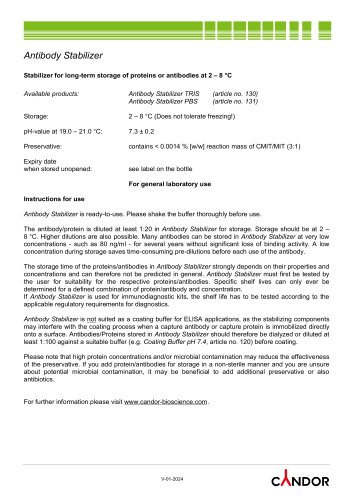 Antibody Stabilizer
1 Page
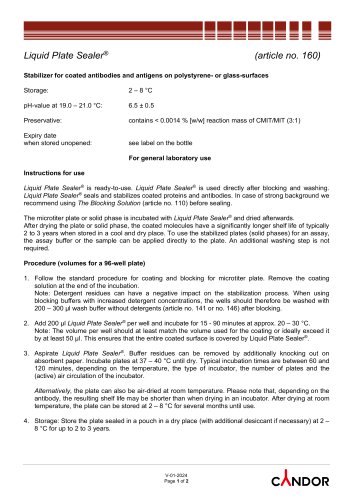 Liquid Plate Sealer®
2 Pages
 Assay Defender®
2 Pages
 Sample Buffer
1 Page
 Blocker selection
3 Pages
 LowCross® HRP-Stab
1 Page
 LowCross-Buffer®
2 Pages
- Solvent reagent
- Molecular biology reagent
- Laboratory reagent
- Buffer solution reagent
- Immunoanalysis reagent kit
- Medical packaging
- Packaging box
- Immunohistochemistry reagent
- ELISA reagent kit
- Enzyme reagent
- Western blot reagent
- Veterinary laboratory reagent
- Reagent for antibodies
- Alkaline phosphatase reagent
- Dilution buffer reagent
- Chromatography reagent
- Washing buffer reagent
- Stabilizer solution reagent
- Blocking buffer reagent