- Catalogs
- Cardia International
- CardiAid CPR|Check Brochure Old

CardiAid CPR|Check Brochure Old

CardiAid CPR|Check Brochure Old
- Utilizes self-adhesive disposable electrodes to check pulse and breathing.
- Completes analysis within 10 seconds, adhering to ILCOR guidelines.
- Uses color-coded lights (green, red, white) to indicate whether CPR is needed.
- Continuously reanalyzes the patient while connected.
- Performs self-tests before and during operation.
- Operates on two CR2016 Lithium Button Cell Batteries, with a compact size of 4.4cm x 3.6cm x 1.7cm and a weight of 15g including batteries.
- CPR is performed by laypersons in only 14% of cases.
- 45% of bystanders fail to detect cardiac arrest.
- The average delay in diagnosis is 24 seconds.
- Only 2% of rescuers can correctly identify pulselessness within the first 10 seconds.
- Bring CardiAid CPR|Check to the unconscious person immediately.
- Remove the device from its box to start it automatically.
- After a short self-test, place the device on the patient's neck and press the analysis button.
- The device will indicate the need for CPR with a green or red light.
- It will continuously reanalyze while connected.
- Red Light: Start CPR.
- Green Light: CPR is not necessary.
- Red and Green Flashing: Analysis not possible due to movement or incorrect placement.
Catalog excerpts
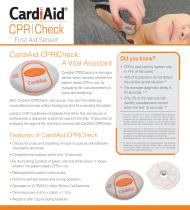
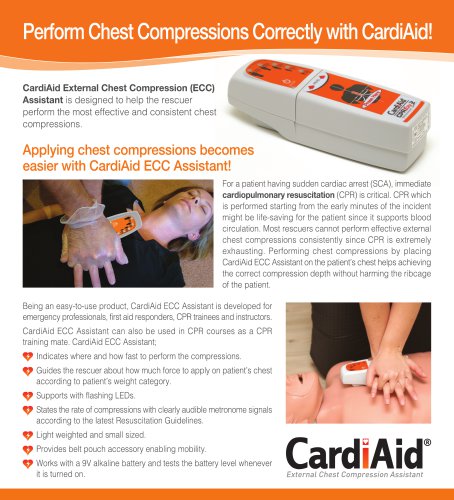
CardiAid CPR|Check: A Vital Assistant CardiAid CPR|Check is a vital signs sensor which decides whether the patient needs CPR or not, by evaluating the vital parameters of pulse and breathing. With CardiAid CPR|Check, the rescuer may start the lifesaving resuscitation process without loosing any time for evaluating the patient. Latest ILCOR Guidelines emphasize that either first aid rescuer or professional, a responder should not spend more than 10 seconds for analysing the signs of life; and this is ensured with CardiAid CPR|Check. Features of CardiAid CPR|Check • Checks for pulse and breathing through its special self-adhesive disposable electrode. • Completes the analysis within only 10 seconds. • By illuminating symbols of green, red and white colour; it shows whether the patient needs CPR or not. • Reanalyses the patient continuously. • Performs self-test before and during operation. • Operates on 2 CR2016 Lithium Button Cell Batteries. • Dimensions are 4,4cm x 3,6cm x 1,7cm. • Weight is only 15g including batteries. Did you know? • CPR is executed by layman only in 14% of the cases.* • 45% of bystanders do not detect the cardiac arrest situation.** • The average diagnostic delay is 24 seconds. *** • Only 2% of the rescuers can identify pulselessness correct within the first 10 seconds.*** * Priv.-Doz. Dr. med. H.-R. Arntz / Universitätsklinikum Benjamin Franklin / Berlin; S.N. Willich Institut für Arbeitsmedizin, Sozialmedizin und Epidemiologie, Klinikum Charité / Berlin; Sudden cardiac death: Is it really an unforseeable event?; Intensivmedizin und Notfallmedizin, Band 36, Heft 6 (1999) ** Jan Breckwoldt et al, Department of Anesthesiology and Perioperative Intensive Care, Charité-University Medicine Berlin; Perceptions of collapse and assessment of cardiac arrest by bystanders of out-of hospital cardiac arrest (OOHCA). Resuscitation (2009), doi:10.1016/j.resuscitation.2009.06.028 *** B. Eberle et al; Department of Anaesthesiology, The Johannes Gutenberg University Medical School, Mainz; Checking the carotid pulse check: diagnostic accuracy of first responders in patients with and without a pulse.
Open the catalog to page 1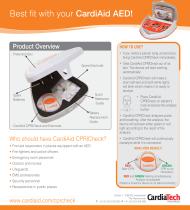
Best fit with your CardiAid AED! Product Overview • If you notice a person lying unconscious, bring CardiAid CPR|Check immediately. Spare Electrode • Take CardiAid CPR|Check out of its box. The device will start working automatically. • CardiAid CPR|Check will make a short self-test and both white lights will blink which means it is ready to analyze. Quick Reference Guide Spare Batteries Battery Replacement Guide CardiAid CPR|Check and Electrode Who should have CardiAid CPR|Check? • First aid responders in places equipped with an AED • Place CardiAid CPR|Check on patient’s neck and press the...
Open the catalog to page 2All Cardia International catalogs and technical brochures
 Rotaid Solid Plus Outdoor
3 Pages
 Rotaid Solid Plus Indoor
3 Pages
 Rotaid Plus Indoor
3 Pages
 CardiAid Brochure_March 2016
10 Pages


Archived catalogs
 CardiAid Catalogue
9 Pages