
- Catalogs
- Carl Friedrich Usbeck
- usbeck 2017

- Company
- Products
- Catalogs
- News & Trends
- Exhibitions
usbeck 2017

usbeck 2017
1. Table of Contents and Product Index
The document starts with a bilingual (German-English) comprehensive index of laboratory equipment and accessories, including burners, clamps, tongs, stands, and various tools, with page references for easy navigation.
2. Usbeck Laboratory Burners Overview
Usbeck offers two main types of laboratory burners:
- DIN-compliant burners: Conform to DIN norm 30665 and German safety regulation BGR 120. These burners maintain a small pilot flame even when controls are closed, requiring central gas shutoff. They are not CE marked as they fall outside the EU Gas Appliance Directive 2009/142/EG.
- Standard burners: Without the pilot flame restriction.
3. Gas Types and Pressure Specifications
- Natural gas burners: Operate at 18.0–25.0 mbar.
- Propane/butane burners: Operate at 47.5–57.5 mbar with mandatory pressure regulators.
Multi-gas burners adjustable for both gas types are available. Distributors must verify country-specific gas pressure standards.
4. Burner Stability and Bases
Burners feature stable powder-coated zinc die-cast bases. Optional suction feet or heavy steel feet enhance stability on smooth surfaces.
5. Detailed Burner Types and Features
- Bunsen Burners: Various air regulation methods, pilot flames, adjustable jets; weights 210–280 g.
- Teclu Burners: Needle valves, stop-cocks, pilot flames; DIN and standard types; weights 245–330 g.
- Micro Burners: Compact, needle valve air regulation, cartridge compatible; ~115 g.
- Safety Burners: Safety pilot flames, thermocouples, needle valves; burner heads ~17 mm diameter; weights 370–400 g.
- Meker Burners: High-performance, large tube/head diameters (28/32 mm), needle valve air regulation; ~335 g.
- Cartridge Burners: For 400 ml propane/butane cartridges, needle valves, piezo ignition (some models), operating up to 1620 °C; weights 145–545 g.
6. Technical Data and Certifications
Burners carry DIN-DVGW registration numbers confirming compliance with German gas safety standards. Technical specs include burner head and tube diameters, weights, ignition types, and optional safety bases (suction feet) available at extra cost.
7. Critical Safety and Usage Notes
- DIN burners maintain pilot flames; gas must be shut off centrally.
- Pressure regulators are mandatory for gas bottles.
- Country-specific regulations vary; distributors must ensure compliance.
- Burners lack CE marking due to regulatory scope.
8. Cartridge Burners and Gas Cartridges
- Piezoelectric ignition, needle valve air regulation, operating temperatures up to 1620 °C.
- Compatible with propane/butane mixtures (70% butane, 30% propane) per DIN EN 417:2012.
- Cartridge sizes: 200 g, 400 ml, 660 g; typical burn time ~3 hours.
- Recommended tripods: models 5136/5146.
9. Gas Safety Tubing and Accessories
- Safety tubing meets DIN Norm 30664-1 and DVGW G 5501 (P), with kink-resistant stainless steel spiral core.
- Available lengths: 750 mm to 2000 mm; working pressure up to 100 mbar.
- Stainless steel tubing clamps with various widths and clamping ranges.
10. Burner Heads and Spirit Burners
- Nickel-plated brass burner heads with 50 mm openings for 17 mm diameter burners.
- Spirit burners made of stainless steel, adjustable wicks, 60 ml capacity, spare wicks included.
11. Ignition Devices
- Gas lighters with piezo ignition, lengths 155 mm and 220 mm, available in various colors.
- Replacement flints supplied in 1 g quantities.
12. Retort Stand Bases and Clamps
- Bases made from stainless steel or powder-coated steel with rubber feet and M10 threaded connections.
- Various sizes and weights, adjustable feet, slip-resistant features.
- Clamps made from powder-coated aluminum alloy, suitable for rods up to 26 mm diameter and table thicknesses up to 55 mm.
- Specialized clamps include cork-lined jaws, vinyl-coated jaws, swivel and flexible designs.
13. Rods and Extensions
- Steel (zinc plated) and stainless steel rods, diameters 12 mm, lengths 250–1500 mm.
- Threaded (M10) and non-threaded options.
- Extension connectors and cup nuts in stainless steel with M10 threading.
14. Bossheads and Connectors
- Double, swivel, and universal bossheads made from zinc diecasting, aluminum alloy, or stainless steel.
- Designed for rods up to 16 or 20 mm diameter with multiple clamping options.
- Suspension hooks with plastic handles or stainless steel construction.
15. Clamps and Specialized Holders
- Universal clamps with cork-lined jaws, supporting rods up to 10 mm diameter and clamping ranges up to 80 mm.
- Retort stand clamps with vinyl-coated jaws, flexible clamps with swivel bossheads and M10 nuts.
- Condenser clamps with 360° rotation and three-prong clamps.
- Rubber belt and chain clamps with cork-lined jaws for securing vessels.
- Burette clamps with vinyl-coated jaws and roller grips for one or two burettes.
16. Rings and Supports
- Rings with bossheads made from zinc-plated steel or powder-coated stainless wire.
- Three-point supports and nickel-plated brass screws.
- Available diameters from 60 mm to 130 mm.
17. Forceps
- Straight forceps with blunt or fine points, made from nickel-plated steel or stainless steel.
- Lengths from 105 mm to 300 mm, weights vary accordingly.
18. Standards and Certifications
- Gas cartridges comply with DIN EN 417:2012.
- Gas safety tubing meets DIN Norm 30664-1 and DVGW G 5501 (P).
- Working pressures for tubing up to 100 mbar.
19. Key Recommendations and Usage Notes
- Use recommended tripods (models 5136/5146) for cartridge burners.
- Ensure compatibility of rods, clamps, and bossheads by matching diameters and thread sizes (M10).
- Safety features such as safety valves and kink-resistant tubing are essential.
- Flexible clamps and components enable adaptable laboratory setups.
20. Overview of Laboratory Instruments and Tools
- Forceps: Various types by material, length, weight, and tip style; includes self-locking and weight forceps.
- Spatulas and Spatula Spoons: Stainless steel, flexible and rigid types, with plastic or wooden handles; autoclavable options available.
- Spoons and Ladles: Open spoons, sodium spoons with copper baskets, deflagrating spoons, chemist’s spoons, weighing scoops; various sizes and materials.
- Scissors: Stainless steel laboratory scissors, dressing scissors, microscopic scissors, universal scissors with nylon handles.
- Bowls, Beakers, Containers: Stainless steel conical and round bowls, graduated beakers, dressing jars with knob covers; capacities from 30 ml to 5000 ml.
- Funnels and Buckets: Stainless steel funnels with air channels and handles; conical graduated buckets with lids, capacities 10,000–15,000 ml.
- Instrument Cases and Trays: Stainless steel with rounded corners and recessed handles; various sizes.
- Evaporating Dishes and Drip Pans: Flat and high evaporating dishes; drip pans with removable gridirons and rubber feet.
- Wire Gauze and Ceramic Plates: Galvanized and stainless steel wire gauze; glass ceramic plates for burner use.
- Stands and Supports: Stainless steel 4-foot stands with ceramic plates; zinc plated steel and stainless steel tripods; dismountable legs for space saving.
- Glassware Tools: Glass tubing cutters, cutting knives with interchangeable blades, diamond pencils.
- Lab Jacks: Shear-resistant and heavy-duty stainless steel plate jacks; some with gas spring assistance; detailed load capacities and dimensions.
21. Materials and Finishes
- Predominantly stainless steel or nickel-plated steel instruments.
- Handles made of plastic, wood, or vinyl coating for grip and durability.
- Autoclavable tools for sterilization.
- Special materials include copper mesh for sodium spoons and hard metals for cutting tools.
22. Critical Parameters and Recommendations
- Tool selection based on length, weight, tip/blade type, and rigidity/flexibility.
- Preference for autoclavable and corrosion-resistant materials for hygiene and durability.
- Respect lab jack load capacities for safety and longevity.
- Proper sizing of containers and instruments enhances laboratory efficiency.
23. Lifting Platform Specifications
- Three models (5260/4, 5262/4, 5263/4) with dimensions from 200x200 mm to 400x400 mm.
- Working height ranges from 65–615 mm; dynamic loads 7–17 kg; static loads up to 60 kg.
- Lifting times vary from 7 to 17 seconds.
- Features include hand or cordless drill height adjustment, integrated safety clutch, shear-resistant design, slip-proof rubber feet.
- Patented design (DE 20 2010 006 420).
24. Laboratory Tools and Accessories
- Cork borer sharpener (zinc diecasting), cork knives (plastic handles).
- Blowpipes (nickel-plated brass) with wooden or plastic mouthpieces.
- Horseshoe magnets (100 mm length, 150 mT field strength).
- Cork borers sets (3 to 18 pieces) covering 5–26.5 mm diameters.
- Charcoal sticks, needle holders, mortars with powder-coated frames and slip-resistant feet.
- Needles, lancets, inoculation loops, dissecting needles with plastic handles.
- Test tube racks for 50 tubes, Hoffmann tubing clamps, Mohr pinchcocks.
- Test tube holders (wood and stainless steel), crucibles of various materials with detailed specs.
25. Water Jet Pumps
- Nickel-plated brass pumps for hose connection, some with non-return valves and vacuum gauges.
- Thread sizes: G 3/8, G 1/2, G 3/4 for water taps.
- Water consumption approx. 5.3–6.4 l/min; max negative pressure -0.9 bar at 4 bar water pressure and 10°C.
26. Laboratory Burners Specifications
- Operating temperatures: 1310°C to 1620°C.
- Gas consumption: 20 to 220 liters/hour depending on model.
- Physical dimensions: heights 100–200 mm; tube diameters 7–28 mm; head diameters 11–32 mm.
- Power ratings: 0.3 kW to 2.5 kW.
- Compatible with natural gas and bottled propane; specified gas pressures with regulators.
- Optional safety bases available.
- Special burners available on request.
27. General Sales, Delivery, and Payment Terms
- Terms apply when agreed in writing; partner terms not expressly accepted are invalid.
- Oral agreements require written confirmation; orders binding upon confirmation.
- Catalog data may change technically without affecting function; catalogs remain company property.
- Long-term contracts terminable with 3 months’ notice; price adjustments allowed for ≥10% cost changes.
- Call-off contracts require binding quantities at least one month before delivery; late changes incur costs.
- Confidentiality obligations last 36 months post-contract, excluding public or previously known info.
28. Confidentiality and Intellectual Property
- Contracting parties must keep information confidential and not disclose or use without consent.
- Drawings and technical documents remain property of submitting party.
- Supplier not liable for third-party IP infringements; customer bears related risks and costs.
29. Samples and Production Tools
- Costs invoiced separately unless agreed otherwise.
- Supplier bears maintenance and storage risks.
- Customer bears costs if cooperation ends prematurely.
- Production tools remain supplier’s property until contract completion; stored free for 3 years post-last delivery.
- Use of customer-specific tools for third parties requires written consent.
30. Pricing and Payment Terms
- Prices in Euros, excluding VAT, packaging, freight, postage, insurance.
- Payment due within 30 days; 2% discount if paid within 8 days and no delays.
- Partial deliveries with defects require payment for defect-free portion.
- Late payments incur interest (min. 8% above base rate).
- Supplier may suspend deliveries on payment default after notice.
- Bills and checks accepted only by agreement with discount fees.
- Supplier may demand advance payment or security on financial deterioration; rights to terminate or claim damages if unmet.
31. Delivery Terms and Risk Transfer
- Delivery ex works unless agreed otherwise.
- Deadlines start upon order confirmation dispatch; extensions allowed for force majeure.
- Partial deliveries allowed and invoiced separately.
- Quantity tolerances ±5% accepted with price adjustment.
- Customer must accept goods promptly; otherwise, shipment or storage at customer risk and cost.
- Supplier selects transport means/routes unless agreed otherwise.
- Risk transfers upon handover to carrier or leaving supplier premises.
32. Delivery Delays
- Supplier must notify customer promptly of delays with reasons and expected delivery date.
- Force majeure or customer-caused delays justify reasonable extensions.
33. Retention of Title
- Supplier retains ownership until all claims settled.
- Customer may resell in ordinary business but cannot pledge or assign as security.
- Supplier may reclaim goods after payment default and notice.
- Claims from resale or leasing assigned to supplier as security.
- Processing or combining goods transfers proportional co-ownership to supplier.
- Customer must inform supplier of third-party claims and provide documents.
- Supplier releases securities exceeding claims by >20% upon request.
34. Warranty
- Supplier guarantees defect-free manufacture per agreed specs.
- Customer assumes risk for suitability if goods made per their specs.
- No warranty for defects from misuse, wear, unauthorized modifications.
- Statutory warranty periods apply unless agreed otherwise.
- Defects must be reported immediately (visible) or within one week of discovery (hidden), no later than one month after risk transfer.
- Acceptance or prototype tests limit claims to undiscoverable defects.
- Supplier inspects defects; justified returns at supplier cost.
- Remedies include repair or replacement; failure within 3 months allows customer to set final deadline and seek price reduction, contract rescission, or self-remedy.
35. Liability
- Further claims excluded except for intent, gross negligence by executives, or breach of essential obligations.
- Liability limited to foreseeable typical damages in such cases.
- Product liability laws for personal or property damage remain unaffected.
- Liability exclusions extend to employees and agents.
- Statutory burden of proof rules apply.
36. Force Majeure
- Events like force majeure, strikes, unrest, official measures, supplier failures release parties from obligations during disruption.
- Parties must inform promptly and adjust obligations in good faith.
37. Place of Performance, Jurisdiction, and Applicable Law
- Place of performance is supplier’s business location unless agreed otherwise.
- Jurisdiction is supplier’s location if customer is merchant or public entity; supplier may sue at customer’s domicile.
- German law exclusively applies; UN CISG excluded.
Catalog excerpts
Magnet Mekerbrenner Messbecher Mikrobrenner Mikroskopierscheren Mikrodoppelspatel Mikrospatelloffel Morser Morserdoppelspatel
Open the catalog to page 2
Index Page Bosshead, Swivel Type 20 Cork Borer Sharpener 46 Magnet Measures Meker Burner Micro-Bunsen Burners Micro-Double Spatulas Micro-Spatula Spoons Microscopic Scissors Mortars Outlet Valve Rapid Action Hose 51 Retort Stand Bases 15 Retort Stand Base Duo 16 Rings with Bosshead 27 Rubber Belt Clamp 25 Test Tube Holder 48 Test Tube Racks 49 Tubing Clamps, Hoffmann 48 Tubing Clamps, Mohr 48 Universal Clamp slewable 22 Double Spatula Curved 30 Double Spatulas, Mortar 30 Glass Ceramic Plates 41,42
Open the catalog to page 3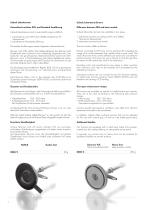
Usbeck Laborbrenner Unterschied zwischen DIN- und Standard-Ausfuhrung Usbeck Laborbrenner sind in zwei Ausfuhrungen erhaltlich: 1. Laborbrenner nach DIN-Norm 30665 „Gasbrenner fur Laboratorien" 2. Laborbrenner Standardausfuhrung Die beiden Ausfuhrungen weisen folgenden Unterschied auf: Brenner nach DIN durfen uber Bedienelemente des Brenners (z.B. Nadelventil oder Gashahn) nicht vollstandig absperrbar sein. Das bedeutet, bei geschlossenen Bedienelementen brennt bei DIN-Brennern auch in Minimalstellung eine kleine Restflamme weiter. Der Anwender ist gezwungen, die Gaszufuhr fur die Brenner an...
Open the catalog to page 4
Bunsenbrenner Bunsen Burner DIN-Ausführung DIN type Luftregulierung air regulation 1000 Erdgas Natural gas 210 g 1001 Propan Bottle gas 210 g Bunsenbrenner Luftregulierung Nadelventil Bunsen Burner air regulation needle valve Erdgas Propan Erdgas Propan Bunsenbrenner DIN-Ausführung Luftregulierung Nadelventil Sparflamme innen Bunsen Burner DIN type air regulation needle valve pilot flame inside Erdgas Propan Die Abbildungen zeigen die Brenner mit Haftfuß (Aufpreis). Technische Daten vgl. Seite 52. Pictures show burners with safety base (extra charge). Specifications see page 52.
Open the catalog to page 5
Bunsenbrenner Luftregulierung Gashahn Sparflamme Bunsen Burner air regulation stop-cock pilot flame DIN-Ausfuhrung DIN type 1030/1 Erdgas Natural gas 225 g Bunsenbrenner Luftregulierung Hebelhahn Sparflamme Bunsen Burner air regulation lever stop-cock pilot flame DIN-Ausfuhrung DIN type 1040/1 1041/1 Erdgas Natural gas 245 g Bunsenbrenner DIN-Ausfuhrung Luftregulierung Doppelhebelhahn Sparflamme Bunsen Burner DIN type air regulation double lever stop-cock pilot flame Die Abbildungen zeigen die Brenner mit Haftfub (Aufpreis). DIN-DVGW-Reg.-Nr. NG-2211AN0133 Technische Daten...
Open the catalog to page 6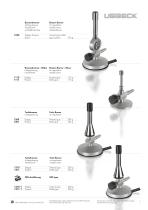
Bunsenbrenner Luftregulierung Nadelventil verstellbare Duse Bunsen Burner air regulation needle valve adjustable jet 1050 Erdgas, Propan, Butan Bunsenbrenner - Mikro Bunsen Burner - Micro Luftregulierung air regulation Nadelventil needle valve Teclubrenner Teclu Burner Luftregulierung air regulation Teclubrenner Luftregulierung Nadelventil Teclu Burner air regulation needle valve Die Abbildungen zeigen die Brenner mit Haftfuft (Aufpreis). Technische Daten vgl. Seite 52.
Open the catalog to page 7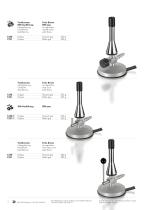
Teclubrenner DIN-Ausführung Luftregulierung Nadelventil Sparflamme Teclu Burner DIN type air regulation needle valve pilot flame Erdgas Propan Teclubrenner Luftregulierung Gashahn Sparflamme Teclu Burner air regulation stop-cock pilot flame Erdgas Propan Erdgas Propan Teclubrenner Luftregulierung Hebelhahn Sparflamme Teclu Burner air regulation lever stop-cock pilot flame Erdgas Propan Die Abbildungen zeigen die Brenner mit Haftfuß (Aufpreis). Technische Daten vgl. Seite 53. Pictures show burners with safety base (extra charge). Specifications see page 53.
Open the catalog to page 8
Teclubrenner DIN-Ausführung Luftregulierung Doppelhebelhahn Sparflamme Teclu Burner DIN type air regulation double lever stop-cock pilot flame Erdgas Propan Teclubrenner Luftregulierung Nadelventil Rohr Ø 19 mm Kopf Ø 30 mm Teclu Burner air regulation needle valve tube Ø 19 mm head Ø 30 mm Erdgas Propan Teclubrenner Luftregulierung Nadelventil für Gaswahl von unten Teclu Burner air regulation needle valve for gastype from underneath Erdgas, Propan, Butan natural gas, bottle gas, butane 255 g Die Abbildungen zeigen die Brenner mit Haftfuß (Aufpreis). Technische Daten vgl. Seite 53. Pictures show...
Open the catalog to page 9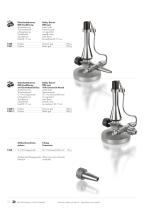
Safety Burner DIN type safety pilot thermocouple air regulation needle valve pilot flame burnerhead 0 17 mm 370 g 370 g Sicherheitsbrenner DIN-Ausfuhrung mit Gewindeanschluss Zundsicherung Thermoelement G 1/4 Linksgewinde Luftregulierung Sparflamme Nadelventil Kopf 0 17 mm Safety Burner DIN type with connexion thread safety pilot thermocouple G 1/4 screwed left-hand air regulation pilot flame needle valve burnerhead 0 17 mm 400 g 400 g Schlauchanschluss-stutzen Tubing Connexion 1333 G1/4 Linksgewinde G1/4 screwed left-hand 45 g Andere Anschlussgewinde Other connexion threads lieferbar. available....
Open the catalog to page 10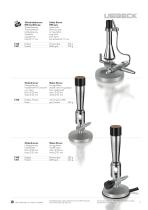
Safety Burner DIN type safety pilot thermocouple air regulation stop-cock pilot flame burnerhead 0 17 mm Mekerbrenner Luftregulierung Nadelventil fur Gaswahl von unten Rohr 0 28 mm Kopf 0 32 mm 1350 Erdgas, Propan, Butan Meker Burner air regulation needle valve for gastype from underneath tube 0 28 mm head 0 32 mm natural gas, bottle gas, butane 335 g Mekerbrenner Luftregulierung Nadelventil Rohr 0 28 mm Kopf 0 32 mm Meker Burner air regulation needle valve tube 0 28 mm head 0 32 mm Die Abbildungen zeigen die Brenner mit Haftfuft (Aufpreis). Technische Daten vgl. Seite 53.
Open the catalog to page 11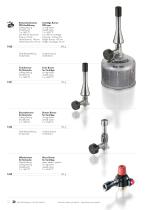
Kartuschenbrenner DIN Ausfuhrung Luftregulierung Nadelventil T=1620°C inkl. 400 ml-Kartusche Propan / Butan Hohe Brenner: 140 mm Hohe Kartusche: 92 mm Cartridge Burner DIN type air regulation needle valve T =1620 °C incl. 400 ml cartridge propane / butane mix Height Burner: 140 mm Height Cartridge: 92 mm 1420 545 g Dreifuftempfehlung: Suitable tripod: Teclu Burner for Cartridge air regulation needle valve T =1620 °C Bunsen Burner for Cartridge air regulation needle valve T =1530 °C 1422 145 g Dreifuftempfehlung: Suitable tripod: Micro Burner for Cartridge piezo electric ignition air regulation needle...
Open the catalog to page 12- Surgery forceps
- Grasping forceps
- Human scissors
- Stainless steel forceps
- Electrosurgical forceps
- Bent forceps
- Dressing forceps
- Stainless steel spatula
- Dressing scissors
- Monopolar forceps
- Titanium forceps
- Oxygen cylinder support
- Vacuum meter
- Laboratory inoculating loop
- Instrument tray
- Autoclavable spatula
- Metal instrument tray
- Surgical bowl