- Catalogs
- Carl Stahl Technocables GmbH
- TECHNOCABLES Edition No. 7

TECHNOCABLES Edition No. 7

TECHNOCABLES Edition No. 7
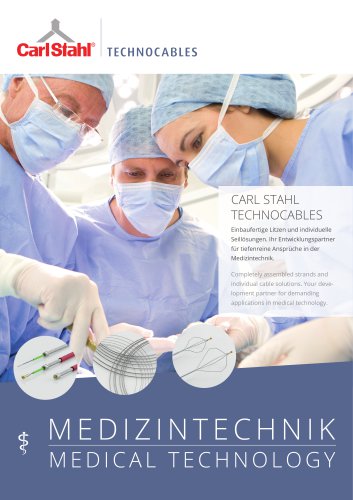
Carl Stahl TECHNOCABLES GmbH is a leading company in technical wire ropes and cables, part of the Carl Stahl Group, with a history since 1880. The company focuses on quality and innovation, employing over 1800 people across 70 global subsidiaries.
- Customer Interaction: The R&D department collaborates with customers to develop tailored solutions using advanced CAD systems and FEM simulations.
- Wire Rope Science: Assembled TechnoCables provide cost-effective solutions for mechanical applications, with flexibility increasing with more wires.
- Design of Wire Ropes: Wire ropes are constructed by twisting strands, with options for fiber cores, and are designated by the number of strands and wires per strand.
- Lay Direction: The lay direction indicates how wires or strands are twisted, with S-lay (left) and Z-lay (right) being common terms.
- Stainless Steel TechnoCables: Includes strands, wire ropes, and coated options.
- Galvanized Steel TechnoCables: Offers similar products in galvanized steel.
- Terminals: Various types of swaged and die-cast terminals are available, including special terminals.
- Bowden Cables: Includes flat and round wire spirals, with various end fittings and accessories.
- Pulleys and Accessories: A range of pulleys and hand crimping tools are offered.
The company maintains high standards of quality through rigorous testing and collaboration with scientific institutions.
Wire ropes are constructed with wires twisted into strands and strands twisted into the rope. The direction of these twists determines the lay type: sZ (right hand regular lay), zZ (right hand langs lay), zS (left hand regular lay), and sS (left hand langs lay). If not specified, sZ is supplied.
Coated wire ropes are recommended for applications involving pulleys or reverse bending. Polyamide is commonly used for its wear and bending resistance, protecting the rope from dirt and maintaining lubrication. PTFE is used for high temperature or low friction requirements.
TechnoCables are made from high tensile strength wires, typically galvanized steel or stainless steel (AISI 316). For corrosive environments, AISI 316 is recommended. Custom materials like titanium, monel, and precious metals are available for specific applications.
The working life of wire ropes depends on factors like pulley diameter, deflection, and dynamic loads. Testing is essential for optimizing and developing products.
Elongation in wire ropes can be constructional, due to gaps between wires and strands, or material-based, proportional to the load applied. Ropes generally return to their original length after unloading unless plastically deformed.
Various constructions are available for different applications, including control cables, suspension systems, and heavy-duty cycles. Applications span automotive, medical, conveyer, and more industries.
Carl Stahl Technocables ensures high quality through continuous quality assurance from raw materials to dispatch, with regular testing in laboratories.
Wire ropes are used in automotive, medical, conveyer, and other industries for applications like safety belt adjustment, gear change, and window lifting systems.
Specifications for stainless steel strands include minimum breaking load, weight, and nominal diameter, with various item numbers for different configurations.
The document provides detailed specifications for various components such as end caps, adjustment screws, hose sockets, and pulleys. Each component is listed with dimensions in millimeters, including diameter, length, and other relevant measurements. The document also includes item numbers for both new and old versions of each component.
The document outlines the importance of selecting the correct pulley and wire rope combination to optimize the lifespan of the wire rope. It provides guidelines on groove geometry, the ratio between groove and rope diameter, surface quality, and material selection.
Recommendations are provided for the minimum diameter of pulleys based on rope construction. The document emphasizes the importance of choosing the right pulley bearing and provides a decision matrix to assist in this selection.
The tables include dynamic load capacities for bearings under normal conditions, with specific calculations for different rotation speeds. The document also provides weight information for components per 100 pieces.
Hose sockets are available in nickel-plated brass, galvanized steel, or stainless steel, with options for neck, thread, and hexagon thread. Pulleys are made from polyamide and feature various bearing types, including self-lubricating sintered bronze and needle roller bearings.
Nylon pulleys are highlighted for their lightweight, corrosion resistance, self-lubrication, and high impact resistance. The document notes the improved tensile strength of lubricated polyamide, allowing for higher loads compared to thermoplastics.
1. Coefficient of friction: Oil lubrication (0.05 – 0.10), Dry lubrication (0.15 – 0.25).
2. Maximum speed: 5 m/s.
3. Maximum temperature: 90 °C.
Various dimensions (A, B, C, D, E, R) are provided with tolerances in mm. Maximum load capacities range from 880 N to 7110 N depending on the model.
1. For long working life, use a load less than 10% of the maximum capacity.
2. Best results with hardened steel shafts with a surface grade of 0.4 – 0.8 Ra (µm).
1. Item No. DI000126: Features include hexagon sleeve shape, nonslip grips, suitable for rope diameters 0.45 – 2.00 mm.
2. Item No. DI000127: Features include round sleeve shape, nonslip grips, suitable for rope diameters 1.20 – 5.00 mm.
Available in various materials like galvanized copper and brass, suitable for different rope diameters.
Includes questions about application, load, safety factor, material quality, environmental conditions, and more to provide a tailored solution.
Refer to general conditions of sale, delivery, and payment. Subject to change without notice.
Catalog excerpts
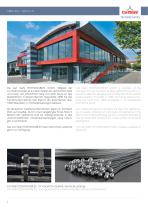
Die Carl Stahl TECHNOCABLES GmbH, Mitglied der Carl Stahl Gruppe, ist auf dem Gebiet der technischen Seile und Litzen seit Jahrzehnten tätig und zählt heute zu den Marktführern in diesem Bereich. Gegründet 1880 hat das Familienunternehmen Carl Stahl in der Zwischenzeit über 1800 Mitarbeiter in 70 Niederlassungen weltweit. Carl Stahl TECHNOCABLES GmbH, a member of the Carl Stahl Group, has been working with technical wire ropes and cables for decades and is today one of the world’s market leaders. Founded in 1880, the family-owned company has more than 1800 employees in 70 subsidiaries around...
Open the catalog to page 2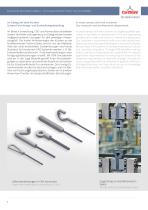
IM DIALOG MIT DEM KUNDEN I IN CLOSE CONTACT WITH THE CUSTOMER Im Dialog mit dem Kunden Unsere Forschungs- und Entwicklungsabteilung In close contact with the customer Our research and development department Im Bereich Entwicklung, CAD und Konstruktion erarbeiten unsere Techniker und Ingenieure im Dialog mit den Kunden maßgeschneiderte Lösungen für den jeweiligen Anwendungsfall. Die hohen Anforderungen der Kunden an die konfektionierten TechnoCables sind für uns der Maßstab. Viele der einst entwickelten Sonderlösungen sind heute Standard. Auf modernen CAD-Systemen werden z. B. Betriebsmittelkonstruktionen,...
Open the catalog to page 4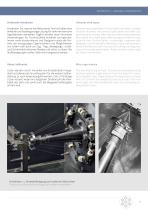
INFOBLOCK I GENERAL INFORMATION Drahtseile entdecken Discover wire ropes Entdecken Sie, warum konfektionierte TechnoCables eine einfache und kostengünstige Lösung für viele mechanische Applikationen darstellen. Täglich werden neue innovative Anwendungen für TechnoCables entdeckt und genutzt. Immer mehr Konstrukteure und Designer nutzen die Vorteile der einzigartigen Eigenschaften und Möglichkeiten von Seilen und Litzen um Zug,- Trag-, Bewegungs-, Schaltund Sicherheitsfunktionen flexibel und sicher zu lösen. Bei Stoßbewegungen sollten Seile nicht eingesetzt werden. Discover why assembled TechnoCables...
Open the catalog to page 5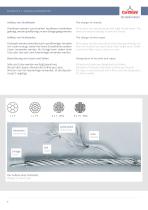
INFOBLOCK I GENERAL INFORMATION Drahtlitzen werden aus einzelnen hochfesten Seildrähten gefertigt, welche spiralförmig um eine Einlage gelegt werden. All strands are manufactured with high tensile wires. The wires are twisted helically to form the strand. The design of wire ropes Drahtseile werden ebenfalls durch spiralförmiges Verseilen von Litzen erzeugt, wobei hier keine Einzeldrähte sondern Litzen verwendet werden. Als Einlage kann neben einer Litze oder Seil auch eine Fasereinlage verwendet werden. Wire ropes are also manufactured by twisting helically, but this time strands are used rather...
Open the catalog to page 6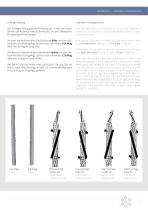
INFOBLOCK I GENERAL INFORMATION Die Schlagrichtung gibt die Richtung an, in der bei Litzen (Seilen) die Außendrähte (Außenlitzen) um den Mitteldraht (Einlage) gewickelt werden. The lay describes the direction in which the wires of a strand or the strands of a rope are twisted around a central wire or core. Werden die Außendrähte (Außenlitzen) links um den Mitteldraht (Herzlitze) gelegt, spricht man von einem S-Schlag oder der Schlagrichtung links. In a strand, if the wires are laid heli-cally over a centre wire in a left direction, the lay is called S-lay or left lay. Werden die Außendrähte (Außenlitzen)...
Open the catalog to page 7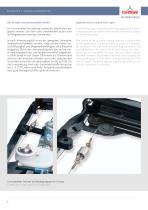
INFOBLOCK I GENERAL INFORMATION Der Einsatz von ummantelten Seilen Applications for coated wire ropes Ein ummanteltes Seil sollte grundsätzlich überall dort eingesetzt werden, wo Seile über Umlenkrollen laufen oder auf Biegewechsel beansprucht werden. Coated wire ropes can be found in most applications where pulleys are used and where the TechnoCable will be subject to reverse bending. Je nach Anwendungsfall muss der geeignete Ummantelungswerkstoff gewählt werden. Aufgrund der hohen Verschleißfestigkeit und Biegewechselfähigkeit wird Polyamid eingesetzt. Durch die Ummantelung wird das Seil vor...
Open the catalog to page 8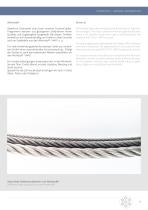
INFOBLOCK I GENERAL INFORMATION Sämtliche Drahtseile und Litzen unseres TechnoCablesProgramms werden aus gezogenen Seildrähten hoher Qualität und Zugfestigkeit hergestellt. Bei diesen Drähten handelt es sich standardmäßig um Drähte in Stahl verzinkt und um Edelstähle aus dem Werkstoff 1.4401 u. a. All TechnoCables are manufactured from wires of high tensile strength. The most common wires are galvanized steel wires, or if stainless steel wire rope is manufactured the material AISI 316 (1.4401) is used. Für viele Anwendungsbereiche besitzen Seile aus verzinktem Draht einen ausreichenden Korrosionsschutz....
Open the catalog to page 9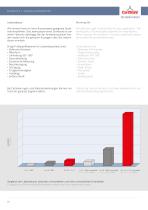
INFOBLOCK I GENERAL INFORMATION Working life Wir können Ihnen für Ihren Einsatzzweck geeignete Drahtseile empfehlen. Die Lebensdauer eines Drahtseils ist von vielen Faktoren abhängig. Bei der Anwendung beim Kunden lassen sich die genauen Aussagen über die Lebensdauer ermitteln. We offer the right TechnoCable for your application. The working life of TechnoCables depends on many factors. When used by the customer, the exact statements about the service life can be determined. Einige Prüfspezifikationen für Lebensdauertests sind: • Rollendurchmesser • Rillenform • Umlenkung 90°–180° • Dauerbelastung...
Open the catalog to page 10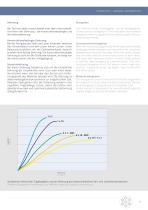
INFOBLOCK I GENERAL INFORMATION Bei TechnoCables unterscheidet man zwei unterschiedliche Arten der Dehnung - die konstruktionsbedingte und die Materialdehnung. Two different kinds of elongation can be distinguished. Constructional elongation of TechnoCables and material elongation which is specific to the material used in the manufacturing process. Konstruktionsbedingte Dehnung Bei der Fertigung der Seile und Litzen entstehen zwischen den Einzeldrähten und den Litzen kleine Lücken. Unter Belastung verdichtet sich der Drahtseilverband, dadurch entsteht eine leichte Dehnung. Die konstruktionsbedingte...
Open the catalog to page 11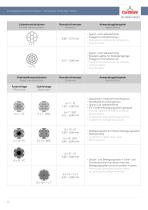
STANDARDKONSTRUKTIONEN I STANDARD CONSTRUCTIONS Carl Stahl TECHNOCABLES Litzenkonstruktionen Strand constructions Fasereinlage Stahleinlage Fibre core Steel core Steuerseil in Plotter/Printer/Kopierer AbreiBseile im Anhangerbau Spann und Halteelemente Fur mittlere Bewegungszyklen geeignet Control cables for plotters, printers, photocopiers Suspension and positioning systems Suitable for average duty cycles Betatigungsseile fur hohere Bewegungszyklen Markisenseile Suitable for higher duty cycles Blind systems Steuer- und Bewegungsseile in Textil- und Druckmaschinen bei denen hochste Bewegungszyklen...
Open the catalog to page 12