


39S

39S
- Variable Frequency Drives (VFDs): Ensure static deflection of vibration isolators is adequate to prevent resonant vibration conditions at low fan speeds. Consider blow-thru fans for reduced discharge sound levels.
- Dirty Filtration: Select air handlers with dirty filters to maintain airflow. Adjustments may be needed if airflow is too high or if cooling coils exhibit moisture carryover.
- Fan, Motor, and Drive Heat: Consider heat losses from fan motors and drives, which affect power requirements and cooling/heating loads. Belt drive losses typically range from 2 to 6 percent.
- Fan Selection: Choose fans based on clean or dirty filter conditions, considering motor horsepower requirements and potential use of VFDs.
- Fan Motor Output Calculation: Account for drive losses and motor efficiency to determine required motor output and heat output.
- Duct Design: Use straight discharge ductwork to maximize fan performance and ensure uniform velocity profile.
- Fan Control on VAV Systems: Consider system parameters, fan type, and control methods like terminal throttling or VFDs for efficient operation.
- Forward-Curved Fans: Suitable for low to medium pressure applications, with stable performance over a wide airflow range.
- Variable Frequency Drives: Modulate fan motor speed to match air volume requirements, offering energy savings and reduced sound levels.
- Supply Fan Control: Maintain constant static pressure in supply ducts using VFDs for efficient operation.
- Indoor Air Quality Applications: Use CO2 demand-controlled ventilation to adjust ventilation levels based on occupancy, enhancing energy efficiency.
- Fans must be dynamically balanced with a solid cold rolled steel shaft designed to operate below its first critical speed.
- Bearings should be rubber mounted, self-aligning, sealed cartridge, and permanently lubricated for a lifespan of 200,000 hours.
- Fans in SH, SV, and SR units should have internal isolation with rubber grommets.
- Fan motors are standard duty, 1725 rpm, open drip-proof, and bolted to an adjustable platform for belt tension and alignment. They should be NEMA B, T-frame design.
- Drive systems are V-belt type with variable pitch motor sheaves for system balancing and air volume adjustment.
- Coils are staggered tube type with seamless copper tubes and deep corrugated aluminum fins, factory leak tested at 500 psig air pressure.
- Steam coils use inner distributing tube (IDT) construction.
- Heaters have automatic and manual resets for protection, with circuit fusing for heaters over 48 amps.
- Constructed with minimum 20-gauge steel and include a 24-vac NEMA 1 control panel.
- Heating elements are open-wound nickel/chrome alloy, and internal wiring is stranded copper rated for 105 C.
- 240-v heaters are derated 75% for 208-v applications.
- Units include disposable filters with optional MERV 7 filters available.
- Mixing boxes have low leak damper assemblies with galvanized steel blades and stainless steel side seals.
- Face and bypass sections have opposed-acting damper blades to minimize warpage.
- Include weather hood and low-leak damper assemblies with galvanized steel blades and corrosion-resistant components.
- Options for manual or motorized fixed outdoor-air dampers for varying outdoor air percentages.
- Motor start/stop station includes terminal strip, 24-v Class 2 transformer, motor relay, contactor, or starter with interlocking disconnect.
Catalog excerpts

Product Data 39SH,SV,SM,SR00-17 Indoor and Outdoor Air Handlers The 39S series air handlers offer: • Horizontal and vertical draw-thru arrangements for heating, cooling, ventilation, and VAV (variable air volume) applications • Small footprint, which assures rigging ease and reduced space requirements Features/Benefits Delivering the air handler components for many stringent specification requirements, the 39S series air handlers are compact and fully assembled; they combine versatility with economical, dependable performance. Dependable performance Copyright 2008 Carrier Corporation Galvanized steel panels ensure structural integrity under all operating conditions. Double-walled hinged access doors on outdoor units also enhance structural stability and provide fast, easy access. Optional stainless steel drain pan controls condensate. Internally mounted motors and drives are installed and aligned at the factory. Because they are contained in a cooled, filtered, dehumidified airstream, motor bearings and belts have less wear and require less servicing. Internal mounting also reduces installation time, shipping damage, and vandalism.
Open the catalog to page 1
Features/Benefits (cont) Precision-balanced fan wheels limit vibration and eliminate abnormal stress on bearings and other components. Fan bearings are rated at 200,000 hours average life. Mixing boxes and filter mixing boxes have parallel blades to provide thorough, efficient air mixing. Dampers are sectioned to prevent excess blade warping and ensure tight closure. Coil flexibility Factory assembled, prealigned drives and fans eliminate field installation expense, saving money. Small envelope size is easy to rig and ensures economical use of building space. Quicker, easier installation and...
Open the catalog to page 2
Model number nomenclature Due to the complexity of the 39S model number, use the "verify model number" function in the AHL/Builder® software for a detailed model explanation. Product Type/Unit Arrangement H - Belt Drive Horizontal Unit Unit Size - Nominal Tons Cooling Coil Heating Coil Coil Configuration TXV — Thermostatic Expansion Valve *Contact your local Carrier representative for a list of available unit arrangements. fContact your local Carrier representative for a list of factory- installed options. **Unit shall be factory wired. Field must switch transformer tap Design Revision TXV/Nozzle...
Open the catalog to page 3
Factory-installed options ITEM MERV 7, 2 in. Pleated Filter Throwaway Filters for Face, Bypass, and Filter Sections Indoor Air Quality (IAQ) Insulation Closed Cell Insulation Double Wall Insulation Motor Start/Stop Station* Plastic Drain Pan† Stainless Steel Drain Pan** Galvanized Steel Drain Pan Std — X — — — Std/— — Std/X — Std X X X Std/X Std/X Std/X LEGEND Standard Item Optional Item Unavailable Item Standard or Unavailable Item Depending on Unit Size Standard or Optional Item Depending on Unit Size *Motor start/stop station is not available with electric heat on 39SH units or with 2 speed...
Open the catalog to page 4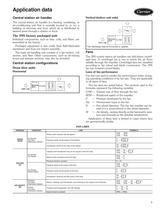
Application data Vertical (indoor unit only) Central station air handler The central station air handler is a heating, ventilating, or air-conditioning unit that is centrally located in, or on, a building or structure and from which air is distributed to desired areas through a system of ducts. The 39S factory packaged unit Individual components, such as fans, coils, and filters, are assembled at the factory. Packaged equipment is less costly than field-fabricated equipment and does not require assembly. The basic air-handling unit consists of a fan section, coil section, and filter. Other components,...
Open the catalog to page 5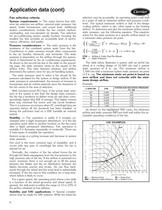
Application data (cont) Fan selection criteria System requirements — The major factors that influence fan selection are airflow, external static pressure, fan speed, brake horsepower, and sound level. Additional system considerations include the fan control method, overloading, and non-standard air density. Fan selection for air-conditioning service usually involves choosing the smallest fan that provides an acceptable level of performance, efficiency, and quality. Pressure considerations — The static pressure is the resistance of the combined system apart from the fan. Contributors to static...
Open the catalog to page 6
Sound considerations — The fan is one of the main sound sources in an air-conditioning system. Other sources of sound include the duct system and terminals, because they generate turbulence in the air flowing through them. Simply estimating fan sound does not give an accurate picture of total system sound, but because fan sound is a major component of system sound, fan sound should be minimized. To minimize its sound generation, a fan must be correctly sized and should be selected to operate at or near peak efficiency. Oversized fans can generate much higher sound power levels than necessary,...
Open the catalog to page 7
Application data (cont) Power losses in the motor and drive should be allowed for when determining the motor output (bhp), so that the motor can be correctly sized and so that the additional heat output can be subtracted from cooling capacity or added to heating capacity. A typical example follows: Given Fan Operating Point: 13,224 cfm 9.6 Fan bhp 3.0% estimated drive loss Calculate the required fan motor output (Hp) due to drive loss: Hp = (Fan bhp) x (Drive Loss) Hp = 9.6 x 1.03 Hp = 9.89 hp (select 10 Hp motor) Calculate the total fan motor heat output (Q) according to motor efficiency: Q...
Open the catalog to page 8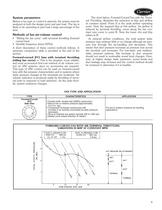
System parameters Before a fan type or control is selected, the system must be analyzed at both the design point and part load. The fan is likely to be operating at part load a large percentage of the time. Methods of fan air-volume control • “Riding the fan curve” with terminal throttling (forward curved fans) • Variable frequency drives (VFDs) A short description of these control methods follows. A summary comparison table is provided at the end of the section. Forward-curved (FC) fans with terminal throttling (riding fan curve) — This is the simplest, most reliable, and most economical first-cost...
Open the catalog to page 9All Carrier| Commercial Systems North America catalogs and technical brochures
 WeatherMaker® 50TCQ
116 Pages
 INFINITY™ 38MPRA
2 Pages
 ActivAIR™ 36CB
24 Pages
 ACTIVAIR™ 36IB
44 Pages
 Axis™
Axis™2 Pages

Archived catalogs
 50ZPB
50ZPB4 Pages
 AHUBuilder
2 Pages
 PERFORMANCE™ 50VT-A
6 Pages
 Carrier® Ductless Systems
8 Pages
 PERFORMANCE™ 50VL-A
6 Pages
 Axis™ Overhead Air Terminals
2 Pages
 ActivAIR™ Induction Beams
2 Pages
 39CC
39CC2 Pages
 A World of Comfort
2 Pages
 Aero® 39M Air Handlers
2 Pages
 17DA Centrifugal Chiller
2 Pages
 Air Handling Units 39 HQ
6 Pages
 48XL-A
30 Pages
 48VL Performance? 14
32 Pages
 48TC WEATHERMAKER®
116 Pages
 48LC WEATHEREXPERT®
52 Pages
 48HC WEATHERMASTER®
124 Pages
 48PM CENTURION?
64 Pages
 48PG CENTURION?
107 Pages
 48A WEATHERMAKER®
116 Pages
 48P WEATHERMASTER®
168 Pages
 48XL Infinity? 15
26 Pages
 OMNIZONE?
80 Pages
 39L AERO®
52 Pages
 30RAP AQUASNAP®
88 Pages
 30RB AQUASNAP®
92 Pages
 EVERGREEN® 23XRV
32 Pages
 AQUAFORCE® 30XA
150 Pages
 AQUAFORCE® 30XW150-400
60 Pages
 EVERGREEN® 30HXA,HXC076-271
52 Pages
 16TJ
16TJ32 Pages
 AQUASNAP® 30MPA,MPW015-045
36 Pages
 39M AERO®
110 Pages
 19XR EVERGREEN®
56 Pages
 Aero Air-Handling Units
2 Pages


- Medical sensor
- Temperature sensor
- Digital thermoregulator
- Cooling thermostat
- Heating thermostat
- Humidity sensor
- Cleanroom air handling unit
- Air-cooled water chiller
- Modular air handling unit
- Thermostat with touchscreen
- Water-cooled water chiller
- Ceiling-mounted fan coil unit
- Wall-mounted fan coil unit
- Floor-mounted fan coil unit
- Air/air heat pump
- Geothermal heat pump