
- Catalogs
- Carrier| Commercial Systems North America
- Aero® Indoor and Weathertight Outdoor Air Handlers


Aero® Indoor and Weathertight Outdoor Air Handlers

Aero® Indoor and Weathertight Outdoor Air Handlers
- Installation and Flexibility: Units are shrink-wrapped for transit protection and can be easily disassembled and reassembled. They offer multiple aspect ratios and stacked configurations for optimal space utilization.
- Durability: Features include a sealed panel double-wall R-13 insulation system, robust casing, and sound performance compliance.
- Performance Optimization: AHUBuilder software aids in selecting optimal fan and coil configurations. Units come with factory-installed variable frequency drives and other components for enhanced performance.
- Indoor Air Quality (IAQ): Offers filtration flexibility with various filter options and factory-installed UV-C germicidal lamps to improve IAQ by reducing airborne microorganisms.
- Coil Options: Extensive coil options include chilled water, direct expansion, hot water, and steam coils, designed for efficient thermal transfer and minimal pressure loss.
- Customization: Units can be customized with components like humidifiers, face and bypass coils, and direct digital controls to meet specific application needs.
Catalog excerpts

Product Data Aero® Indoor and Weathertight Outdoor Air Handlers 1,500 to 60,500 Nominal CFM 39MN,MW 03-110 Indoor and Weathertight Outdoor Air Handlers © Carrier Corporation 2019 Form 39M-15PD
Open the catalog to page 1
Features/Benefits The Aero 39M air handler is the only unit on the market that practically installs itself. Carrier’s 39M air handlers offer: • Shrink-wrapped units for complete protection while in transit • Multiple aspect ratios to choose from to fit spaces short and wide or tall and narrow. • Factory-supplied variable frequency drives that are programmed and started up at the factory • Sealed panel double-wall R-13 insulation system • Stacked indoor unit configurations for application versatility and maximum space utilization • Outdoor weathertight cabinets have sloped roofs to reduce standing...
Open the catalog to page 2
UV-C germicidal lamps • Energy Savings: Lowers energy costs by improving HVAC system heat transfer and increasing net cooling capacity. • Maintenance Savings: Continuously cleans coils, drain pans, plenums, and ducts, reducing or eliminating manual cleaning and the use of harmful chemicals. • Improved IAQ: Reduces the spread of airborne microorganisms that trigger allergy and asthma symptoms and reduces the spread of bacteria and viruses that can cause infectious diseases. • Water Conservation: Reclaiming clean condensate for tower makeup, irrigation or gray water flushing reduces water and waste...
Open the catalog to page 3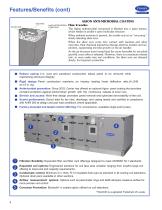
Features/Benefits (cont) BACTERIA SILVER IONS AgION ANTIMICROBIAL COMPOUND AGION ANTI-MICROBIAL COATING How it works: The Agion antimicrobial compound is blended into a paint system, which resides in zeolite’s open molecular structure. When ambient moisture is present, the zeolite acts as an “ion pump,” slowly releasing silver ions. When the silver ions come into contact with bacteria and other microbes, their chemical interaction disrupts electron transfer and respiration, suppressing microbe growth on the air handler. As the air becomes more humid (and the more favorable for microbial growth),...
Open the catalog to page 4
AHRI certification The Air-Conditioning, Heating, and Refrigeration Institute (AHRI) is a voluntary, nonprofit organization comprised of the manufacturers of air conditioning, refrigeration, and heating products. More than 90% of the air conditioning and refrigeration machinery and components manufactured in the United States is produced by members of AHRI. Carrier 39M air handlers are rated in accordance with AHRI Standard 430, which is the industry standard for central station air-handling units. Certification by participating manufacturers of units within the scope of this program requires...
Open the catalog to page 5
Application data Central station air handler The central station air handler is a heating, ventilating, or air-conditioning unit that is centrally located in, or on, a building or structure. The air handler distributes air to desired areas through a system of ducts. The 39M factory packaged unit Individual components, such as fans, coils, and filters, are assembled at the factory. Packaged equipment is less costly than field-fabricated equipment and does not require assembly. The basic air-handling unit consists of a fan section and a coil section. Other components, such as filter sections, airmixing...
Open the catalog to page 6
Multizone Mixing dampers blend hot-deck and cold-deck temperatures to produce a desired temperature for individual zones. Several blending dampers per unit produce independent zones, each responding to its own thermostat (indoor unit only). High filtration units employ a filter section ahead of the cooling and heating coils. A second filter section, called a final filter, is placed at the end of the unit at the point where the air enters the ductwork. DIF- , FINAL FUSER FILTER Fans The 39M central station air handlers use belt-driven centrifugal fans. A centrifugal fan is one in which the air...
Open the catalog to page 7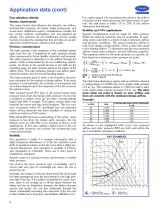
Application data (cont) (SPDESIGN - SPMIN) Fan selection criteria System requirements The major factors that influence fan selection are airflow, external static pressure, fan speed, brake horsepower, and sound level. Additional system considerations include the fan control method, overloading, and non-standard air density. Fan selection for air-conditioning service usually involves choosing the smallest fan that provides an acceptable level of performance, efficiency and quality. Pressure considerations The static pressure is the resistance of the combined system apart from the fan. Contributors...
Open the catalog to page 8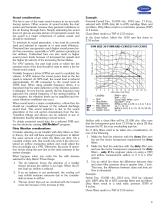
Dirty filtration considerations Consider selecting an air handler with dirty filters so that, in theory, the unit will have enough horsepower to deliver the same amount of air when the filters are dirty. On a constant volume unit, that would only work if the unit contained an airflow measuring station and could adjust the flow accordingly via a VFD. Otherwise, the point of operation moves along the rpm line as the static pressure in the system changes. What happens when you order the fan with sheaves selected for dirty filters? Three things: 1. The air balancer forces the selection of a smaller...
Open the catalog to page 9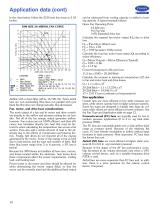
Horsepower) MSE — Max. Static Eff RP — Rated Point SC — System Curve In the chart below, follow the 2210 rpm line down to 2.55 inches. Airflow with a clean filter will be 16,700 cfm. Since airfoil fans are non-overloading (bhp lines run parallel with rpm lines) the bhp does not change (actually, bhp decreases). Fan, motor, and drive heat considerations The work output of a fan and its motor and drive contribute directly to the airflow and pressure exiting the air handler. Not all of the fan energy output generates airflow, however. Fan motors are not 100% efficient, and their efficiency loss...
Open the catalog to page 10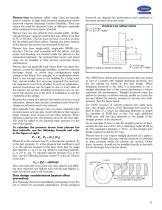
Plenum fans (sometimes called ‘‘plug’’ fans) are typically used in medium to high static pressure applications where ductwork requires discharge location flexibility. They can reduce the need for ductwork turns or diffusers, especially when equipment room space is limited. Plenum fans are less efficient than double-width, doubleinlet airfoil fans. General construction also differs from that of FC or AF fans. The fan does not have a scroll to enclose the fan wheel and direct airflow. Instead, the entire interior of the plenum fan section is pressurized by the fan. Plenum fans have single-width,...
Open the catalog to page 11All Carrier| Commercial Systems North America catalogs and technical brochures
 WeatherMaker® 50TCQ
116 Pages
 INFINITY™ 38MPRA
2 Pages
 ActivAIR™ 36CB
24 Pages
 ACTIVAIR™ 36IB
44 Pages
 Axis™
Axis™2 Pages
Archived catalogs
 50ZPB
50ZPB4 Pages
 AHUBuilder
2 Pages
 PERFORMANCE™ 50VT-A
6 Pages
 Carrier® Ductless Systems
8 Pages
 PERFORMANCE™ 50VL-A
6 Pages
 Axis™ Overhead Air Terminals
2 Pages
 ActivAIR™ Induction Beams
2 Pages
 39CC
39CC2 Pages
 A World of Comfort
2 Pages
 Aero® 39M Air Handlers
2 Pages
 17DA Centrifugal Chiller
2 Pages
 Air Handling Units 39 HQ
6 Pages
 48XL-A
30 Pages
 48VL Performance? 14
32 Pages
 48TC WEATHERMAKER®
116 Pages
 48LC WEATHEREXPERT®
52 Pages
 48HC WEATHERMASTER®
124 Pages
 48PM CENTURION?
64 Pages
 48PG CENTURION?
107 Pages
 48A WEATHERMAKER®
116 Pages
 48P WEATHERMASTER®
168 Pages
 48XL Infinity? 15
26 Pages
 OMNIZONE?
80 Pages
 39L AERO®
52 Pages
 30RAP AQUASNAP®
88 Pages
 39S
39S36 Pages
 30RB AQUASNAP®
92 Pages
 EVERGREEN® 23XRV
32 Pages
 AQUAFORCE® 30XA
150 Pages
 AQUAFORCE® 30XW150-400
60 Pages
 EVERGREEN® 30HXA,HXC076-271
52 Pages
 16TJ
16TJ32 Pages
 AQUASNAP® 30MPA,MPW015-045
36 Pages
 39M AERO®
110 Pages
 19XR EVERGREEN®
56 Pages
 Aero Air-Handling Units
2 Pages


- Medical sensor
- Temperature sensor
- Digital thermoregulator
- Cooling thermostat
- Heating thermostat
- Humidity sensor
- Cleanroom air handling unit
- Air-cooled water chiller
- Modular air handling unit
- Thermostat with touchscreen
- Water-cooled water chiller
- Ceiling-mounted fan coil unit
- Wall-mounted fan coil unit
- Floor-mounted fan coil unit
- Air/air heat pump
- Geothermal heat pump