
- Catalogs
- Cascade Dafo
- The DAFO Guide to Bracing

The DAFO Guide to Bracing

The DAFO Guide to Bracing
- Mild: For slight issues like occasional hyperextension or mild pronation. Recommended braces include DAFO FlexiSport for larger, active patients and JumpStart Bunny for early intervention.
- Moderate: For more pronounced symptoms such as visible heel eversion or moderate pronation. Recommended braces include DAFO 3.5 and DAFO Tami2.
- Strong: For severe conditions like constant hyperextension or strong pronation. Recommended braces include DAFO 4 and DAFO FlexiSport.
- Low Tone Pronation: Characterized by a pronated foot with a collapsed arch. Recommended braces include HotDog and Chipmunk.
- High Tone Pronation/Supination: Involves muscle contractures. Recommended braces include DAFO 4 and DAFO Tami2.
- Swing Phase Inconsistency: Involves unsteady foot movement. Recommended braces include JumpStart Bunny and DAFO 3.5.
- Excessive Plantarflexion/Toe Walking: Common in toddlers but concerning if persistent. Monitoring and potential intervention are suggested.
- Specifications: Descriptions of each product's intended use, such as JumpStart Bunny for early intervention and DAFO 4 for ankle positioning issues.
- Procedures: Recommendations on choosing the appropriate strap or orthosis based on the patient's condition.
- Norms and Recommendations: Guidance on selecting the right DAFO model based on condition severity and patient activity level.
- Product Features: Detailed features of each DAFO model, including foot control and adjustable straps.
- Clinical Considerations: Discussion on conditions like knee hyperextension and crouching, and how DAFO products assist in management.
- Excess Plantarflexion and Toe Walking: Products like JumpStart Bunny and DAFO 3.5 are recommended.
- Knee Hyperextension: DAFO models like 3.5 and Tami2 provide solutions.
- Crouching or Excess Knee Flexion: DAFO Turbo and Floor Reaction are designed for pronounced crouching.
- Positioning or Limited Ambulation: DAFO Softy models offer cushioned support.
Catalog excerpts

The DAFO Guide to Brace Selection Cascade Dafo believes... “better mobility gives children a wider range of experiences, more success in the activities they choose, and ultimately more control over their lives.” 1. Find your patient group that best matches your child’s presenation. 2. Each patient group has descriptive categories of involvement: Mild, Moderate, or Strong. 3. Within each category are the recommended DAFOs For more information regarding a specific brace, please visit www.cascadedafo.com informa tion For more ascade visit www.c brace, please about a specific h absent • Medial arc n eel eversio • Distinct h duction orefoot ab • Marked f to lift h difficult • Medial arc Moderate antly reduced h signific • Medial arc heel eversion • Visible uction e refoot abd • Visible fo with resistanc h can be lifted • Medial arc but visible h reduced • Medial arc el eversion • Slight he efoot abduction • Slight for lift h easy to • Medial arc Frog ® JumpStart Leap Ideal early intervention Most supportive More supportive Maximum support Mostly sensory High Tone Mild High Tone High Tone High Tone High Tone ntly h significa • Medial arc reduced el eversion • Visible he resists correction • Actively h slightly • Medial arc increased l inversion • Slight hee rrection • Gently resists co h reduced • Medial arc l eversion • Slight hee rrection • Gently resists co Supination c h dramati • Medial arc ars fixed • Foot appe t • Strong, persisten ion to correct resistance High Tone h absent • Medial arc n eel eversio • Marked h t • Strong, persisten ion to correct resistance • Medial arch clearly increased el inversion • Visible he resists correction • Actively Frog ® JumpStart Leap Pronation Supination heel inverts e down and ntrating • Foot is to hen conce control w • Very little ngle level terrain • Foot appears to da frequently even on • Falls or stumbles ear unsteady ntrating • Foot and ankle app hen conce control w ven terrain • Can improve g especially on une t stumblin • Frequen ear steady ntrating • Foot and ankle app hen conce • Can control w creases when tired al falling in • Occasion Moderately flexible Free ankle Ideal early intervention DAFO FlexiSpo patients round half toe walking • Heel off g but not eliminate limited • Can improve n range is slightly • Dorsiflexio ccasionally ntrating • Heel off ground o hen conce when running • Can control w pronounced xion more ory • Plantarfle n range is satisfact • Dorsiflexio hyperextension • Constant and forceful • Sudden control no voluntary • Little or hyperexte • Frequent but not forceful • Distinct inate when focused ut not elim • Can reduce b nsion al hyperexte • Occasion istinct • Soft and not d hen focused • Can control w Moderate nsion Moderately flexible Posterior strap Ideal early intervention Ideal early intervention DAFO FlexiSpo patients Night stretching ays round alw • Heel off g entation • Cannot vary pres d n is limite • Dorsiflexio Free ankle Ideal early intervention Moderately flexible Very flexible strut JumpStart Bunny DAFO FlexiSpo patients Ideal early intervention nee flexion t and marked k • Constan y control no voluntar • Little or n ambulation nt impact o • Significa knee flexion t to constant ted • Frequen some when promp • Can correct with fatigue • Always present daily activity • Some limits on e flexion and slight kne ted • Occasional easily when promp • Can correct d with fatigue • Often associaten daily function • Slight impact o Ideal early intervention Semi-rigid strut Moderately flexible Free ankle/Dorsi-assist Posterior strap DAFO FlexiSpo patients sion Hyperexten DAFO Floor DAFO FlexiSpo patients DAFO FlexiSpo patients For larger, active and maintain to manually correct • Difficult atypical contours • Unique shapes, far from balanced • Correction DAFO 3.5 smaller patients for or Excess n Knee Flexio Semi-rigid strut, correct res with correction • Can manually pronounced featu • Boney and maintain anually correct and ection • Easy to m contours with corr • Typical foot DAFO Turbo or Limited Ambulation For more Softy DAFO 3.5 strut Semi-rigid strut Moderately flexible Softy DAFO 3.5 strut Moderately flexible www. casca please visit ic brace, about a specif inform ation ade Dafo approach .com lection or the Casc ww.cascadedafo ore about brace se To learn m tion Groups, visit w 32. to Patient Presenta pport at 800.848.73 or call Technical Su Cascade Dafo, dedaf o.com Softy DAFO Turboweight bearing under Resists crouching To request a copy online, go to the Comments and Request area on www.cascadedafo.com
Open the catalog to page 1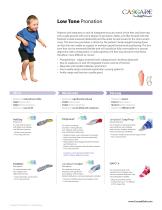
Low Tone Pronation Patients with weakness or lack of integrated muscle control of the feet and lower leg will usually present with some degree of pronation, fallen arch (flat-footed) with the forefoot turned outward (abducted) and the ankle turned inward in the more severe cases. This low tone pronation is driven by the patient’s body weight bearing down on feet that are unable to support or maintain good biochemical positioning. The low tone foot can be extremely flexible and will usually be fully correctable to a neutral alignment with manipulation. In older patients, the foot may become more...
Open the catalog to page 2
High Tone Pronation or Supination Muscle contractures in patients with high tone can pull the foot into a pronated (fallen arch, forefoot turned outward, ankle turned inward) or supinated, high arch with forefoot turned inward (abducted) and ankle turned outward in the more severe cases. For the milder cases, ankle range and function remain good. As severity increases, poor foot position affects ankle function. Correcting the foot will help with ankle function. As degree of contractures increase, ankle is directly affected and moves patient into Toe Walking or Inconsistent Ankle Moducation categories....
Open the catalog to page 3All Cascade Dafo catalogs and technical brochures
 Fast Fit
2 Pages
 DAFO KAFO
1 Page
 DAFO FlexiSport
1 Page
 DAFO 5 Softy
1 Page
 DAFO Turbo Softy
1 Page
 DAFO 2 Softy
1 Page
 DAFO 3.5 Softy
1 Page
 DAFO 4 Softy
1 Page
 DAFO Turbo
1 Page
 DAFO 2
1 Page
 DAFO 3.5
1 Page
 DAFO Tami2
1 Page
 DAFO TWO STEP
1 Page
 DAFO FA
1 Page
 DAFO Rear entry
1 Page
 DAFO 8 Softy
1 Page
 Hemi Style DAFO
1 Page
 DAFO 7
1 Page
 JRA SH O E INSERT
1 Page
 DAFO 9
1 Page


Archived catalogs
 DAFO FlexiSport - 2013
1 Page
- Orthopedic immobilization
- Splint
- Articulated orthopedic immobilization
- Orthopedic insole
- Knee orthosis
- Orthopedic insole with heel pad
- Pediatric orthopedic immobilization
- Ankle and foot orthosis
- Extension orthopedic immobilization
- Dynamic orthopedic immobilization
- Custom orthopedic immobilization
- Knee splint
- Plantar fasciitis splint
- Elbow splint
- Custom-made orthopedic insole
- Plantar fasciitis orthopedic insole
- Pediatric orthopedic insole
- Supra-malleolar orthosis (SMO)
- Knee extension orthopedic immobilization