
- Catalogs
- Cellular Technology Limited
- Serum Free Media

Serum Free Media
Serum Free Media
The document discusses the development and advantages of CTL Serum-free Media for T cell and B cell assays. These media are designed to provide low background and high signal, outperforming traditional serum-based methods.
Specifications and Benefits
- Low Background: Essential for detecting rare antigen-specific T cells among PBMCs. CTL Serum-free Media are quality-controlled to ensure minimal non-specific activity, unlike traditional sera which can elevate background levels.
- High Signal: Traditional sera contain suppressive factors that can inhibit T cell activation. CTL Serum-free Media enhance the detection of antigen-specific T cells, particularly CD8 and CD4 cells, by avoiding these suppressive effects.
Standardization and Quality Control
CTL Serum-free Media provide consistent performance across different laboratories, overcoming the variability introduced by using different serum batches. Each batch is quality-controlled for reproducibility.
Cost Effectiveness
Using CTL Serum-free Media reduces costs associated with serum-based media, such as batch testing, bulk ordering, and storage. It offers a ready-to-use, hassle-free alternative.
Product Portfolio
The CTL Serum-free Media portfolio includes:
- CTL-Test™: For direct ex vivo testing of PBMC in T cell cytokine assays.
- CTL-Test™ PLUS: Enhances detection of rare antigen-specific memory cells.
- CTL-Test™ B: For expansion and testing of PBMC in B cell assays.
- CTL-Wash™ Supplement 10x: Maintains PBMC viability and functionality.
- CTL-Cryo™: Serum-free freezing media for cryopreservation.
- CTL Anti-Aggregate Wash™ 20x: Prevents cell loss during thawing.
Conclusion
CTL Serum-free Media provide a standardized, cost-effective solution for T cell and B cell assays, ensuring low background and high signal detection.
Catalog excerpts
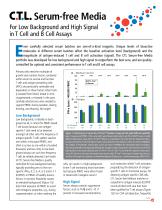
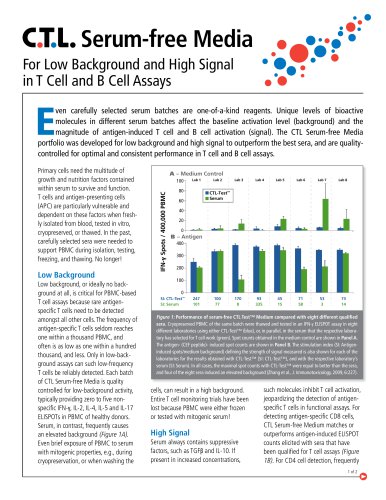
Serum-free Media For Low Background and High Signal in T Cell and B Cell Assays ven carefully selected serum batches are one-of-a-kind reagents. Unique levels of bioactive molecules in different serum batches affect the baseline activation level (background) and the magnitude of antigen-induced T cell and B cell activation (signal). The CTL Serum-free Media portfolio was developed for low background and high signal to outperform the best sera, and are qualitycontrolled for optimal and consistent performance in T cell and B cell assays. Low Background Low background, or ideally no background at all, is critical for PBMC-based T cell assays because rare antigenspecific T cells need to be detected amongst all other cells. The frequency of antigen-specific T cells seldom reaches one within a thousand PBMC, and often is as low as one within a hundred thousand, and less. Only in low-background assays can such low-frequency T cells be reliably detected. Each batch of CTL Serum-free Media is quality controlled for low-background activity, typically providing zero to five nonspecific IFN-γ, IL-2, IL-4, IL-5 and IL-17 ELISPOTs in PBMC of healthy donors. Serum, in contrast, frequently causes an elevated background (Figure 1A). Even brief exposure of PBMC to serum with mitogenic properties, e.g., during cryopreservation, or when washing the IFN-γ Spots / 400,000 PBMC Primary cells need the multitude of growth and nutrition factors contained within serum to survive and function. T cells and antigen-presenting cells (APC) are particularly vulnerable and dependent on these factors when freshly isolated from blood, tested in vitro, cryopreserved, or thawed. In the past, carefully selected sera were needed to support PBMC during isolation, testing, freezing, and thawing. No longer! CTL-Test™ Serum Figure 1: Performance of serum-free CTL Test™ Medium compared with eight different qualified sera. Cryopreserved PBMC of the same batch were thawed and tested in an IFN-γ ELISPOT assay in eight different laboratories using either CTL-Test™ (blue), or, in parallel, in the serum that the respective laboratory has selected for T cell work (green). Spot counts obtained in the medium control are shown in Panel A. The antigen- (CEF peptide)- induced spot counts are shown in Panel B. The stimulation index (SI: Antigeninduced spots/medium background) defining the strength of signal measured is also shown for each of the laboratories for the results obtained with CTL-Test™ (SI: CTL-Test™), and with the respective laboratory’s serum (SI: Serum). In all cases, the maximal spot counts with CTL-Test™ were equal to better than the sera, and four of the eight sera induced an elevated background (Zhang et al., J. Immunotoxicology, 2009, 6:227). cells, can result in a high background. Entire T cell monitoring trials have been lost because PBMC were either frozen or tested with mitogenic serum! High Signal Serum always contains suppressive factors, such as TGFβ and IL-10. If present in increased concentrations, such molecules inhibit T cell activation, jeopardizing the detection of antigenspecific T cells in functional assays. For detecting antigen-specific CD8 cells, CTL Serum-free Medium matches or outperforms antigen-induced ELISPOT counts elicited with sera that have been qualified for T cell assays (Figure 1B). For CD4 cell detecti
Open the catalog to page 1
Serum-free Media Standardization and Quality Control Using different sera while working with PBMC is likely to produce different results. Each serum is a unique reagent containing unique concentrations of molecules that activate or inhibit T cells and APC. The need to work with serum has been a major obstacle for standardized and reproducible ex vivo experimentation. No longer! CTL Serum-free Media contain highly-defined and constant bioactive components, and each batch is quality controlled for consistant performance. The CTL Serum-free Media platform permits assay standardization within a laboratory,...
Open the catalog to page 2All Cellular Technology Limited catalogs and technical brochures
 Serum-free-media
2 Pages
 CTL-Wash™
1 Page
 ELISPOT
4 Pages
 96 well Cell Counting
4 Pages
 B-Poly-S™
1 Page
 TVA
TVA2 Pages
 S6 Micro M2
1 Page
 S6 Macro M2
1 Page
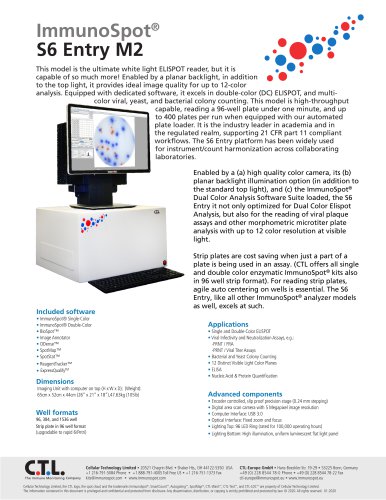 S6 Entry M2
1 Page
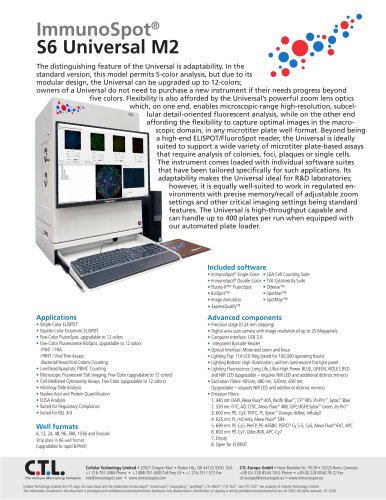 S6 Universal M2
1 Page
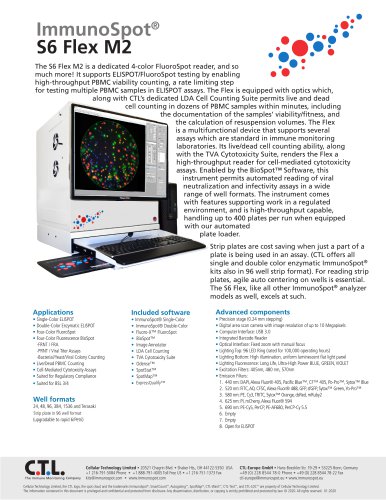 S6 Flex M2
1 Page
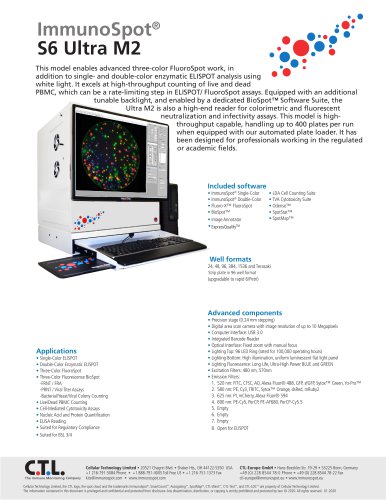 ImmunoSpot® S6 Ultra M2
1 Page
- Solvent reagent
- Molecular biology reagent
- Dye reagent kit
- Cytology reagent
- Buffer solution reagent
- Immunoanalysis reagent kit
- Medium reagent
- Antibody
- Colorimetric reagent
- ELISA reagent kit
- Microplate reader
- IgG reagent kit
- Western blot reagent
- 96-well microplate reader
- Immunoassay microplate reader
- ELISA microplate reader
- Flow cytometry reagent
- Immunofluorescence reagent
- Dilution buffer reagent
- Cell counting reagent