


Cepheid Bladder Cancer Urologist Brochure

Cepheid Bladder Cancer Urologist Brochure
The document discusses the use of molecular testing, specifically the Xpert® Bladder Cancer Detection and Monitor tests, to aid in the treatment plans for patients with bladder cancer. These tests are in vitro diagnostic medical devices designed to detect and monitor bladder cancer non-invasively using urine samples.
Bladder Cancer Facts
By 2030, the incidence of bladder cancer is expected to rise significantly. In Europe, 124,000 new cases are diagnosed annually, with over 40,000 deaths. The risk increases with age, and the median diagnosis age is around 70 years. Most newly diagnosed cases are non-muscle invasive bladder cancer (NMIBC), which has a high recurrence rate.
Haematuria and Bladder Cancer
Blood in urine (haematuria) is a common symptom of bladder cancer, but most cases of haematuria are not cancer-related. Common causes include infections, stones, and benign conditions. The Xpert® tests can help differentiate between cancer and other conditions, reducing patient anxiety and aiding in follow-up strategies.
Xpert® Bladder Cancer Tests
The Xpert® Bladder Cancer Detection test helps assess the likelihood of cancer in patients with haematuria, while the Monitor test checks for recurrence in previously diagnosed patients. Both tests measure five mRNA tumor markers in urine, providing a positive or negative result.
Test Performance
The Detection test has a sensitivity of 75.8% and a specificity of 84.6% among patients with haematuria. The Monitor test shows a sensitivity of 75.0% and a specificity of 80.6% for patients with a history of bladder cancer. The negative predictive value (NPV) is high for both tests, ensuring reliable negative results.
Procedure
To perform the test, a urine sample is collected and processed using the Xpert® Urine Transport Reagent kit. The sample is then analyzed to provide results that guide treatment decisions.
Conclusion
The Xpert® tests offer a non-invasive, reliable method for detecting and monitoring bladder cancer, supporting better patient management and treatment planning.
Catalog excerpts

+ use molecular testing to help drive my patients’ treatment plans. Xpert ® Bladder Cancer Detection & Xpert ® Bladder Cancer Monitor In Vitro Diagnostic Medical Device Not all tests available in all countries
Open the catalog to page 1
Bladder Cancer Facts By 2030, the annual incidence of bladder cancer is projected to increase to (nearly double that of 2012)1. In Europe2 Every Year • 124,000 people are newly diagnosed with bladder cancer • ~415,000 people live with bladder cancer • More than 40,000 people die from the disease The Incidence of Bladder Cancer is Increasing Because • The risk of getting bladder cancer increases with age, and more Europeans are living longer • The median age of diagnosis is ~70 years 75% of newly diagnosed patients have non-muscle invasive bladder cancer (NMIBC)3. Their 5 year survival chances...
Open the catalog to page 2
Haematuria — Blood in the Urine Blood in the urine is the most common symptom of bladder cancer. • 4 out of 5 people with bladder cancer have some blood in their urine, however5: • 80-90% patients with gross haematuria do NOT have cancer • And over 95% of patients with microhaematuria do NOT have cancer Instead, the most common causes of haematuria are urinary tract infection, nephrolithiasis (stones), polycystic kidney disease, trauma, benign prostatic hyperplasia (BPH) in older men, or, in some cases, even vigorous exercise. Sometimes, it can be difficult for doctors to decide who may have...
Open the catalog to page 3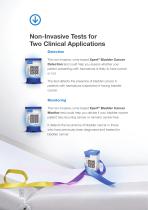
Non-Invasive Tests for Two Clinical Applications Detection Xpert® Bladder Cancer Detection The non-invasive, urine based Xpert ® Bladder Cancer Detection test could help you assess whether your patient presenting with haematuria is likely to have cancer or not. The test detects the presence of bladder cancer in patients with haematuria suspected of having bladder cancer. Xpert® Bladder Cancer Monitor The non-invasive, urine based Xpert ® Bladder Cancer Monitor test could help you decide if your bladder cancer patient has recurring cancer or remains cancer-free. It detects the recurrence of bladder...
Open the catalog to page 4
Xpert ® Bladder Cancer Detection Xpert ® Bladder Cancer Monitor Bladder cancer confirmed by urologist and pathologist Patient with haematuria Appointment with urologist 3 Investigations & tests; e.g. ultrasound, cystoscopy 4 Positive Result – treatment e.g TURB &/or BCG/ similar 5 Monitor for recurrence, according to local guidelines How Do They Work? Both are ‘non-invasive’ tests that measure the expression of five mRNA tumour markers in a voided urine sample. The five mRNA tumour markers were: • Selected for their presence and ability to distinguish bladder cancer cells from normal cells. •...
Open the catalog to page 5
Sensitivity, Specificity & NPV Understanding the concepts of sensitivity, specificity and negative predictive value helps to understand the value of these tests and of other diagnostic methods like cystoscopy and cytology. Sensitivity — the percentage of people with bladder cancer who are correctly identified as having the condition (or the proportion of true positives that are correctly identified). Specificity — the percentage of healthy people who are correctly identified as not having bladder cancer (or the proportion of true negatives that are correctly identified). Sensitivity/Specificity...
Open the catalog to page 6
An increase in test sensitivity usually causes a decrease in test specificity. That means some patients might get positive test results but a cancer cannot be found by cystoscopy. Thus, there is a discrepancy between test results. In some patients, these discrepant results are caused by false positive results of the test. In other patients, these discrepant results might be caused by false negative results by cystoscopy. Negative Predictive Value (NPV) — is an estimate of the probability that subjects with a negative screening test truly do not have the disease. A high negative predictive value...
Open the catalog to page 7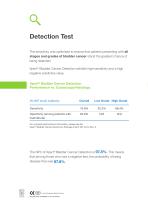
The sensitivity was optimised to ensure that patients presenting with all stages and grades of bladder cancer stand the greatest chance of being detected. Xpert® Bladder Cancer Detection exhibits high sensitivity and a high negative predictive value. Xpert® Bladder Cancer Detection Performance vs. Cystoscopy/Histology (N=897 study subjects) Overall Low Grade High Grade Specificity (among patients with 84.6% N/A N/A haematuria) For complete performance information, please see the Xpert® Bladder Cancer Dectection Package Insert: 301-2414, Rev. A The NPV of Xpert® Bladder Cancer Detection is 97.8%....
Open the catalog to page 8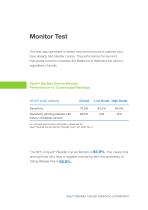
This test was optimised to detect recurrent tumours in patients who have already had bladder cancer. The performance for low and high grade tumours increases the likelihood of detecting the tumour regardless of grade. Xpert® Bladder Cancer Monitor Performance vs. Cystoscopy/Histology (N=257 study subjects) Overall Low Grade High Grade Specificity (among patients with 80.6% N/A N/A history of bladder cancer) For complete performance information, please see the Xpert® Bladder Cancer Monitor Package Insert: 301-5933, Rev A The NPV of Xpert® Bladder Cancer Monitor is 93.9%. This means that among...
Open the catalog to page 9
What Do I Need to Do Next? The test is very simple for you and your patient. All the patient needs to do is provide a urine sample. Obtain a urine sample of at least 4.5mL in the primary collection cup. Use the disposable transfer pipette provided in the Xpert Urine Transport Reagent kit in the pouch with the tube. Invert cup 3 times to mix the urine. Obtain one Xpert® Urine Transport Reagent kit. Insert the transfer pipette into the bottom of the urine cup. Transfer approximately 4.0mL of urine so that the volume reaches the black line on the tube label. NOTE: Do not use the pipette from the...
Open the catalog to page 10
Remember Order a Detection test if… Xpert® Bladder Cancer Detection …you have a patient present with haematuria whom you suspect may have bladder cancer, but has no previous history of bladder cancer Order a Monitor test if… Xpert® Bladder Cancer Monitor …you have a previously diagnosed bladder cancer patient and you want to know if the cancer has recurred + use molecular testing to help drive my patients’ treatment plans. Leal et al. Eur Urol. 2016 Mar;69(3): 438-472. Burger M, Catto JW, Dalbagni G, Grossman HB, Herr H, Karakiewicz P, Kassouf W, Kiemeney LA, La Vecchia C, Shariat S, Lotan Y....
Open the catalog to page 11All Cepheid catalogs and technical brochures
 Xpert® Xpress Flu/RSV 2023
4 Pages
 GeneXpert® Infinity Systems
8 Pages
 The New GeneXpert®
12 Pages
 Cepheid Virology Brochure
4 Pages
 Xpert® Breast Cancer STRAT4
4 Pages
 Xpert® HIV-1 Viral Load
4 Pages
 Xpert® HIV-1 Qual
4 Pages
 Xpert® HCV Viral Load
4 Pages
 Xpert® FII & FV
4 Pages
 Xpert® HBV Viral Load
4 Pages
 Xpert® HPV
4 Pages
 Xpert® TV
4 Pages
 Xpert® MTB/RIF Ultra
4 Pages
 Xpert® Xpress Strep A
4 Pages
 Xpert® Norovirus
4 Pages
 GeneXpert® System
12 Pages
 Xpert® BCR-ABL Ultra
4 Pages
 Xpert® CT/NG
6 Pages
 Xpert® MRSA/SA BC
4 Pages


Archived catalogs
 Xpert® Carba-R
4 Pages
 Xpert® C. difficile BT
4 Pages
 Xpert® EV
3 Pages
 Xpert® SA Nasal Complete
4 Pages
 Xpert® vanA/vanB
4 Pages
 Xpert® Ebola
4 Pages
 Xpert® MRSA NxG
4 Pages
 Cepheid Corporate Overview
16 Pages
 Xpert® MTB/RIF
4 Pages
 Xpert® GBS
3 Pages
 Xpert® MRSA/SA SSTI
4 Pages
 Xpert® MRSA
2 Pages

- Cepheid test kit
- Blood detection kit
- Plasma detection kit
- Cepheid rapid blood test
- Infectious disease detection kit
- Rapid serum test
- Rapid plasma test
- Cepheid rapid virus test
- Cepheid molecular biology test kit
- Rapid whole blood test
- Respiratory disease assay kit
- Cepheid rapid infectious disease test
- Clinical detection kit
- Rapid respiratory disease test
- Urine rapid diagnostic test
- Reporting software
- Windows software
- Laboratory software
- Cepheid rapid bacteria test
- Cell detection kit