
- Catalogs
- Charles River Laboratories
- Celsis® ATP-bioluminescence


Celsis® ATP-bioluminescence

Celsis® ATP-bioluminescence
Abstract: This document presents a case study comparing the standard ATP metabolite reaction with the amplified Celsis AMPiScreen® reaction, which reduces microbial hold times to 18-24 hours for microbial limits testing.
Situation: Pharmaceutical and personal care product manufacturers must perform contamination testing to ensure product safety. Traditional ATP bioluminescence is a sensitive method for quality control, but companies seek faster alternatives that can detect non-microbial ATP in various products.
Solution: The Celsis AMPiScreen® assay amplifies ATP bioluminescence, achieving results up to 50% faster than standard methods. It uses an enzyme-catalyzed reaction to enhance ATP detection, reducing time to results to as little as 18 hours for bacteria and 24 hours for yeasts and molds.
How It Works: The AMPiScreen® method amplifies ATP beyond the sample's inherent levels using a proprietary combination of enzymes, extractants, and buffers. This increases the bioluminescent signal, enhancing assay sensitivity and reducing time to results.
Results: Companies using amplified ATP technology benefit from shorter release times and improved quality control. For example, a healthcare product manufacturer identified contamination in raw materials, preventing potential health risks. Products with natural ingredients, which may contain non-microbial ATP, also benefit from this method, as it reduces false positives and improves detection accuracy.
Conclusion: The Celsis AMPiScreen® assay is an effective tool for rapid microbial detection, allowing companies to release safe products to market more quickly.
Catalog excerpts

Enzyme Technology: How Amplifying the ATP Bioluminescence Reaction Produces Faster Time to Results Key Points: • An amplified ATP bioluminescence reaction achieves results 50% faster than standard ATP assay. This case study compares the standard adenosine The Celsis AMPiScreen® assay is an amplified version of triphosphate (ATP) metabolite reaction with the amplified ATP bioluminescence that works up to 50% faster. ATP reaction of Celsis AMPiScreen®, which can reduce microbial drives the reaction that produces light, which is, in turn, hold times to 18-24 hours for microbial limits testing. measured by a luminometer. ATP is present in all living • Detection is possible in as little as 18 hours for bacteria and 24 hours for yeasts and molds. • Reaction is not constrained by the finite amount of metabolic ATP available. • Increased assay sensitivity achieves a stronger signal in less time. Situation Leading pharmaceutical companies, as well as home and beauty product manufacturers around the world, are required to perform contamination testing to release their products safely to the market. In controlled manufacturing environments, these sterile and non-sterile products rarely generate positive results when screened for contamination, and thus rarely yield any counts to enumerate, so a simple cells as the transport molecule for most cell metabolic processes, including protein synthesis, replication, and motility. If microbial contamination is present, the reaction moves forward. Unlike traditional methods, which require 3-7 days of incubation to achieve visible growth, the standard ATP assay reduces time to detection to 24 hours for bacteria and 48 hours for fungi. Amplifying ATP gets results even faster. absence/presence test is all that is needed. The gold Definitive detection is based on having a sufficient quantity standard of easy-to-use, reliable rapid microbial methods of microbial ATP present to generate a clear, detectable light is ATP bioluminescence, a very sensitive technique already signal. The AMPiScreen® assay uses an enzyme-catalyzed widely accepted and broadly used for quality control testing. reaction to overcome this limitation, thus reducing time to However, companies are looking to find alternative methods results for microbial contamination testing to as few as 18 that lead to increased time savings and better product hours for general detection of bacteria and 24 hours for compatibility, and have the ability to detect in the presence yeast and mold. This is 25-50% faster than the already- of non-microbial ATP for their raw materials, in-process and rapid standard ATP method and 80% faster than traditional finished goods.
Open the catalog to page 1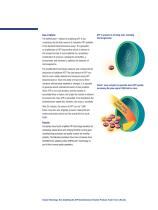
How It Works The AMPiScreen method of amplifying ATP is not ® ATP is present in all living cells, including microorganisms. constrained by the finite amount of metabolic ATP available in the standard bioluminescence assay. The generation or amplification of ATP beyond that which is inherent in the assayed sample is accomplished via a proprietary combination of enzymes, extractants and buffers, a luminometer, and software to optimize the detection of microorganisms. The amplification technology catalyzes and compounds the production of additional ATP The total amount of ATP can . then be more...
Open the catalog to page 2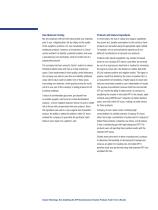
Products with Natural Ingredients Not all companies will test their inbound bulk raw materials In recent years, the use of natural and organic ingredients prior to use, mitigating their risk by relying on the quality has grown and, despite assumptions to the contrary, these of the supplier’s practices. For one manufacturer of products can be tested using the appropriate rapid method. healthcare products, however, an investment in a Celsis® To illustrate, we’ve summarized the experience of four system enabled it to identify a potential problem and issue different manufacturers of personal care...
Open the catalog to page 3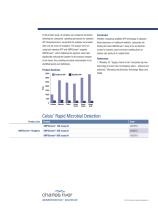
In the product study, all samples were prepared and tested following the companies’ operating procedures for standard Whether comparing amplified ATP technology to standard ATP bioluminescence, except that the samples were tested bioluminescence or traditional methods, companies are after only 24 hours of incubation. The assays were run finding the Celsis AMPiScreen® assay to be an effective using both standard ATP and AMPiScreen reagents. screen for bacteria, yeast and mold, enabling them to AMPiScreen , which optimizes the signal-to-noise ratio, release safe products to market faster. significantly...
Open the catalog to page 4All Charles River Laboratories catalogs and technical brochures
 Endosafe® Nexus 200™
4 Pages
 Endosafe® nexgen-MCS™
3 Pages
 EndoScan-V™
4 Pages
 Celsis AMPiScreen® reagent
3 Pages
 Celsis Advance II™
3 Pages
 Celsis Accel®
3 Pages

- Detection kit
- Solvent reagent
- Immunoassay detection kit
- Laboratory reagent
- Analysis software
- Infectious disease detection kit
- Enzyme reagent
- Sample tube
- Laboratory test tube
- Buffer solution reagent
- Control software
- Quality control reagent
- ELISA detection kit
- Reporting software
- Laboratory software
- Bacteria reagent
- IgG assay kit
- Monitoring software
- Cell detection kit
- Hospital software