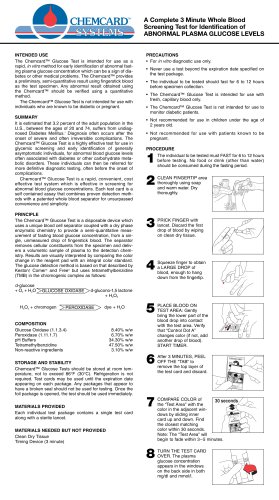
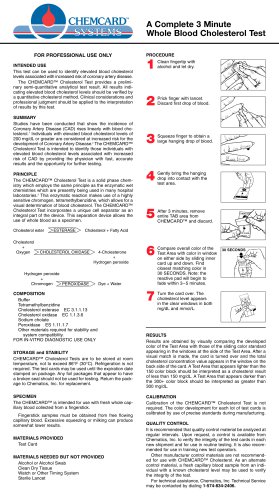
Chemcard™ Cholesterol Test - Self Testing
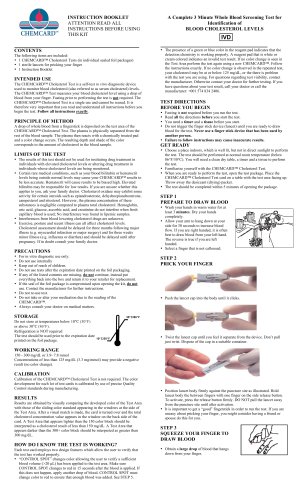
Chemcard™ Cholesterol Test - Self Testing
The kit includes CHEMCARD™ Cholesterol Tests, a sterile lancet, and an instruction booklet.
The CHEMCARD™ Cholesterol Test is designed for self-monitoring of blood cholesterol levels using a fingerstick blood sample. It is a single-use test that does not require fasting.
A drop of blood is applied to the test area, where plasma is separated and reacts with a chemically treated pad, resulting in a color change that indicates cholesterol levels.
The test should not be used to initiate or alter drug treatments. Accuracy may be affected by certain medical conditions, exercise, posture, and recent illness.
For in vitro diagnostic use only. Do not use internally or after the expiration date. Keep out of reach of children and do not reuse the test.
Store between 10°C and 30°C. Refrigeration is not required.
The test is effective for cholesterol levels between 150 - 300 mg/dL.
No calibration is required as each lot is calibrated during manufacturing.
Results are obtained by matching the test area color with a color standard. Cholesterol levels are indicated on the back of the card.
Follow a series of steps to prepare, draw blood, apply it to the test area, and interpret results. Ensure the control spot changes color to verify sufficient blood volume.
Results categorize cholesterol levels as Desirable, Borderline-High, or High, with corresponding health risk levels.
Includes information on cholesterol, test accuracy, and tips for blood drawing and color matching.
Self-testing can help monitor cholesterol levels, especially when combined with diet and exercise.
Discusses the impact of other health factors like high blood pressure and smoking on heart disease risk.
Data from self-tests conducted by 227 untrained volunteers showed:
- 90.7% accurately determined their cholesterol level within one color block compared to laboratory tests.
- Diagnostic sensitivity was 92.4%, and specificity was 81.3%.
- There were 28 incorrect diagnoses, including 18 false positives and 10 false negatives.
The document mentions the UNISTIK-2 lancet, but no specific details or data are provided.
Catalog excerpts

INSTRUCTION BOOKLET ATTENTION READ ALL INSTRUCTIONS BEFORE USING THIS KIT CONTENTS The following items are included: • 1 CHEMCARD™ Cholesterol Tests (in individual sealed foil packages) • 1 sterile lancets for pricking your finger • 1 Instruction Booklet INTENDED USE The CHEMCARD™ Cholesterol Test is a self-test in vitro diagnostic device used to monitor blood cholesterol (also referred to as serum cholesterol) levels. The CHEMCARD™ Test measures your blood cholesterol level using a drop of blood from your finger. Fasting prior to performing the test is not required. The CHEMCARD™ Cholesterol Test is a single use and cannot be reused. It is therefore very important that you read and understand all instructions before you begin the test. Follow all instructions exactly. PRINCIPLE OF METHOD A drop of whole blood from a fingerstick is deposited on the test area of the CHEMCARD™ Cholesterol Test. The plasma is physically separated from the rest of the blood sample. The plasma then reacts with a chemically treated pad and a color change occurs. The resulting depth and shade of the color corresponds to the amount of cholesterol in the blood sample. LIMITS OF THE TEST • The results of this test should not be used for instituting drug treatment in individuals with elevated cholesterol levels or altering drug treatment in individuals whose cholesterol levels are being monitored. • Certain rare medical conditions, such as your blood bilirubin or hematocrit levels being outside normal levels may cause your CHEMCARD™ results to be less accurate. Hematocrit will cause results to be biased high. Elevated bilirubin may be responsible for low results. If you are unsure whether this applies to you, ask your family doctor. Cholesterol oxidase may exhibit some activity for certain steroids such as epiandrosterone, dehydroepiandrosterone, campesterol and sitosterol. However, the plasma concentration of these substances is negligible compared to plasma total cholesterol. Hemoglobin, uric acid, glucose, ascorbic acid, and creatinine do not interfere when fresh capillary blood is used; No interference was found in lipemic samples. • Interferences from blood lowering cholesterol drugs are unknown. • Exercise, posture and recent illness can all affect cholesterol levels. Cholesterol assessment should be delayed for three months following major illness (e.g. myocardial infarction or major surgery) and for three weeks minor illness (e.g. influenza or diarrhea) and should be delayed until after pregnancy. If in doubt consult your family doctor. For in vitro diagnostic use only. Do not use internally Keep out of reach of children. Do not use tests after the expiration date printed on the foil packaging. If any of the listed contents are missing, do not continue, instead put everything back into the box and return it to your retailer for replacement. If the seal of the foil package is compromised upon opening the kit, do not use. Contact the manufacturer for further instructions. Do not re-use test. Do not take or alter your medication due to the reading of the CHEMCARD™. Always consult your doctor on medical matters. A Complete 3 Minute Whole Blood Screening Test for Identification of BLOOD CHOLESTEROL LEVELS • The presence of a green or blue color in the reagent pad indicates that the detection chemistry is working properly. A reagent pad that is white or cream colored indicates an invalid test result. If no color change is seen in the Test Area perform the test again using a new CHEMCARD™. Follow the instructions exactly. If no color change is observed in the repeated test, your cholesterol may be at or below 125 mg/dL, or the there is problem with the test you are using. For questions regarding test viability, contact the manufacturer. Otherwise contact your doctor for further testing. If you have questions about your test result, call your doctor or call the manufacturer: +001 574 834 2406. TEST DIRECTIONS BEFORE YOU BEGIN Fasting is not required before you run the test. Read all the directions before you start the test. You need a timer and a tissue before you start. Do not trigger the finger stick device (lancet) until you are ready to draw blood for the test. Never use a finger stick device that has been used by another person. • Failure to follow instructions may cause inaccurate results. • • • • • Choose a place indoors, which is well lit, but not in direct sunlight to perform the test. The test should be performed at normal room temperature (below 86°F/30°C). You will need a clean dry table, a timer and a tissue to perform the test. • Familiarize yourself with the CHEMCARD™ Cholesterol Test. • When you are ready to perform the test, open the test package. Place the CHEMCARD™ Cholesterol Test card on a table with the test area facing up. Throw away the desiccant (drying) packet. • The test should be completed within 5 minutes of opening the package. STEP 1 PREPARE TO DRAW BLOOD • Wash your hands in warm water for at least 3 minutes. Dry your hands completely. • Allow your arm to hang down at your side for 30 seconds to increase blood flow. If you are right handed, it is often best to draw blood from your left hand. The reverse is true if you are left handed. • Select a finger that is not calloused. STEP 2 PRICK YOUR FINGER • Push the lancet cap into the body until it clicks. STORAGE Do not store at temperatures below 10°C (50°F) or above 30°C (86°F). Refrigeration is NOT required The test should be used prior to the expiration date printed on the foil package. • Twist the lancet cap until you feel it separate from the device. Don’t pull just twist. Dispose of the cap in a suitable container. WORKING RANGE 150 - 300 mg/dL or 3.9- 7.8 mmol Concentrations of less than 125 mg/dL (3.3 mg/mmol) may provide a negative result (no color change). CALIBRATION Calibration of the CHEMCARD™ Cholesterol Test is not required. The color development for each lot of test cards is calibrated by use of precise Quality Control standards during manufacturing. RESULTS Results are obtained by visually comparing the developed color of the Test Area with those of the sliding color standard appearing in the windows at the side of the Test Area. After a visual match is made, the card is turned over and the total cholesterol concentration value appears in the window on the back side of the card. A Test Area that appears lighter than the 150 color block should be interpreted as a cholesterol result of less than 150 mg/dL. A Test Area that appears darker than the 300+ color block should be interpreted as greater than 300 mg/dL. HOW DO I KNOW THE TEST IS WORKING? Each test card employs two design features which allow the user to verify that the test has worked properly. • “CONTROL SPOT” changes color allowing the user to verify a sufficient blood volume (>20 µL) has been applied to the test area. Make sure CONTROL SPOT changes to red in 15 seconds after the blood is applied. If this does not happen, apply another drop of blood. CONTROL SPOT must change color to red to ensure that enough blood was added. See STEP 5. • Position lancet body firmly against the puncture site as illustrated. Hold lancet body the between fingers with one finger on the side release button. To activate, press the release button firmly. DO NOT pull the lancet away from the puncture site until after activation. • It is important to get a “good” fingerstick in order to run the test. If you are uneasy about pricking your finger, you might consider having a friend or spouse do this for you.
Open the catalog to page 1All Chematics catalogs and technical brochures
 Alco-Screen™ 02
1 Page
 Alco-Screen™
1 Page