

Case-Study-AM-Zorggroep-Limburg_HRES
Case-Study-AM-Zorggroep-Limburg_HRES
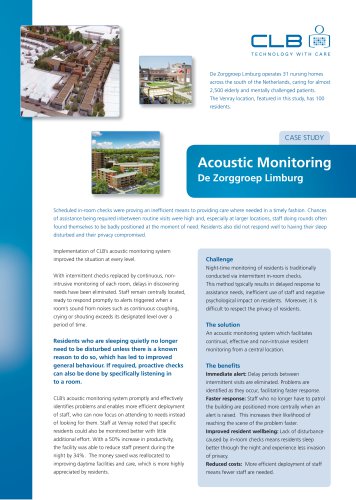
Traditional night-time monitoring of residents involves intermittent in-room checks, leading to delayed responses, inefficient staff use, and negative psychological impacts on residents. Privacy concerns are also prevalent.
An acoustic monitoring system enables continuous, effective, and non-intrusive monitoring from a central location.
- Immediate Alert: Eliminates delays between visits, allowing for faster problem identification and response.
- Faster Response: Staff are centrally located, increasing their ability to respond quickly to alerts.
- Improved Resident Wellbeing: Reduces disturbances from in-room checks, enhancing sleep and privacy.
- Reduced Costs: Efficient staff deployment reduces the number of staff needed.
CLB's acoustic monitoring system replaces intermittent checks with continuous monitoring, eliminating delays in discovering needs. Staff remain centrally located, ready to respond to alerts triggered by specific sounds exceeding designated levels. This system improves general resident behavior and allows for proactive checks by listening in when necessary.
The system has increased productivity by 50% and reduced night staff by 34%, reallocating savings to improve daytime facilities and care. Specific residents can be monitored with minimal effort, enhancing care quality.
In-room monitoring units connect to on-site hubs linked to CLB's central system. Each location has a per-ward monitoring client for local management. Alerts are routed to mobile handsets and fixed screens, allowing staff to listen and communicate with rooms.
- Alerts can be relayed via mobile communication methods like WiFi Messenger or the CLB smart Phone app.
- The system is prepared for 3rd Generation acoustic monitoring, recognizing specific sound categories to increase alertness and reduce false alarms.
- Mental Healthcare
- Elderly Care
- Neo-natal (intensive) care units
- Unicare & UniControl Call Screen
- Controller
- Room module
- 3rd party Dect telephone & messaging system
With appropriate procedures, the system does not raise privacy issues. In-room indicators inform patients of monitoring, and when explained correctly, clients appreciate the balance between care and privacy.
Catalog excerpts
De Zorggroep Limburg operates 31 nursing homes across the south of the Netherlands, caring for almost 2,500 elderly and mentally challenged patients. The Venray location, featured in this study, has 100 residents. case study Acoustic Monitoring De Zorggroep Limburg Scheduled in-room checks were proving an inefficient means to providing care where needed in a timely fashion. Chances of assistance being required inbetween routine visits were high and, especially at larger locations, staff doing rounds often found themselves to be badly positioned at the moment of need. Residents also did not respond well to having their sleep disturbed and their privacy compromised. Implementation of CLB’s acoustic monitoring system improved the situation at every level. Challenge Night-time monitoring of residents is traditionally With intermittent checks replaced by continuous, non- conducted via intermittent in-room checks. intrusive monitoring of each room, delays in discovering This method typically results in delayed response to needs have been eliminated. Staff remain centrally located, assistance needs, inefficient use of staff and negative ready to respond promptly to alerts triggered when a psychological impact on residents. Moreover, it is room’s sound from noises such as continuous coughing, difficult to respect the privacy of residents. crying or shouting exceeds its designated level over a period of time. The solution An acoustic monitoring system which facilitates Residents who are sleeping quietly no longer need to be disturbed unless there is a known reason to do so, which has led to improved general behaviour. If required, proactive checks can also be done by specifically listening in to a room. continual, effective and non-intrusive resident monitoring from a central location. The benefits Immediate alert: Delay periods between intermittent visits are eliminated. Problems are identified as they occur, facilitating faster response. CLB’s acoustic monitoring system promptly and effectively Faster response: Staff who no longer have to patrol identifies problems and enables more efficient deployment the building are positioned more centrally when an of staff, who can now focus on attending to needs instead alert is raised. This increases their likelihood of of looking for them. Staff at Venray noted that specific reaching the scene of the problem faster. residents could also be monitored better with little Improved resident wellbeing: Lack of disturbance additional effort. With a 50% increase in productivity, caused by in-room checks means residents sleep the facility was able to reduce staff present during the better through the night and experience less invasion night by 34%. The money saved was reallocated to improving daytime facilities and care, which is more highly Reduced costs: More efficient deployment of staff means fewer staff are need
Open the catalog to page 1
Marc Denton, Care Communication Advisor, Venlo In-room monitoring units feed in to multiple on-site hubs, which are connected to CLB's central system. Each location has a per-ward monitoring client, which allows local staff to manage their own part of system. Local staff activate the acoustic monitoring as they arrive on shift at night and deactivate it in the morning. Monitoring can be activated per ward or individually per patient. Alerts are routed to mobile handsets and various fixed screens, both enable staff to listen in and talk back into the rooms. The system can also be used during the...
Open the catalog to page 2All CLB bv catalogs and technical brochures
 PS-C1600_NC_AM-Module
2 Pages
 PS-C1610_Single_AM-Module
2 Pages
 Acoustic_Monitoring_HRES
2 Pages
 Case-study-Treloars
2 Pages
 Case-Study-Abbey-Delray
2 Pages