
- Catalogs
- Copley Scientific
- Copley-Inhaler-Testing-Brochure


Copley-Inhaler-Testing-Brochure

Copley-Inhaler-Testing-Brochure
Copley Scientific Limited, founded in 1946, specializes in manufacturing inhaler test equipment. The company emphasizes high-quality pharmaceutical testing equipment, expert training, and lifetime support, adhering to Quality by Design (QbD) principles and ISO 9001:2015 certification.
Orally inhaled and nasal drug products (OINDPs) include metered-dose inhalers (MDIs), dry powder inhalers (DPIs), nebulisers, and nasal sprays. These devices offer rapid action and fewer side effects for local and systemic therapy via the lungs or nasal mucosa.
- Metered-Dose Inhalers (MDIs): Use a propellant for aerosol delivery, requiring coordination.
- Dry Powder Inhalers (DPIs): Deliver medication in powder form, relying on inhalation strength.
- Aqueous Droplet Inhalers: Propellant-free, delivering a soft mist.
- Nebulisers: Aerosolize liquid formulations, requiring minimal coordination.
- Nasal Sprays: Used for systemic drug delivery in liquid or powder forms.
Products comply with global pharmacopoeias and regulatory standards, ensuring data integrity and product reliability. Key regulatory bodies include the EMA and FDA.
Copley offers testing equipment for inhalers, including Delivered Dose Uniformity (DDU) and Aerodynamic Particle Size Distribution (APSD) tools, along with impactors for detailed performance analysis.
Automation tools enhance testing efficiency, and qualification services ensure equipment accuracy and compliance with pharmacopoeial criteria.
Copley Scientific Limited is committed to advancing inhaler testing technology, providing reliable solutions to meet pharmaceutical industry needs.
The FDA manages regulation through CDER and CDRH, providing guidelines for MDIs and DPIs. International harmonization efforts include ICH guidelines supporting a new Pharmaceutical Quality System (PQS).
Pharmacopoeias define medicine standards, with the European Pharmacopoeia and USP providing guidelines for inhalation products.
ISO sets standards for medical devices, including inhalers and nebulisers.
Challenges include changes in drug delivery devices and regulatory requirements, with critical quality attributes like delivered dose and particle size distribution being crucial.
The document outlines procedures for delivered dose testing of inhalers, emphasizing the importance of consistent drug emission and adherence to pharmacopoeial standards.
The USP specifies air volume sampling limits and the use of Breath Actuation Controllers for testing.
Testing systems require components like Mouthpiece Adapters, Vacuum Pumps, and Flow Meters.
Involves sampling at specific flow rates, with critical flow controllers ensuring accurate conditions.
Captures aerosol emissions from inhalers, integrating with the DUSA system.
Effectiveness depends on drug delivery rate and particle size, with guidelines provided by the EMA and pharmacopoeias.
Describes testing nebulisers and inhalers using breathing simulators, with procedures for generating specific breathing patterns and collecting active drug on filters.
Facemask testing assesses drug delivery in infants and small children, using standardized methods.
Simulates patient tidal breathing to determine drug delivery efficiency.
Provides patterns for different age groups to ensure accurate simulation during testing.
Holds spacers/VHCs and facemasks in place during testing, with adjustable features.
Supports different age models with replaceable face skins for testing.
APSD is a critical quality attribute, with cascade impactors measuring particle size distribution.
Include components like mouthpiece adapters and vacuum pumps, separating particles into size bands.
Cascade impactors operate on inertial impaction, with stages collecting particles based on aerodynamic diameter.
Selection depends on product requirements and geographical location, with the ACI being widely used.
An 8-stage impactor for measuring APSD, complying with USP and Ph.Eur. standards.
A high-performance impactor with seven stages, designed for flexibility and productivity.
A 4-stage impactor for inhaler testing, reducing re-entrainment issues.
ACIs are subject to rigorous quality control, ensuring compliance with standards.
The NGI meets Ph.Eur. and USP specifications, with a particle size range of 0.24 – 11.7 microns.
The NGI is user-friendly, electrically conductive, and designed for easy automation.
Involves setting up the NGI, performing a leak test, and collecting samples for analysis.
Include components like mouthpiece adapters and data analysis software for a fully operational test system.
Outlines tests for APSD of these devices, including optimal and worst-case conditions.
Highlights the importance of facemask performance and recommends using a Facemask Test Apparatus for realistic APSD measurements.
Categorizes nasal technologies and stresses the importance of quantifying fine particle doses.
Describes the use of the NGI Cooler to prevent evaporation during testing.
Discusses the FDA's PAT initiative and QbD principles, emphasizing APSD as a critical quality attribute.
Cascade impactors measure APSD, requiring skilled analysts to avoid errors.
Simplifies measurement by using fewer stages of the ACI, focusing on key metrics.
Speeds up testing and reduces errors by using a reduced number of impactor stages.
Offers fast screening of new formulations, linking in vitro and in vivo performance.
Expected to enhance formulation screening efficiency in early development phases.
A modified version of the ACI for AIM, matching product's MMAD for efficient testing.
An abbreviated method for using the NGI in AIM applications.
Designed for AIM-HRT applications, separating doses into Coarse and Fine Particle Mass.
Proposes strategies to enhance IVIVC, including using anatomically accurate models and realistic breathing profiles.
Offers a realistic representation of the human mouth and throat for testing.
Allows decoupling of flow rates between the inhaler and impactor for accurate measurement.
Replace constant flow rate conditions with realistic breathing profiles, improving IVIVCs.
Details three models of breathing simulators, each varying in volume capacity and waveform capabilities.
Include components like mouthpiece adapters and cascade impactors for a fully operational test system.
Outlines procedures for testing nebulisers and MDIs with spacers/VHCs according to standards.
CITDAS software is used for processing cascade impactor data, offering a user-friendly interface.
Highlights the importance of breathing simulators in improving IVIVCs and the role of QbD in method development.
Outlines equipment for DPI testing, including Breathing Simulator Model BRS 3100 and Critical Flow Controllers.
Involves using a 2-way switching valve and vacuum pump to replicate inhalation cycles.
Emphasizes the importance of stable flow rates for accurate DPI testing.
Incorporate features like differential pressure meters and flow control valves for managing test conditions.
Provides guidelines for DPI testing, emphasizing realistic patient conditions and stable flow rates.
Details the TPK 2100 and BAC 2100 systems for inhaler testing, focusing on specifications and procedures.
The TPK 2100 ensures tests are conducted under sonic flow conditions, with data output capabilities.
Guides users through test set-up procedures, supporting both inline and inlet flow meter methods.
Provides detailed test reports, including environmental conditions and calibration data.
Emphasizes the importance of accurate flow rates in testing inhalers.
The TPK 2100 and BAC 2100 systems offer precise control and comprehensive reporting for inhaler testing.
Outlines the procedure for measuring flow rates in inhaler testing, specifying target flow accuracy.
Custom adapters ensure an airtight seal between the inhaler and test apparatus.
Describes Copley Low and High Capacity Pumps for inhaler testing, designed for easy integration.
CITDAS Version 3.10 standardizes the analysis of aerodynamic size distribution of drug output from inhalers.
- Streamlined data input and customizable user setup.
- Automatic calibration data application and graphical representation of test results.
- Improved accuracy and expanded mass balance calculations.
- Dissolution Testing: Focuses on drug delivery and lung deposition.
- Generic Drug Development: Reintroduction of test methods for generic OIPs.
- Cold Freon® Effect: Instruments to quantify aerosol spray force and plume temperature.
- NGI Dissolution Cup and Membrane Holder for size-fractionated particle testing.
Emphasizes the role of CITDAS V3.10 in enhancing inhaler testing data analysis accuracy and efficiency.
Discusses the use of ACI and NGI for drug testing, with simulated lung fluids mimicking lung conditions.
Five types of SLFs simulate different lung conditions and interactions.
Guidance for demonstrating bioequivalence for active ingredients, streamlining generic drug development.
USP monographs specify equipment and methods for testing drugs like Fluticasone Propionate.
Details equipment required for testing inhalers, emphasizing standardized equipment use.
Highlights the importance of testing spray force and plume temperature for therapeutic equivalence.
Describes the process for coating NGI cups, including dispensing, draining, and drying cycles.
Facilitates sample recovery by dissolving active drugs in solvent with gentle agitation.
Provides means of recovering active drugs from induction ports with variable speed control.
Utilizes ultrasonic baths for cleaning, ensuring consistent procedures.
Performance affected by parameters like shaking speed and firing force, requiring systematic investigation.
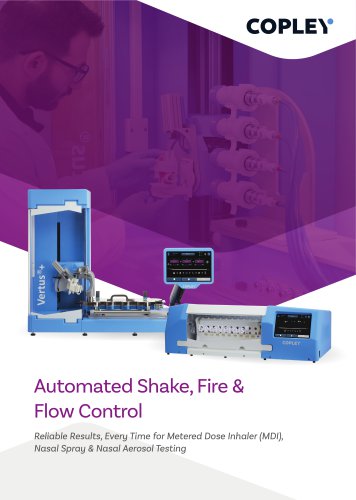
A fully automated shake and fire system for precise MDI testing.
Incorporates an integrated weighing balance for automatic shot weight measurement.
A high-throughput system for Dose Content Uniformity testing of MDIs.
Automates nasal spray testing, addressing variability issues.
Automated systems enhance inhaler testing efficiency and reliability, meeting regulatory requirements.
DecaVertus II supports LAN connectivity and includes accessories for MDIs.
Documentation and kits available for qualification and maintenance.
Automates sample recovery from NGI, reducing human error.
Emphasizes the importance of proper qualification and validation procedures.
Lists potential impactor-related issues and emphasizes addressing them for accurate results.
Ensures inhaler testing system reliability through proper qualification.
Measures nozzle diameters to ensure compliance with standards.
Regular cleaning prevents deposit accumulation affecting particle size distribution.
Uses Effective Diameter and In-Use Margin to assess impactor suitability.
Cleaning and pinning can restore performance if ED is too small.
Regular leak testing ensures seal integrity.
Regular mensuration and cleaning are critical for maintaining performance.
Discusses challenges posed by static electricity in inhaler testing.
Offers services like leak testing and Cut-Point Particle Calibration.
Provides design solutions and service contracts for maintenance and calibration.
Offers tailored training packages for analysts and lab managers.
Ensures customer support from purchase through to after-sales.
Catalog excerpts

Driving Results in Inhaler Testing METERED-DOSE INHALERS • DRY POWDER INHALERS NEBULISERS • NASAL SPRAYS 2020 EDITIO
Open the catalog to page 1
Inhaler Testing About Us Copley: Driving Results for Over 70 Years Founded in 1946 in Nottingham, UK, Copley remains family owned and managed. We are recognised as the world’s leading manufacturer of inhaler test equipment, in addition to being a trusted provider of test instrumentation for other pharmaceutical dosage forms. We continue to work closely with industry groups and leading experts to bring relevant new products to market, with all equipment backed by expert training and lifetime support. These commitments are exemplified by our investment in the ISO 9001:2015 Quality Management System...
Open the catalog to page 2
The Copley Promise Innovative Innovative product design features ensure ease-of-use and maximum productivity by streamlining work flows. Compliant Products are certified to quality standards defined by global pharmacopoeias and regulators, ensuring data integrity. Trusted Robust design and manufacture from a company with over 70 years’ experience guarantees product reliability and longevity.
Open the catalog to page 3
Inhaler Testing Device Safety, Quality and Modified Configurations for use at 60 and 90 L/min ISO 9001:2015 Quality Management System International Standards Organisation (ISO) Expert Groups Next Generation Impactor (NGI) Current Pharmacopoeial Specifications 19 Delivered Dose Aerodynamic Particle Size Distribution (APSD) Multi-Stage Liquid Impinger (MSLI) European Pharmacopoeia (Ph.Eur.) Glass Twin Impinger (GTI) Impactors for testing: MDIs with Spacers and VHCs Nasal Delivery Systems Abbreviated Impactor Measurement (AIM) Table of Contents Equipment Selection Guide Inhaled Drug Products Pharmacopoeial...
Open the catalog to page 4
Flow Meters Analytical Errors Instrument-Related Errors Flow Meter Model DFM4 Flow Meter Model DFM 2000 Labour Saving Tools - Delivered Dose Uniformity Pharmacopoeial Criteria Mouthpiece Adapters DUSA Shaker Stage Mensuration Vacuum Pumps Labour Saving Tools - Cup Coating (NGI) High Capacity Pump HCP5 Restoring Performance Super Capacity Pump SCP5 Labour Saving Tools - Sample Preparation (ACI & NGI) Gentle Rocker Qualification Documentation IQ/OQ Documentation Data Analysis Software CITDAS Sample Preparation Unit SPU 2000 Spare Tubing Labour Saving Tools - Impactor Cleaning (ACI & NGI) Quick-Release...
Open the catalog to page 5
Equipment Selection Guide Equipment Selection Guide Metered-Dose Inhaler (MDI)* Nasal Spray (Aqueous) DUSA for DPIs (Page 28) Filter Holder & Adapter (Page 32) N/A (Direct into Vial/Flask) Mouthpiece Adapter (Page 90) Mouthpiece Adapter (Page 90) Mouthpiece Adapter (Page 90) Vacuum Pump (Page 91) Vacuum Pump (Page 91) Breathing Simulator (Page 75) Flow Meter (Page 88) Critical Flow Controller (Page 80) Waste Shot Collector (Page 31) Flow Meter (Page 88) Breath Actuation Controller (Page 86) - Option Waste Shot Collector (Page 31) Cascade Impactor: Cascade Impactor: Delivered Dose Uniformity (DDU)...
Open the catalog to page 6
Inhaled Drug Products Inhaled Drug Products Introduction The devices used for inhaled and nasal drug delivery are collectively referred to as orally inhaled and nasal drug products (OINDPs). The range of products available is broad, encompassing inhalers (metered-dose, dry powder and aqueous droplet), nebulisers (jet, ultrasonic and vibrating mesh) and nasal sprays (aqueous based, dry powder and propellant based). larger particles, for example lactose, to which it attaches. During aerosolisation the active is stripped from the carrier and inhaled whilst the carrier particles impact on the mouth...
Open the catalog to page 7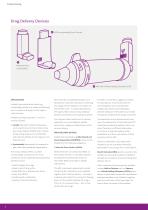
Inhaler Testing Drug Delivery Devices MDI incorporating Dose Counter MDI with Valved Holding Chamber (VHC) APPLICATIONS Inhaled drug products are becoming increasingly popular as a means of delivering local or systemic therapy via the lungs or nasal mucosa. Inhalation therapy has been in use for a number of years: a) Locally (directly) to treat lung diseases such as asthma and chronic obstructive pulmonary disease (COPD), and to deliver locally acting drugs such as antibiotics and antivirals directly to the lungs to curb infection, and b) Systemically (absorption), for example in pain relief...
Open the catalog to page 8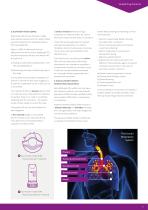
Inhaled Drug Products 2. Dry Powder Inhalers (DPIs) Historically, the DPI was limited to single dose capsule systems and the inhaler market was dominated by the chlorofluorocarbon (CFC) propelled MDI. When, in 1997, the Montreal Protocol effectively banned the ozone depleting CFCs, the pharmaceutical industry was faced with the option of: a) Finding an alternative propellant (as in the HFA propelled MDI), or b) Developing new ways of delivering drug to the lungs It is the latter that provided a resurgence of interest in the DPI. As the name suggests, in the DPI the medication comes in the form...
Open the catalog to page 9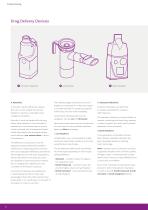
Inhaler Testing Drug Delivery Devices Ultrasonic Nebuliser 4. Nebulisers A nebuliser may be defined as a device that can convert a liquid into aerosol droplets to produce a respirable cloud suitable for inhalation. Normally it must be loaded with the drug before each treatment. Once activated it operates on a continuous basis. It should not be confused with the Aqueous Droplet Inhaler described in the preceding section which delivers a pre-metered dose or bolus of medication. This difference is important since the regulatory bodies traditionally classified nebulisers as medical equipment. This...
Open the catalog to page 10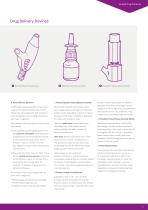
Inhaled Drug Products Drug Delivery Devices Powder-based Nasal Device Metered Nasal Spray Pump 5. Nasal Delivery Systems a) Metered Spray Pumps (Aqueous-based) Traditionally, nasal preparations have been used for the local administration of antihistamines, decongestants and steroids in order to alleviate cold or allergy symptoms and nasal congestion. Mechanical metered-dose spray pumps have largely replaced droppers and squeeze bottles as the drug delivery device of choice because of the latter’s inability to deliver an accurate and consistent dose. More recently attention has focused on two...
Open the catalog to page 11
Inhaler Testing Organisations and their Roles Introduction The ultimate responsibility for the safety, quality and efficacy of medicines and medical devices lies with the various national regulatory bodies designated to safeguard public health. In Europe and in the USA this function is performed by the European Medicines Agency (EMA) and by the Food and Drug Administration (FDA) respectively. The regulatory authorities are supported in this role by: a) The Pharmacopoeias whose job is to define the standards with which the drug formulation shall comply and the methods by which compliance will...
Open the catalog to page 12All Copley Scientific catalogs and technical brochures
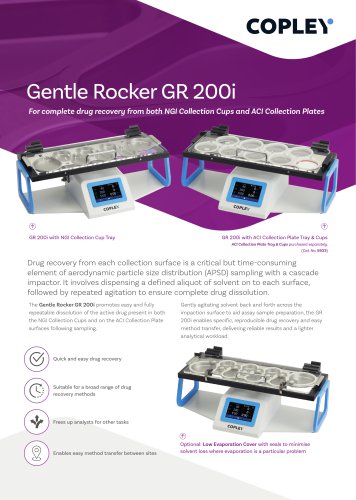 Gentle Rocker GR 200i
2 Pages
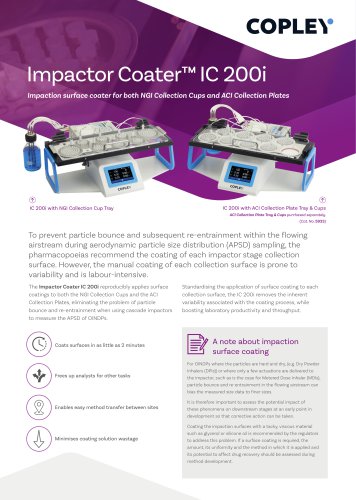 Impactor Coater™ IC 200i
2 Pages
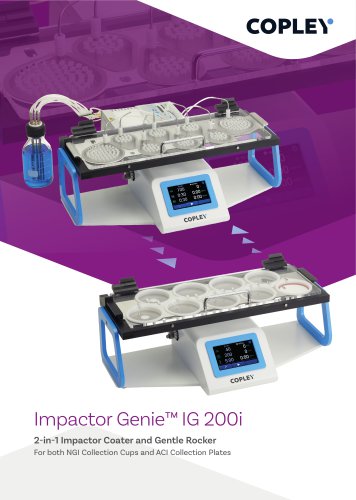 Impactor Genie™ IG 200i
4 Pages
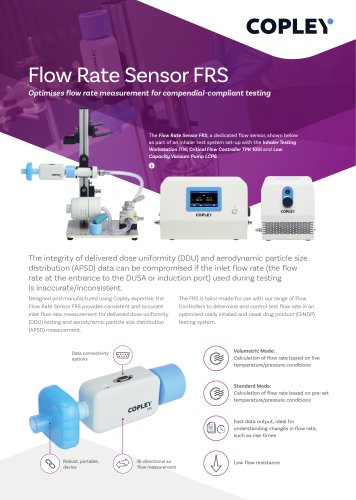 Flow Rate Sensor FRS
2 Pages
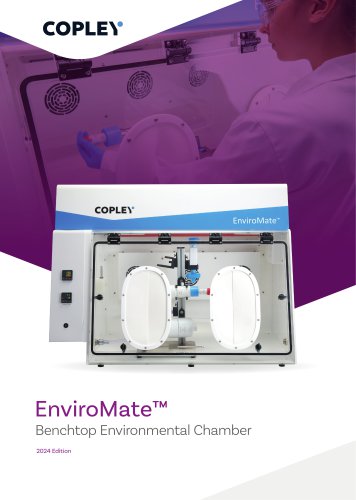 EnviroMate™
8 Pages
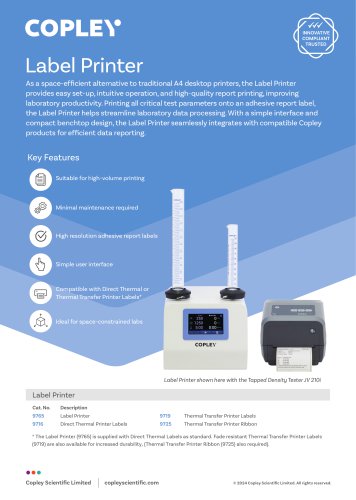 Label Printer
2 Pages
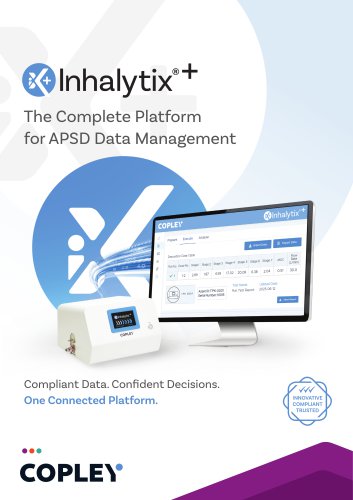 Inhalytix®+ Brochure
12 Pages
 Driving Results in Inhaler Testing
332 Pages



Archived catalogs
 Download Air Sampling Brochure
40 Pages
 Pharmaceutical Testing
76 Pages
 Inhaler Testing Brochure
132 Pages
- General care phantom
- Laboratory agitator
- Sample preparation system
- Medical sensor
- Laboratory vacuum pump
- Benchtop laboratory agitator
- Tablet computer software
- Tablet PC software
- Automatic sample processor
- Laboratory testing system
- Digital laboratory agitator
- Reporting software
- Oil-free vacuum pump
- Climatic test cabinet
- Laboratory sample preparation system
- Laboratory software
- Temperature test cabinet
- Positive-displacement vacuum pump
- Benchtop sample preparation system