
- Catalogs
- Copley Scientific
- Inhaler Testing Brochure


Inhaler Testing Brochure

Inhaler Testing Brochure
Copley Scientific, established in 1946 in Nottingham, UK, is a prominent manufacturer of inhaler test equipment and other pharmaceutical testing instruments. The company has expanded its offerings to include equipment for testing various pharmaceutical dosage forms, such as tablets, creams, and transdermal patches. Known for its innovative solutions in testing orally inhaled and nasal drug products (OINDPs), Copley Scientific maintains a strong international presence.
Copley Scientific prioritizes accuracy, precision, and reproducibility in pharmaceutical testing, adopting Quality by Design principles to ensure high-quality instrumentation. The company is committed to continuous improvement and customer service, supported by ISO 9001:2008 certification.
The document provides an overview of inhaled drug products, including metered-dose inhalers (MDIs), dry powder inhalers (DPIs), nebulisers, and nasal delivery systems. Each type has specific advantages and limitations, such as the need for coordination with MDIs and the cost of DPIs. Applications for local and systemic therapy are also discussed.
The document details the use of cascade impactors and other systems for measuring the aerodynamic particle size distribution of OINDPs, including descriptions of various impactors like the Andersen Cascade Impactor (ACI) and the Next Generation Impactor (NGI).
The roles of regulatory bodies such as the European Medicines Agency (EMA) and the Food and Drug Administration (FDA) in ensuring drug safety, quality, and efficacy are outlined. International standards and expert groups involved in pharmaceutical aerosol research are also covered.
Current pharmacopoeial specifications for delivered dose and aerodynamic particle size distribution are discussed, with guidelines from the EMA, Ph.Eur., FDA, and USP.
The document describes automation tools for inhaler testing, including systems for dose uniformity and impactor cleaning, and covers qualification processes for impactor testing.
Copley Scientific offers a comprehensive range of equipment and services for inhaler testing, supported by a commitment to quality and innovation, ensuring accurate and efficient testing of inhaled drug products.
The document discusses various drug delivery devices, including MDIs, DPIs, aqueous droplet inhalers, nebulisers, and nasal delivery systems, highlighting their features and applications.
The roles of regulatory bodies like the EMA and FDA in ensuring the safety and efficacy of drug delivery devices are outlined, along with the Quality by Design (QbD) approach and guidelines from the International Conference on Harmonisation (ICH).
The document outlines the lack of worldwide standards for OINDPs and describes the regulatory frameworks in Europe, the USA, and Japan.
The International Conference on Harmonisation (ICH) aims to harmonize drug regulation across the EU, Japan, and the USA, with guidelines covering pharmaceutical development, quality risk management, and quality systems.
The European Pharmacopoeia and the United States Pharmacopeia (USP) define standards for medicines, including monographs and testing methods for inhalation preparations.
The International Standards Organisation (ISO) sets standards for medical devices used in OINDPs, with relevant standards including ISO 20072 for inhalers and ISO 27427 for nebulisers.
Several expert groups assist regulatory bodies in establishing best practices, including the European Pharmaceutical Aerosol Group (EPAG) and the Product Quality Research Institute (PQRI).
Key attributes for OINDPs include Delivered Dose and Particle Size, crucial for determining the therapeutic effectiveness of inhaled drugs.
The document outlines specifications and procedures for testing MDIs and DPIs, including the use of Dosage Unit Sampling Apparatus (DUSA) and related equipment.
Various ancillaries required for a complete test system are listed, including mouthpiece adapters, vacuum pumps, and flow meters.
The document provides detailed procedures and equipment specifications for testing the dose uniformity of inhalers, ensuring compliance with pharmacopoeial standards.
The document outlines procedures for testing the delivered dose of nebulisers and pMDIs using add-on devices such as Spacers and Valved Holding Chambers (VHCs).
The importance of the Aerodynamic Particle Size Distribution (APSD) as a critical quality attribute is highlighted, essential for determining where particles are deposited in the respiratory tract.
Various equipment and accessories required for testing are listed, including different models of breath simulators, filter holders, and adapters.
The document provides comprehensive guidelines for testing the delivered dose of inhalation products using nebulisers and pMDIs with add-on devices.
Cascade impactors measure aerodynamic particle size, crucial for understanding particle behavior in the respiratory tract, with the Andersen Cascade Impactor (ACI) and Next Generation Impactor (NGI) recommended for testing.
Cascade impactors operate on inertial impaction principles, where particles are separated based on inertia, with solutions for issues like particle bounce and inter-stage losses.
The document describes the components of an inhaler particle sizing system, including the mouthpiece adapter, induction port, cascade impactor, and vacuum pump.
Different types of impactors, such as the ACI, NGI, and Multi-Stage Liquid Impinger (MSLI), are compared, with the choice depending on the product, required data, and testing purpose.
The ACI is used to determine the particle size of DPIs, requiring a preseparator to collect non-inhalable powder boluses, with key factors for testing DPIs outlined.
For low resistance DPIs, the ACI can operate at flow rates greater than 28.3 L/min, with modified configurations available for 60 and 90 L/min.
Concerns about the ACI's manufacture and performance led to improvements by Copley Scientific, ensuring compliance with USP and Ph.Eur. standards.
The "Quick Clamp" accessory simplifies the assembly and disassembly of the impactor stack, with options for automation and various accessories available.
Each ACI is machined to precise tolerances to ensure reproducibility and stage mensuration, eliminating the need for repetitive calibration.
The NGI was developed to address the limitations of the ACI, offering features such as a wider particle size range, excellent stage efficiency, and user-friendly design.
The NGI is a high-efficiency, two-stage preseparator designed to classify non-inhalable particles, with various sample collection cups for different tests.
The MSLI is a four-stage liquid impinger used for determining particle size distribution in DPIs and MDIs, designed to minimize inter-stage losses.
The MMI Model 160 is a five-stage cascade impactor for DPIs, calibrated for 60 to 90 L/min, with removable collection cups and low inter-stage losses.
This device is used for routine quality control of nebulizers, MDIs, and some DPIs, operating on liquid impingement principles to separate respirable and non-respirable doses.
These are add-on devices for pMDIs to improve inhalation technique, with testing procedures focusing on Aerodynamic Particle Size Distribution (APSD).
To determine the Aerodynamic Particle Size Distribution (APSD) of spacers and Valved Holding Chambers (VHCs), various equipment is required, including the Andersen Cascade Impactor (ACI) and Next Generation Impactor (NGI).
Nasal preparations are used for local administration of medications, with potential for systemic absorption and direct brain delivery.
The document outlines procedures for testing nasal sprays and aerosols using expansion chambers and cascade impactors.
The document references guidelines from the European Medicines Agency (EMA) and the FDA regarding the quality and testing of inhalation and nasal products.
The document discusses the FDA's initiative on Process Analytical Technology (PAT) and Quality by Design (QbD) for pharmaceutical manufacturing.
The document concludes by emphasizing the role of cascade impactors in measuring APSD, crucial for determining the deposition of particles in the respiratory tract.
Cascade impaction is laborious and time-consuming, requiring high skill levels to avoid errors, with the Product Quality Research Institute (PQRI) highlighting the need for more efficient methods.
AIM simplifies the process by using fewer impactor stages, focusing on key metrics like Impactor Sized Mass (ISM) and the ratio of Large Particle Mass to Small Particle Mass (LPM/SPM).
AIM is used in QC to ensure product batch consistency, involving a reduced number of stages in the Andersen Cascade Impactor (ACI).
In R&D, AIM helps in the fast screening of new formulations, aiming to correlate in vitro results with in vivo performance.
AIM offers faster throughput, reduced complexity, and easier automation compared to traditional methods.
Companies like Copley Scientific are developing various AIM models for both QC and R&D, based on reduced versions of popular impactors like the ACI and NGI.
AIM represents a significant advancement in aerosol testing, offering a more efficient and less error-prone alternative to traditional cascade impaction methods.
Two main strategies are proposed for improving IVIVC: replacing the existing induction port with a more realistic mouth/throat model and using breathing profiles that mimic in vivo conditions.
The Mixing Inlet is introduced as a solution to decouple the flow rate through the device from the air flow through the impactor, enabling more representative testing.
The document describes the optimisation of test setups using new equipment like the Breathing Simulator, AIT, and Mixing Inlet to enhance data gathering for bioequivalence demonstration.
The document emphasizes the importance of using anatomically accurate models and realistic breathing profiles to improve the correlation between in vitro and in vivo results.
Two types of flow meters are discussed: one based on differential pressure and the other on thermal mass measurement, both essential for accurate flow rate measurement.
Essential components include mouthpiece adapters, tubing, quick release connectors, and pumps, with emphasis on selecting a vacuum pump with excess capacity.
These devices are crucial for mimicking human breathing patterns in testing, with Copley Scientific offering three models catering to different physiological profiles and testing needs.
These devices are designed for testing passive breath-activated devices and breath-actuated MDIs, respectively, ensuring accurate dose delivery.
The CITDAS software facilitates the processing of impactor drug deposition data, adhering to pharmacopoeial requirements.
Three models are discussed: BRS 1100, BRS 2000, and BRS 3000, each designed for different testing needs and physiological profiles.
The document underscores the importance of using appropriate equipment and methodologies to ensure accurate and reliable testing of OINDPs.
The BRS 3000 is a breathing simulator used for testing DPIs, with features like a flow control valve and a solenoid valve to replicate the user's inspiration.
To simulate in vivo conditions, the flow rate must produce a pressure drop of 4 kPa, as recommended by European and US Pharmacopoeias.
In vitro testing involves using a 2-way switching valve connected to a vacuum pump to simulate a single inhalation cycle.
The TPK 2000 model controls and documents parameters for DPI testing, featuring a 4-line LCD display and automatic test setup.
The document outlines the importance of simulating patient inspiration accurately during DPI testing, providing reliable data on DPI performance.
The TPK 2000-R is a critical flow controller with an external temperature/humidity sensor, enhancing data quality by encouraging leak testing before each analysis.
The TPK 2000 guides users through the test setup procedure, including setting the pressure drop over the inhaler and adjusting the flow rate.
The BAC 2000 is a simplified version of the TPK 2000, designed for breath-actuated metered dose inhalers (MDIs), spacers, valved holding chambers (VHCs), and nebulisers.
CITDAS provides a standardized approach to analyzing aerodynamic size distribution of drug output from MDIs, DPIs, and nebulisers.
The Copley Inhaler Testing Data Analysis Software (CITDAS) offers a standardized approach to analyzing impactor data, supporting data from various impactors like ACI, MSLI, MMI, and NGI.
The document outlines the procedure for determining the proper test flow rate, emphasizing the need for a constant volumetric air flow during cascade impaction.
The document details the specifications of flow meters used in testing, including their range, accuracy, and resolution.
The Copley Scientific Low and High Capacity Pumps, Models LCP5 and HCP5, are designed for testing MDIs, DPIs, nebulisers, and nasal sprays.
Specifications for various models of laboratory vacuum pumps used in inhaler testing systems are provided, including the Low Capacity Pump Model LCP5, High Capacity Pump Model HCP5, and Super Capacity Pump Model SCP5.
Each pump model includes vacuum inlets for flexible positioning and flow control valves for regulated applications.
Includes quick release connectors, tubing, and rinsing caps for various testing setups.
Discusses dissolution testing challenges for inhaled products and the development of generic drugs.
The document includes performance charts for each pump model, illustrating flow rates against absolute pressure.
The United States Pharmacopeia (USP) has introduced product-specific monographs for fluticasone propionate and salmeterol, specifying the use of certain test equipment.
The document specifies the use of Glass Sample Collection Apparatus for dose uniformity testing and the Andersen Cascade Impactor (ACI) for APSD measurement.
Specific procedural requirements for APSD and DDU testing are outlined, including the use of a 28.3 L/min version of the ACI.
A list of ancillaries and spare parts necessary for testing is provided, including mouthpiece adapters, vacuum pumps, and flow meters.
The document discusses the "cold freon" effect, which can affect patient compliance, and the use of the Spray Force Tester Model SFT 1000 and Plume Temperature Tester Model PTT 1000.
Automation in testing is emphasized as a means to improve efficiency and reduce human error.
The document provides detailed information on various automated tools designed to improve the efficiency and consistency of inhaler testing processes.
This device automates the rinsing of DUSA collection tubes, ensuring consistent drug recovery and reducing the risk of repetitive strain injury (RSI) for analysts.
This unit aids in the recovery of active drugs from induction ports and pre-separators used in inhaler testing.
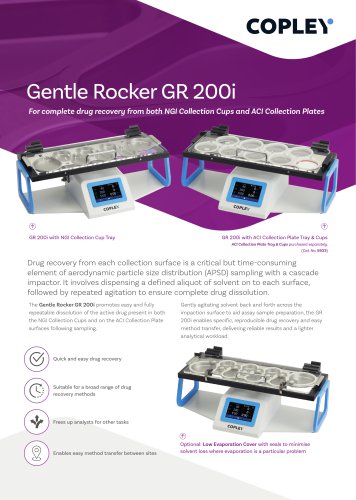
Designed to agitate NGI collection cups, this device helps dissolve active drugs in solvents.
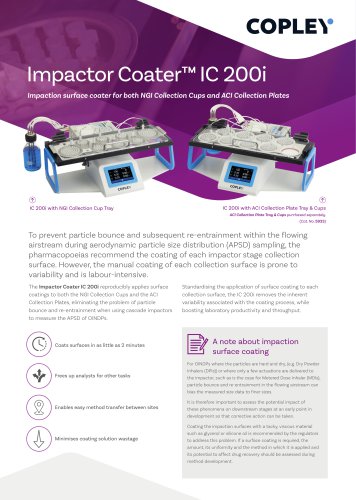
This tool addresses particle bounce issues in cascade impactors by applying a uniform coating to NGI collection cups.
These tools are designed to enhance laboratory efficiency by automating repetitive tasks, reducing variability, and minimizing physical strain on analysts.
The document provides detailed information on the cleaning and sample recovery systems for cascade impactors, specifically the Andersen Cascade Impactor (ACI) and the Next Generation Impactor (NGI).
The cleaning system is designed for both ACI and NGI components, emphasizing the importance of regular cleaning to maintain precision and prevent debris accumulation.
Features include digital temperature control, a timer, and an audible alarm.
The Andersen Sample Recovery System (A-SRS) automates the recovery of samples from the ACI, reducing human error and increasing throughput.
Both systems are controlled via PC or in-built computers with user-friendly software, compliant with 21 CFR Part 11.
Induction Port and Preseparator Rinsers automate the rinsing process for NGI components.
The document discusses the compliance and features of a software system used for testing, which is 21 CFR Part 11 compliant.
The document lists various products related to the NGI Sample Recovery System, including spare parts and maintenance services.
The document distinguishes between 'qualification' for instrumentation and 'validation' for processes and software.
Errors in inhaler testing can arise from analytical (human) errors and instrument errors.
The document outlines criteria from European and US Pharmacopoeias for cascade impactor systems.
Stage mensuration is crucial for ensuring that cascade impactors meet critical dimensions.
Regular cleaning of cascade impactors is necessary to prevent the accumulation of deposits that can affect measurements.
The document explains the interpretation of mensuration data using parameters like Effective Diameter and In-Use Margin.
If stage mensuration indicates excessive wear, the stage must be replaced.
This document provides detailed information on the maintenance and qualification of inhaler testing systems, focusing on cascade impactors and related equipment.
Regular cleaning using ultrasonics and stage pinning is recommended to maintain performance.
IQ/OQ Documentation guides users through the qualification process, ensuring the system is fully qualified for use.
Pressure drop across impactor stages is used to monitor nozzle performance indirectly.
Copley Scientific offers design solutions and service contracts for maintenance and calibration.
The document emphasizes the importance of regular maintenance, qualification, and training to ensure the accuracy and reliability of inhaler testing systems.
Catalog excerpts
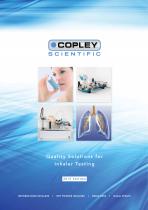
COPLEY SCIENTIFIC metered-dose inhalers nasal sprays
Open the catalog to page 1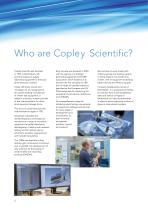
Who are Copley Scientific? Copley Scientific was founded in 1946 in Nottingham, UK by Frank Copley to supply laboratory equipment to the local pharmaceutical industry. Today, still family owned and managed, we are recognised as the world’s leading manufacturer of inhaler test equipment, in addition to being a trusted provider of test instrumentation for other pharmaceutical dosage forms. This focus on pharmaceutical test instrumentation began in 1957. Subsequent decades saw marked expansion and today we manufacture a range of innovative equipment for tablet dissolution, disintegration, friability...
Open the catalog to page 2
Our Philosophy Copley Scientific is a strong, stable company with a track record of success, but equally important we are agile and forward-looking, with a philosphy closely aligned to the needs of the market we serve. Continuous improvement is a core element of this approach and we strive to exceed the expectations of the industry, not only by enhancing equipment performance but also through unrivalled service. Accurate, precise, reproducible data drives pharmaceutical development and ensures product safety, but high productivity in testing is increasingly important. These commitments are exemplified...
Open the catalog to page 3
Equipment Selection Guide Equipment Selection Guide Inhaled Drug Products Inhaled Drug Products 7 Metered-Dose Inhalers (MDIs) 8 Valved Holding Chambers (VHC) 8 Dry Powder Inhalers (DPIs) 9 Aqueous Droplet Inhalers 9 Nasal Delivery Systems 11 Metered Spray Pump Powder based Nasal Devices 11 Propellant based Nasal Aerosols (MDIs) 11 Novel Nasal Devices 11 Organisations and their Roles European Medicines Agency Food and Drug Administration Global Harmonisation Task Force (GHTF) 15 Drug Safety, Quality and European Pharmacopoeia United States Pharmacopeia Device Safety, Quality and International...
Open the catalog to page 4
Critical Flow Control 78 Critical (Sonic) Flow 79 Critical Flow Controller Critical Flow Controller Breath Actuation Controller Data Analysis Software Copley Inhaler Testing Data Analysis Software (CITDAS) 86 Waters Empower Spreadsheet 88 Flow Meter Model DFM3 Flow Meter Model DFM 2000 Low Capacity Pump Model High Capacity Pump Model Super Capacity Pump Model Device Resistance Measurement 96 Dissolution Testing (Generic Drug Development) 100 Spray Force Tester Plume Temperature Tester Labour Saving Tools - Delivered Dose Uniformity 106 Labour Saving Tools - Sample Sample Prep Unit SPU 2000 108...
Open the catalog to page 5
Equipment selection guide INHALER TESTING SYSTEMS - SUMMARY Metered-Dose Inhaler (MDI) Nasal Spray (Aqueous) Description of Drug Delivery Device Delivered Dose Uniformity Sampling Apparatus (Page 24) Waste Shot Collector (Page 31) Breath Actuation Controller (Page 84) - USP only Flow Meter (Page 90) Adapter for above (Page 91) Mouthpiece Adapter (Page 92) Pump (Page 93) DUSA Shaker (Page 106) Sampling Apparatus (Page 28) Waste Shot Collector (Page 31) Critical Flow Controller (Page 78) Flow Meter (Page 90) Adapter for above (Page 71) Mouthpiece Adapter (Page 92) Pump (Page 93) DUSA Shaker (Page...
Open the catalog to page 6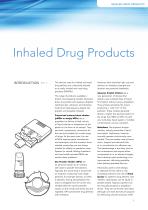
Inhaled drug products Inhaled Drug Products Introduction The devices used for inhaled and nasal drug delivery are collectively referred to as orally inhaled and nasal drug products (OINDPs). The range of products available is broad, encompassing inhalers (metereddose, dry powder and aqueous droplet), nebulisers (jet, ultrasonic and vibrating mesh) and nasal (aqueous based, dry powder and propellant based). Pressurised metered-dose inhalers (pMDIs or simply MDIs) use a propellant to deliver a fixed volume of liquid solution or suspension to the patient in the form of an aerosol. They are small,...
Open the catalog to page 7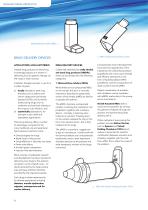
Inhaled drug products MDI incorporating Dose Counter Drug Delivery Devices APPLICATIONS (LOCAL/SYSTEMIC) DRUG DELIVERY DEVICES Inhaled drug products are becoming increasingly popular as a means of delivering local or systemic therapy via the lungs or nasal mucosa. Collectively described as orally inhaled and nasal drug products (OINDPs), these can be divided into the following categories: Inhalation therapy has been in use for a number of years: 1. Metered-Dose Inhalers (MDIs) locally (directly) to treat lung diseases such as asthma and chronic obstructive pulmonary disease (COPD), and to deliver...
Open the catalog to page 8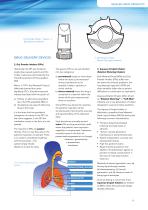
Inhaled drug products Dry Powder Inhaler - Passive Type (device metered) Drug Delivery Devices Dry Powder Inhaler Passive Type (pre-metered) 2. Dry Powder Inhalers (DPIs) Historically, the DPI was limited to single dose capsule systems and the inhaler market was dominated by the chlorofluorocarbon (CFC) propelled MDI. When, in 1997, the Montreal Protocol effectively banned the ozone depleting CFCs, the pharmaceutical industry was faced with the option of: a) finding an alternative propellant (as in the HFA propelled MDI), or b) developing new ways of delivering drug to the lungs It is the latter...
Open the catalog to page 9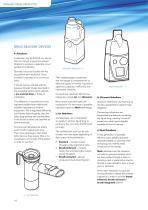
Inhaled drug products Drug Delivery Devices 4. Nebulisers A nebuliser may be defined as a device that can convert a liquid into aerosol droplets to produce a respirable cloud suitable for inhalation. Normally it must be loaded with the drug before each treatment. Once activated it operates on a continuous basis. It should not be confused with the Aqueous Droplet Inhaler described in the preceding section which delivers a pre-metered dose or bolus of medication. This difference is important since the regulatory bodies have traditionally classified nebulisers as medical equipment. This is regulated...
Open the catalog to page 10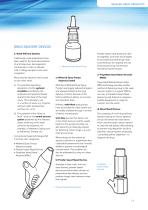
Inhaled drug products Drug Delivery Devices 5. Nasal Delivery Systems Traditionally, nasal preparations have been used for the local administration of anti-histamines, decongestants and steroids in order to alleviate cold or allergy symptoms and nasal congestion. Metered Nasal Spray Pump More recently attention has focused on two other areas: a) Metered Spray Pumps (Aqueous based) a) The potential rapid drug absorption into the systemic circulation provided by the turbinates and lymphoid tissues located at the back of the nasal cavity. This is already in use in a number of areas, e.g. migraine...
Open the catalog to page 11All Copley Scientific catalogs and technical brochures
 Gentle Rocker GR 200i
2 Pages
 Impactor Coater™ IC 200i
2 Pages
 Impactor Genie™ IG 200i
4 Pages
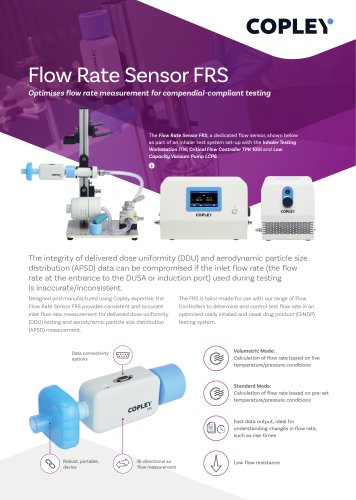 Flow Rate Sensor FRS
2 Pages
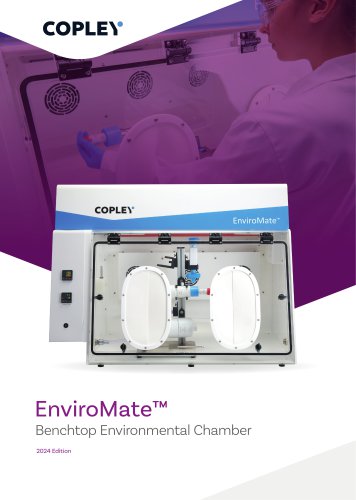 EnviroMate™
8 Pages
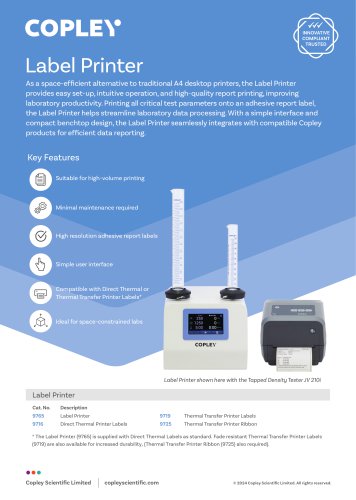 Label Printer
2 Pages
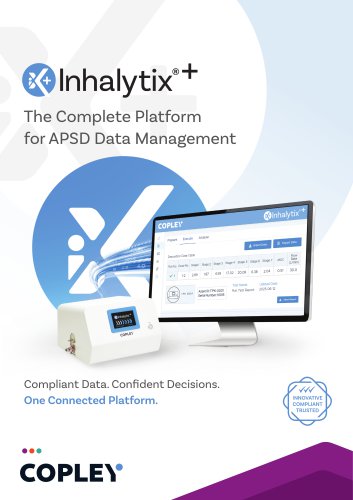 Inhalytix®+ Brochure
12 Pages
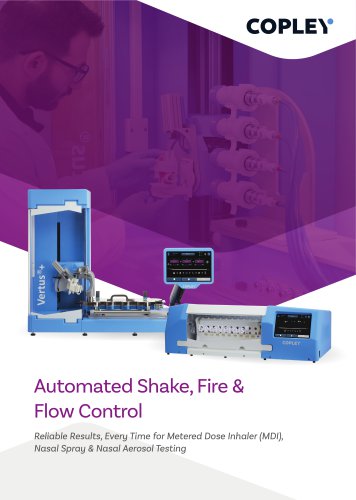
 Driving Results in Inhaler Testing
332 Pages


Archived catalogs
 Copley-Inhaler-Testing-Brochure
150 Pages
 Download Air Sampling Brochure
40 Pages
 Pharmaceutical Testing
76 Pages
- General care phantom
- Laboratory agitator
- Sample preparation system
- Medical sensor
- Benchtop laboratory agitator
- Tablet computer software
- Tablet PC software
- Automatic sample processor
- Laboratory testing system
- Digital laboratory agitator
- Reporting software
- Oil-free vacuum pump
- Climatic test cabinet
- Laboratory software
- Laboratory sample preparation system
- Temperature test cabinet
- Positive-displacement vacuum pump
- Benchtop sample preparation system