
- Catalogs
- Copley Scientific
- Volume and Resistance Compensator VRC


Volume and Resistance Compensator VRC
1 /2Pages
Volume and Resistance Compensator VRC
1 /2Pages
Catalog excerpts
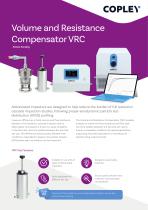
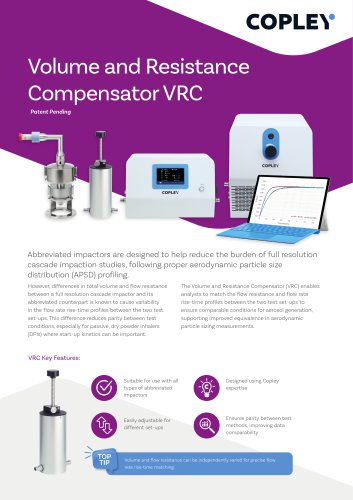
Volume and Resistance Compensator VRC Patent Pending Abbreviated impactors are designed to help reduce the burden of full resolution cascade impaction studies, following proper aerodynamic particle size distribution (APSD) profiling. However, differences in total volume and flow resistance between a full resolution cascade impactor and its abbreviated counterpart is known to cause variability in the flow rate rise-time profiles between the two test set-ups. This difference reduces parity between test conditions, especially for passive, dry powder inhalers (DPIs) where start-up kinetics can be important. The Volume and Resistance Compensator (VRC) enables analysts to match the flow resistance and flow rate rise-time profiles between the two test set-ups to ensure comparable conditions for aerosol generation, supporting improved equivalence in aerodynamic particle sizing measurements. Suitable for use with all types of abbreviated impactors Designed using Copley expertise Easily adjustable for different set-ups Ensures parity between test methods, improving data comparability Volume and flow resistance can be independently varied for precise flow rate rise-time matching.
Open the catalog to page 1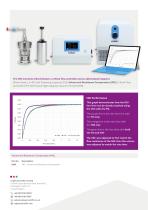
The VRC connects inline between a critical flow controller and an abbreviated impactor. Shown here (L to R): Fast Screening Impactor (FSI), Volume and Resistance Compensator (VRC), Critical Flow Controller (TPK 100i-R) and High Capacity Vacuum Pump (HCP6). This graph demonstrates how the NGI rise-time can be closely matched using the VRC with the FSI. The purple line is the rise-time line with the FSI only. The orange line is the rise-time with the NGI only The green line is the rise-time with both the FSI and VRC Time (seconds) Volume and Resistance Compensator (VRC) Cat. No. VRC - Volume and...
Open the catalog to page 2All Copley Scientific catalogs and technical brochures
 Gentle Rocker GR 200i
2 Pages
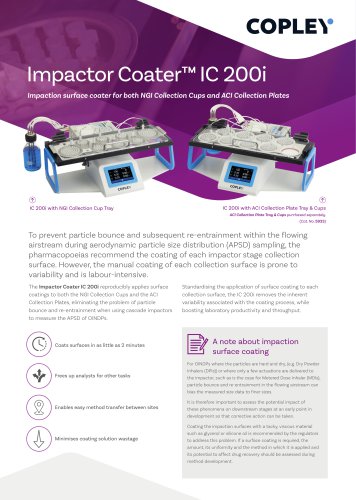 Impactor Coater™ IC 200i
2 Pages
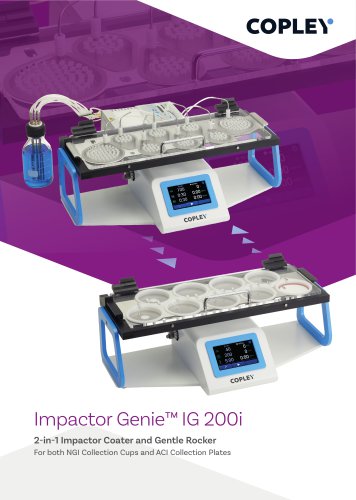 Impactor Genie™ IG 200i
4 Pages
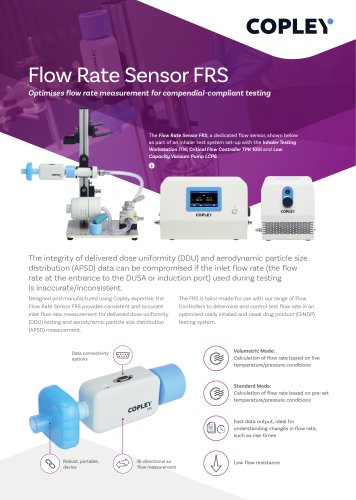 Flow Rate Sensor FRS
2 Pages
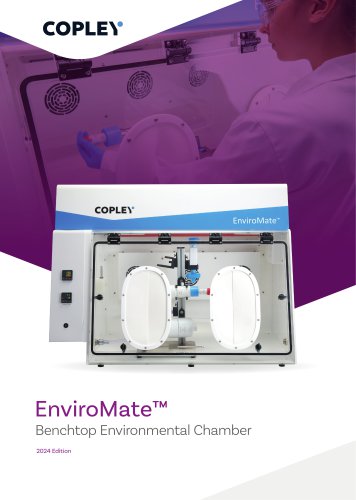 EnviroMate™
8 Pages
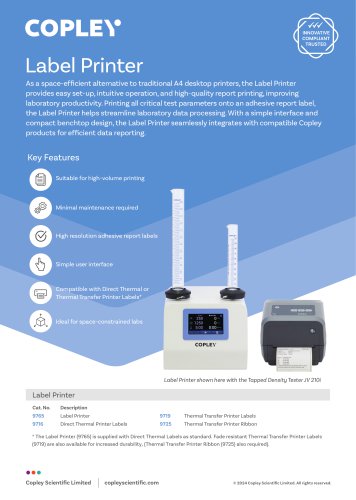 Label Printer
2 Pages
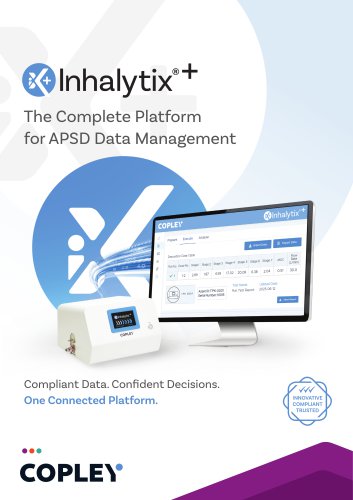 Inhalytix®+ Brochure
12 Pages
 Driving Results in Inhaler Testing
332 Pages



Archived catalogs
 Copley-Inhaler-Testing-Brochure
150 Pages
 Download Air Sampling Brochure
40 Pages
 Pharmaceutical Testing
76 Pages
 Inhaler Testing Brochure
132 Pages
- Analysis software
- General care phantom
- Laboratory agitator
- Sample preparation system
- Laboratory vacuum pump
- Benchtop laboratory agitator
- Tablet computer software
- Medical sensor
- Tablet PC software
- Automatic sample processor
- Laboratory testing system
- Digital laboratory agitator
- Reporting software
- Oil-free vacuum pump
- Climatic test cabinet
- Laboratory software
- Laboratory sample preparation system
- Temperature test cabinet
- Positive-displacement vacuum pump
- Benchtop sample preparation system