


- Products
- Catalogs
- News & Trends
- Exhibitions
aview: CAC

aview: CAC
Coreline's aview CAC utilizes deep learning AI technology to quantify coronary artery calcification (CAC) and assess the risk of coronary artery disease. The system automatically segments the heart and surrounding structures to accurately analyze calcified plaques in coronary arteries, providing a major indicator for diagnosing coronary artery disease.
The AI diagnostic accuracy of the CAC system is 99.2%, as evaluated through the Robinsca clinical examination of 997 non-contrast ECG CT images. The system demonstrates high concordance with the Agatston score (87%) and detection and classification concordance (95%).
The CAC workflow involves transferring DICOM data directly from medical equipment and PACS to aview CAC. The system automatically segments coronary arteries (LM, LAD, LCX, RCA), analyzes calcified plaques, and generates quantitative results and reports. These reports can be conveniently checked in PACS.
The system provides cardiovascular and surrounding structures segmentation, offering quantitative and rich results. It predicts risk using the latest classification methods, such as CAC-DRS, and provides a comprehensive coronary artery calcification score, including Agatston, volume, mass, and MESA scores. The results can be extracted as CSV files for research purposes, and reports are available in PDF format.
The CAC system integrates with all standard reading environments and complies with DICOM and TCP/IP protocols. It facilitates easy data exchange with hospital PACS and imaging equipment, allowing data access through a web browser.
With 99.2% accuracy and fully automatic analysis, the CAC system aids in the early diagnosis of coronary artery disease, enhancing patient treatment and management.
Catalog excerpts

CAC Automatic analysis solution for coronary artery calcification based on artificial intelligence Coronary Artery Calcification
Open the catalog to page 1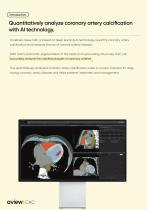
Quantitatively analyze coronary artery calcification with AI technology. Coreline's aview CAC is based on deep learning AI technology. Quantify coronary artery calcification and measure the risk of coronal arterial disease. With CAC’s automatic segmentation of the heart and surrounding structures, CAC can accurately analyze the calcified plaques in coronary arteries. The quantitatively analyzed coronary artery calcification index is a major indicator for diagnosing coronary artery disease and helps patients’ treatment and management.
Open the catalog to page 2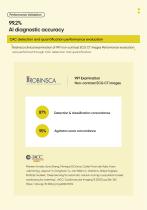
Performance Validation 99.2% AI diagnostic accuracy CAC detection and quantification performance evaluation Robinsca clinical examination of 997 non-contrast ECG CT images Performance evaluation was performed through CAC detection and quantification. 997 Examination Non-contrast ECG CT images Detection & classification concordance Agatston score concordance Marleen Vonder, Sunyi Zheng, Monique D.Dorrius, Carlijn M.van der Aalst, Harry J.de Koning, Jaeyoun Yi, Donghoon Yu, Jan Willem C. Gratama, Dirkjan Kuijpers, Matthijs Oudkerk, "Deep learning for automatic calcium scoring in population based...
Open the catalog to page 3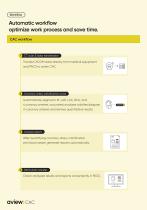
Automatic workflow optimize work process and save time. CAC workflow CT scan & data transmission Transfer DICOM data directly from medical equipment and PACS to aview CAC. Coronary artery calcification score Automatically segment LM, LAD, LCX, RCA, and 4 coronary arteries, accurately analyzes calcified plaques in coronary arteries and derives quantitative results. 3 Analysis report After quantifying coronary artery calcification per blood vessel, generate reports automatically. 4 PACS data transfer Check analyzed results and reports conveniently in PACS.
Open the catalog to page 4
Proprietary AI technology detects even the smallest lesions without missing a beat. Cardiovascular & surrounding structures segmentation PACS data transfer Analyzed results and reportsIt is convenient to check in PACS By segmenting the heart and surrounding structures except the coronary artery, the calcified plaque on the wall of the coronary artery is not missed and the accuracy of the analysis increases. Analysis with chest CT image Coronary artery calcification can be quantified not only on heart CT images but also on chest CT images, helping early detection.
Open the catalog to page 5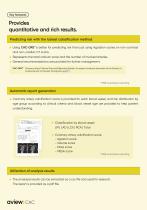
Provides quantitative and rich results. Predicting risk with the lastest calssification method Using CAC-DRS★ is better for predicting risk than just using Agatston scores on non-contrast and non-cardiac CT scans. Represents the total calcium score and the number of involved arteries. General recommendations are provided for further management CAC-DRS★ : Coronary Artery Calcium Data and Reporting System. An expert consensus document of the Society of Cardiovascular Computed Tomography Automatic report generation Coronary artery calcification score is provided for each blood vessel, and risk distribution...
Open the catalog to page 6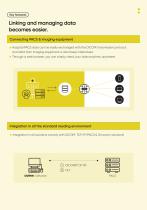
Linking and managing data becomes easier. Connecting PACS & imaging equipment Hospital PACS data can be easily exchanged with the DICOM transmission protocol, and data from imaging equipment is also freely interlocked. Through a web browser, you can simply check your data anytime, anywhere. Integration in all the standard reading environment Integration in all solutions comply with DICOM, TCP/IP (PACS & 3rd party solutions)
Open the catalog to page 7
CAC With 99.2% accurate and fully automatic analysis, CAC helps early diagnosis of coronary artery disease. Prosper with Better Health
Open the catalog to page 8All Coreline catalogs and technical brochures
 aview: Research
6 Pages
 aview: RT ACS
4 Pages
 aview: Lung Texture
8 Pages
 aview:LCS
8 Pages
- Analysis software
- Radiology software
- Visualization software
- Tablet computer software
- Tablet PC software
- Reporting software
- Diagnostic software
- Planning software
- Online software
- Automated software
- Treatment software
- Traceability software
- Data management software
- AI-assisted software
- Artificial intelligence software
- Web-based software
- Test software
- Printing software
- Server-based software
- Real-time software