


Biomimetic Cementless Technology

Biomimetic Cementless Technology
Our advanced biomimetic calcium phosphate (CaP) coating features a microcrystalline structure that maintains substrate surface roughness, providing a large area for bone integration. The biphasic composition, with over 70% brushite, promotes both short and long-term osseointegration. The bone-like morphology of the coating enhances the capillary effect, potentially accelerating the implant healing process.
Innovative Coating Process
The electrolytic process at room temperature forms a 20µm thin, needle-like, microcrystalline coating similar to natural bone tissue. This coating integrates seamlessly into bone tissue development and has a hydrophilic effect beneficial for growth factor adsorption and bone cell adhesion.
Advantages Over Conventional Coatings
Unlike traditional plasma spraying, electrolysis ensures complete and uniform coverage of implant surfaces while maintaining surface roughness. This provides a large area for bone deposition, reduces the risk of coating delamination, and increases implant tolerance to micro-movements.
Clinical Applications and Efficacy
Advanced biomimetic CaP coatings have shown excellent clinical survivorship in various orthopedic applications, including dental, spine, hip, knee, and ankle implants. Animal studies and clinical trials demonstrate increased bone formation and improved mechanical anchorage in the early post-implantation period.
Biphasic Coating Benefits
The biphasic CaP coating contains a soluble brushite phase for rapid resorption and short-term bone synthesis, while the highly crystalline HA phase releases ions over time for long-term bone integration. This coordinated bioactivity provides excellent osseointegration.
Accelerated Bone Integration
These coatings resorb into the joint space within 8-12 weeks, exposing the porous structure to rapidly deposited bone tissue, enhancing mechanical interlock between bone and implant. Rapid osteoblast coverage and bone matrix development have been observed within 30 hours in culture medium.
Commitment to Innovation
Corin is dedicated to using advanced coating technologies to improve implant function and longevity. Our biomimetic coatings are featured on various implant ranges as an advanced cementless fixation option, demonstrating excellent biological fixation in clinical retrieval analyses.
Catalog excerpts

Biomimetic Cementless Coat Responsible Innovation
Open the catalog to page 1
A new generation in cementless coatings Our advanced biomimetic calcium phosphate (CaP) coating has a microcrystalline structure which maintains substrate surface roughness providing a large area for bone integration. The biphasic composition of this coating (>70% brushite) has been shown to promote short and long term osseointegration while the bone like (biomimetic) coating morphology can provide a potent capillary effect which may help to accelerate the implant healing process1,2,3,4,5,6,7,8,9.
Open the catalog to page 2
Advanced biomimetic cementless coating technology with more than 20 years of clinical heritage 5,6,9 Responsible Innovation
Open the catalog to page 3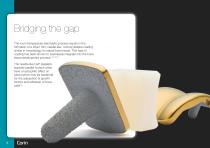
Bridging the gap The room temperature electrolytic process results in the formation of a 20µm thin, needle-like, microcrystalline coating similar in morphology to natural bone tissue. This type of coating has been shown to seamlessly integrate into the bone tissue development process1,2,3,10,11. The needle-like CaP platelets, stacked parallel to each other have a hydrophilic effect on blood which may be beneficial for the adsorption of growth factors and adhesion of bone cells2,4.
Open the catalog to page 4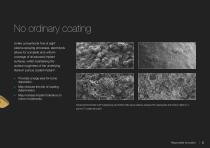
No ordinary coating Unlike conventional ‘line of sight’ plasma spraying processes, electrolysis allows for complete and uniform coverage of all exposed implant surfaces, whilst maintaining the surface roughness of the underlying titanium porous coated implant2. ■■ Provides a large area for bone deposition. May reduces the risk of coating delamination. May increase implant tolerance to micro-movements. Advanced biomimetic CaP coating (top and bottom left) versus plasma-sprayed HA coating (top and bottom right) on a porous Ti-coated structure
Open the catalog to page 5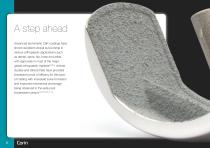
A step ahead Advanced biomimetic CaP coatings have shown excellent clinical survivorship in various orthopaedic applications such as dental, spine, hip, knee and ankle, with approvals in most of the major global orthopaedic markets5,6,8,9. Animal studies and clinical trials have provided impressive proof of efficacy for this type of coating with increased bone formation and improved mechanical anchorage being observed in the early post implantation period1,2,3,7,9,10,11,12.
Open the catalog to page 6
Over one million implants coated with microcrystalline calcium phosphate since 19952 Responsible Innovation
Open the catalog to page 7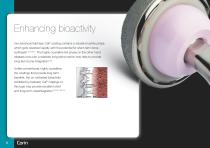
Enhancing bioactivity Our advanced biphasic CaP coating contains a soluble brushite phase which gets resorbed rapidly with the potential for short-term bone synthesis2,3,7,8,9,10. The highly crystalline HA phase on the other hand releases ions over a relatively long period which may help to provide long-term bone integration5,6,9. Unlike conventional, highly crystalline, HA coatings that provide long term benefits, the co-ordinated bioactivity exhibited by biphasic CaP coatings of this type may provide excellent short and long-term osseintegration1,3,5,6,7,8,9,10.
Open the catalog to page 8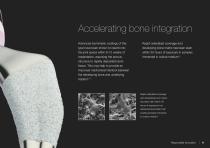
Accelerating bone integration Advanced biomimetic coatings of this type have been shown to resorb into the joint space within 8-12 weeks of implantation, exposing the porous structure to rapidly deposited bone tissue. This may help to provide an improved mechanical interlock between the developing bone and underlying implant1,11. Rapid osteoblast coverage and developing bone matrix has been seen within 30 hours of exposure in samples immersed in culture medium3. Rapid osteoblast coverage and developing bone matrix has been seen within 30 hours of exposure in an advanced biomimetic CaP coating...
Open the catalog to page 9
Pioneers in progressive technologies Corin is dedicated to the use of advanced coating technologies to improve implant function and longevity. Our advanced biomimetic coating features on AMC™, Uniglide™, TriFit TS™, Trinity™ and Zenith™ implant ranges as an advanced cementless fixation option. Retrieval analysis of a cementless Uniglide tibial plateau, from a patient who underwent five episodes of knee surgery prior to unicondylar knee replacement, showed excellent biological fixatio
Open the catalog to page 10
Achieving new heights in innovation Responsible Innovation
Open the catalog to page 11
References: 1. Schwarz ML, Kowarsch M, Rose SB, Jani L. Histomorphometrical and mechanical evaluation of various surfaces on titanium test bodies placed into femora of the Göttinger minipig. Can a resorbable CaP coating increase osteointegration? 49th Annual Meeting of the Orthopaedic Research Society 2003; Poster. 2. Data on file Corin Group 2009. 3. Becker P, Nebe B, Luthen F, Rychle J, Neumann HG. Cellular investigations on electrochemically deposited CaP-composite. 18th European Conference on Biomaterials 2003. Abstract. 10. Zeggel P. Bioactive Calcium phosphate coatings for dental implants....
Open the catalog to page 12All Corin catalogs and technical brochures
 MiniHip™ - The evidence base
16 Pages
 MiniHip™ - product overview
12 Pages
 Trinity™ - surgical technique
16 Pages
 Trinity - design rationale
12 Pages
 ECiMa™
12 Pages
 TriFit TS™
12 Pages
 Trinity™ - product overview
12 Pages
 Optimized Positioning System
12 Pages
 Unity knee surgical technique
24 Pages
 TriFit TS surgical technique
12 Pages
 MiniHip™ - surgical technique
12 Pages
 OPS™
OPS™6 Pages
 Unity KneeTM
16 Pages
 TriFit TS?
12 Pages
 MiniHip - design rationale
16 Pages
 MiniHip - product overview
12 Pages
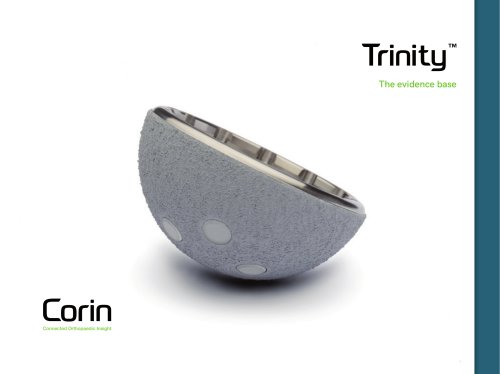
 Trinity
12 Pages


- Femoral stem
- Knee prosthesis
- Acetabular prosthesis
- Cementless femoral stem
- Cementless acetabular prosthesis
- Hip prosthesis
- Femoral head prosthesis
- Cemented femoral stem
- Primary hip prosthesis
- Cementless hip prosthesis
- Revision knee prosthesis
- Mobile-bearing knee prosthesis
- Cemented knee prosthesis
- Motion assessment system
- Cemented hip prosthesis
- Mobile assessment system
- Minimally invasive femoral stem
- Minimally invasive hip prosthesis