


TriFit TS surgical technique

TriFit TS surgical technique
Catalog excerpts

Responsible Innovation Cementless Tapered Femoral Stem Surgical technique
Open the catalog to page 1
Contents Operative summary Pre-operative planning Femoral neck osteotomy Femoral canal preparation Sequential rasping Calcar preparation Trial reduction Stem implantation Femoral head impaction Stem extraction Ordering information
Open the catalog to page 2
Conformity | Stability | Versatility Responsible Innovation
Open the catalog to page 3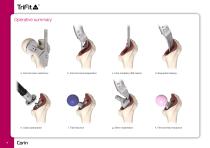
Operative summary a. Femoral neck osteotomy b. Femoral canal preparation h. Femoral head impaction
Open the catalog to page 4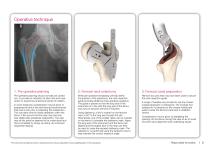
Operative technique 2. Femoral neck osteotomy 3. Femoral canal preparation Pre-operative planning should normally be carried out, to provide an indication of stem size and neck option to restore the anatomical centre of rotation. While pre-operative templating will help define the position of the osteotomy, the neck resection guide provides additional intra-operative guidance. The guide is placed so that the long axis of the instrument is in line with the long axis of the femur, and may be secured with pins if required. Remove any pins that may have been used to secure the neck resection guide....
Open the catalog to page 5
The T-handled reamer is used to define the neutral axis of the femoral canal. It is important to create an open pathway to the appropriate depth. This reduces the risk of distal hang-up which can lead to undersizing and improper seating of the stem. The chosen handle should be attached to the starter rasp and inserted/impacted into the femur, making sure that axial and rotational alignment is maintained at all times. Progressively larger rasps are then used to create an appropriately-sized cavity for receiving the definitive implant. The growth between adjacent rasp sizes is uniform to make sequential...
Open the catalog to page 6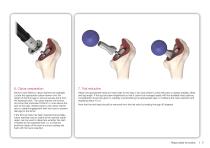
Ø40mm and Ø50mm calcar reamers are available. Locate the appropriate calcar reamer onto the spigot of the final rasp to remove excess bone from the resected neck. The calcar reamer will remove any bone that protrudes 0.25mm or more above the face of the rasp. Initiate power to the calcar reamer prior to careful engagement with the bone to prevent damage to the femur. Attach the appropriate head and neck trials to the rasp in situ and perform a trial reduction to assess stability, offset and leg length. If the leg has been lengthened so that it cannot be managed easily with the available head...
Open the catalog to page 7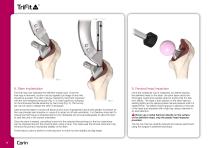
9. Femoral head impaction The final rasp size indicates the definitive implant size. Once the final rasp is removed, suction may be applied but lavage of any kind should be avoided. The stem may be inserted by hand and impacted with the non-threaded introducer (Fig. 1) or held captive by screwing on the introducer/handle assembly by hand only (Fig. 2). The tommy bar can be used to release the stem if necessary. Once the acetabular cup is implanted, but before placing the definitive head on the stem, the stem taper should be thoroughly rinsed and carefully dried to ensure that it is free from...
Open the catalog to page 8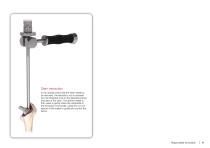
Stem extraction In the unlikely event that the stem needs to be removed, the extraction rod is screwed into the threaded hole on the lateral/proximal shoulder of the stem. The slotted mallet is then used to gently strike the underside of the extraction rod handle, using the cut-out feature of the mallet to guide and control the blows. Responsible Innovation
Open the catalog to page 9
Ordering information standard tapered stem 694.0001 Size 1 Cementless 694.0002 Size 2 Cementless 694.0003 Size 3 Cementless 694.0004 Size 4 Cementless 694.0005 Size 5 Cementless 694.0006 Size 6 Cementless 694.0007 Size 7 Cementless 694.0008 Size 8 Cementless 694.0009 Size 9 Cementless 694.0010 Size 10 Cementless 694.0011 Size 11 Cementless lateralised tapered stem 694.1001 Size 1 Cementless 694.1002 Size 2 Cementless 694.1003 Size 3 Cementless 694.1004 Size 4 Cementless 694.1005 Size 5 Cementless 694.1006 Size 6 Cementless 694.1007 Size 7 Cementless 694.1008 Size 8 Cementless 694.1009 Size 9...
Open the catalog to page 10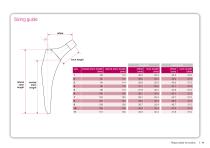
Sizing guide offset 50° neck length standard size 1 medial stem length (mm) lateral stem length (mm) 2 lateral stem length medial stem length Responsible Innovation
Open the catalog to page 11
Printed on Cocoon 100 which contains 100% total recycled fibre and is produced at a mill which holds the ISO 14001 for Environmental Management Systems. The pulp is bleached using Elemental Chlorine Free processes. BIOLOX delta is a registered trademark of CeramTec ©2014 Corin P No I1204 Rev3 07/2014 ECR 13404
Open the catalog to page 12All Corin catalogs and technical brochures
 MiniHip™ - The evidence base
16 Pages
 MiniHip™ - product overview
12 Pages
 Trinity™ - surgical technique
16 Pages
 Trinity - design rationale
12 Pages
 Biomimetic Cementless Technology
12 Pages
 ECiMa™
12 Pages
 TriFit TS™
12 Pages
 Trinity™ - product overview
12 Pages
 Optimized Positioning System
12 Pages
 Unity knee surgical technique
24 Pages
 MiniHip™ - surgical technique
12 Pages
 OPS™
OPS™6 Pages
 Unity KneeTM
16 Pages
 TriFit TS?
12 Pages
 MiniHip - design rationale
16 Pages
 MiniHip - product overview
12 Pages
 Trinity
12 Pages


- Knee prosthesis
- Acetabular prosthesis
- Cementless femoral stem
- Cementless acetabular prosthesis
- Hip prosthesis
- Femoral head prosthesis
- Cemented femoral stem
- Primary hip prosthesis
- Cementless hip prosthesis
- Revision knee prosthesis
- Mobile-bearing knee prosthesis
- Cemented knee prosthesis
- Motion assessment system
- Cemented hip prosthesis
- Minimally invasive femoral stem
- Mobile assessment system
- Minimally invasive hip prosthesis