


TriFit TS?

TriFit TS?
The TriFit TS™ cementless tapered femoral stem is designed to fit patients effectively, addressing modern clinical challenges in hip replacement. It builds on the successful clinical heritage of the TriFit™ tapered stem, offering a patient-matched solution.
Responsible Innovation
The product is designed to meet the demands of changing patient demographics, including younger, more active patients and those with obesity. Key considerations include preserving anatomy, optimal biomechanics reconstruction, and less invasive surgical techniques.
Conformity
The TriFit TS™ stem uses global CT data to define optimal implant geometry for patient-specific solutions. It features a fixed neck length and an anatomical CCD angle of 127° to conform to patient anatomy and accurately reconstruct biomechanics.
Stability
The stem's design promotes proximal loading and prevents distal hang-up, reducing the risk of subsidence. It is made from forged titanium alloy for strength and biocompatibility, with a polished distal portion to prevent osteointegration and a proximal portion coated with BONIT® for stability.
Versatility
The stem is suitable for minimally invasive surgical approaches and is compatible with the Trinity™ advanced bearing acetabular system. It offers a range of sizes and offsets to restore the center of rotation and biomechanics for different anatomies.
Preserving Anatomy
The design aims to preserve natural anatomy, minimizing bone removal and promoting physiological loading of the femur. This helps maintain good bone stock for the future.
Bearing Options
The TriFit TS™ is compatible with the Trinity™ system, offering various high-performance bearings, including ECiMa™ vitamin E highly cross-linked polyethylene and BIOLOX® delta ceramic-on-ceramic.
Advanced Instrumentation
The stem follows a 'rasp only' philosophy, eliminating the need for distal reaming. It is compatible with minimally invasive approaches, promoting faster rehabilitation.
References
The document includes references to studies and data supporting the design and effectiveness of the TriFit TS™ stem.
Catalog excerpts

Cementless Tapered Femoral Stem Product overview
Open the catalog to page 1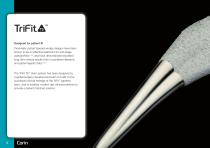
Designed for patient fit Proximally coated tapered wedge designs have been shown to be an effective treatment for end-stage osteoarthritis1,2,3, and have demonstrated excellent long-term clinical results both in published literature and global registry data4,5,6,7. The TriFit TS™ stem system has been designed by a global surgeon development team to build on the successful clinical heritage of the TriFit™ tapered stem, and to address modern day clinical problems to provide a patient matched solution.
Open the catalog to page 2
Conformity | Stability | Versatility Responsible Innovation
Open the catalog to page 3
Challenging demographics Patient demographics are changing. Whilst we are seeing an ageing population overall, those seeking surgical interventions are often younger, more active and more demanding than ever before8. In addition, increasing levels of obesity seen in many sectors of society also mean that patients are placing ever more demand on their hip prostheses9. A consequence of this evolving landscape is the increasing potential for patients to require a revision surgery in the second to fourth decade following a total hip replacement. Key considerations for contemporary hip replacement...
Open the catalog to page 4
Conformity Optimal implant geometry defined by global CT data10 for a patient matched solution Stability Optimised proximal-to-distal ratio and proximal flare designed for immediate and effective stability Versatility Suitable for minimally invasive surgical approaches for anatomy preservation and compatible with Trinity™ advanced bearing acetabular system Responsible Innovation
Open the catalog to page 5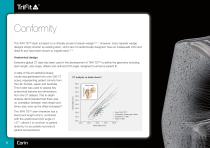
Conformity The TriFit TS™ stem is based on a clinically proven bi-planar wedge4,5,6,7. However, many tapered wedge designs simply shorten an existing stem, which are not anatomically designed, have an inadequate CCD and distal fit and have been shown to migrate early11,12. Anatomical design Extensive global CT data has been used in the development of TriFit TS™ to define the geometry including stem length, size range, offsets and optimal CCD angle, designed to enhance patient fit. The TriFit TS™ stem therefore has a fixed neck length which, combined with the anatomical CCD angle of 127°, allows...
Open the catalog to page 6
Size range Restoration of the centre of rotation and biomechanics of differing patient anatomies is facilitated via a comprehensive suite of sizes, whilst small increments and two offset options (standard and lateralised) ensure a seamless range. standard offset medial stem length (mm) lateral stem length (mm) Standard offset Lateral offset neck length lateral stem length medial stem length offset neck length (mm) (mm) offset neck length (mm) (mm) Progressive size increments with direct lateralisation to optimise soft tissue tension Responsible Innovation
Open the catalog to page 7
Stability The proximal-to-distal ratio, distal sweep and proximal flare are designed to promote proximal loading and prevent distal hang-up, which may reduce the risk of subsidence as seen with other stems of this philosophy11,12. TriFit TS™ is manufactured from forged titanium alloy for strength and biocompatibility. Distally the stem is polished to help prevent osteointegration by transferring load proximally. Pure titanium is vacuum plasma sprayed over the proximal portion, which is then overlaid with 20μm of BONIT® coating. Primary stability Axial stability ■■ Anterior-posterior dual taper...
Open the catalog to page 8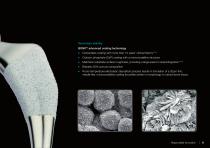
Secondary stability BONIT® advanced coating technology ■■ Cementless coating with more than 15 years’ clinical history13,14 Calcium phosphate (CaP) coating with a microcrystalline structure Maintains substrate surface roughness, providing a large area for osseointegration15,16 Biphasic 60% porous composition Room temperature electrolytic deposition process results in formation of a 20µm thin, needle-like, microcrystalline coating (brushite) similar in morphology to natural bone tissue Responsible Innovation
Open the catalog to page 9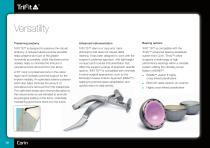
Versatility Preserving anatomy Advanced instrumentation Bearing options TriFit TS™ is designed to preserve the natural anatomy. A reduced lateral proximal shoulder helps preserve as much of the greater trochanter as possible, whilst the distal portion similarly helps to minimise the amount of cancellous bone removed from the femur. TriFit TS™ stem is a ‘rasp only’ stem philosophy that does not require distal reaming. It has been designed to work with the surgeon’s preferred approach, with lightweight compact and modular instrumentation that offers the surgeon a range of approach-specific options....
Open the catalog to page 10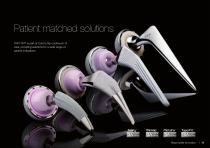
Patient matched solutions TriFit TS™ is part of Corin's hip continuum of care, providing solutions for a wide range of patient indications ODEP rating ODEP rating ODEP rating Responsible Innovation
Open the catalog to page 11
References: 1. Healy WL, Tilzey JF, Iorio R, Specht LM, Sharma S. Prospective, randomized comparison of cobalt-chrome and titanium trilock femoral stems. The Journal of Arthroplasty 2009;24(6):831-836. 2. Meding JB, Galley, MR, Ritter MA. High survival of uncemented proximally porouscoated titanium alloy femoral stems in osteoporotic bone. Clinical Orthopaedics and Related Research 2010;468:441–447. 3. Lachiewicz PF, Soileau ES, Bryant P. Second-generation proximally coated titanium femoral component: Minimum 7-year results. Clinical Orthopaedics and Related Research 2007;465:117-121. 4. Sakalkale...
Open the catalog to page 12All Corin catalogs and technical brochures
 MiniHip™ - The evidence base
16 Pages
 MiniHip™ - product overview
12 Pages
 Trinity™ - surgical technique
16 Pages
 Trinity - design rationale
12 Pages
 Biomimetic Cementless Technology
12 Pages
 ECiMa™
12 Pages
 TriFit TS™
12 Pages
 Trinity™ - product overview
12 Pages
 Optimized Positioning System
12 Pages
 Unity knee surgical technique
24 Pages
 TriFit TS surgical technique
12 Pages
 MiniHip™ - surgical technique
12 Pages
 OPS™
OPS™6 Pages
 Unity KneeTM
16 Pages
 MiniHip - design rationale
16 Pages
 MiniHip - product overview
12 Pages
 Trinity
12 Pages


- Knee prosthesis
- Acetabular prosthesis
- Cementless femoral stem
- Cementless acetabular prosthesis
- Hip prosthesis
- Femoral head prosthesis
- Cemented femoral stem
- Primary hip prosthesis
- Cementless hip prosthesis
- Revision knee prosthesis
- Mobile-bearing knee prosthesis
- Cemented knee prosthesis
- Motion assessment system
- Cemented hip prosthesis
- Mobile assessment system
- Minimally invasive femoral stem
- Minimally invasive hip prosthesis