


ECGmax

ECGmax
This special edition of corpuls.science highlights advancements in electrocardiogram (ECG) technology, focusing on the 22-lead ECG system. This system enhances the traditional 12-lead ECG by providing a more comprehensive view of cardiac activity without changing electrode placement.
The ACS (Acute Coronary Syndrome) algorithm is essential for diagnosing myocardial ischemia and infarction, distinguishing between STEMI and NSTEMI based on specific ECG changes. It aids in quick diagnosis and risk assessment, crucial for timely treatment.
ECG filtering is vital in emergency medicine to reduce artifacts caused by environmental factors, ensuring accurate ECG interpretation. Corpuls devices offer various filters to minimize these artifacts, enhancing the reliability of ECG readings.
The 22-lead ECG system includes posterior, right cardiac, and orthogonal leads, providing a more detailed cardiac assessment. It is integrated with the corpuls.mission server for real-time data sharing and analysis.
The CEB® is a novel biomarker offering real-time cardiac injury assessment, comparable to troponin tests, without additional interventions. It simplifies diagnosis with a traffic light system, enhancing clinical decision-making.
Advancements in ECG technology, particularly the 22-lead system and CEB®, represent significant progress in cardiac diagnostics, offering comprehensive and real-time insights into cardiac health.
ECG filtering is essential for reducing interference and ensuring accurate readings. Notch filters target specific frequencies like mains frequency, while low-pass filters reduce high-frequency noise. High-pass filters address low-frequency interference from breathing. However, filtering can alter ECG morphology, affecting diagnostic accuracy.
Bandpass filters combine low- and high-pass filters to manage interference. For diagnostic purposes, a high-pass filter of 0.05 Hz and a low-pass filter of 150 Hz are recommended to preserve ECG signal integrity.
The primary goal of ECG monitoring is to detect life-threatening arrhythmias like ventricular fibrillation. During patient transport, interference can hinder rhythm detection. A bandpass filter with the smallest frequency bandwidth is advised to minimize noise.
ECG signals are transmitted via infrared or wireless to devices like corpuls3 TOUCH. The process involves digital filtering, signal processing for VF and QRS detection, and heart rate calculation. The corpuls.mission platform facilitates telemedical communication.
corpuls.mission is a medical communication platform designed for preclinical missions, integrating medical data, chat, video, and documentation. It supports telemedical connections, real-time monitoring, and secure data handling.
ECGmax enhances traditional 12-lead ECGs by providing 22 leads, aiding in diagnosing conditions like posterior myocardial infarctions. The Cardiac Electrical Biomarker (CEB®) offers a quick assessment of myocardial ischemia.
ECG filtering and advanced diagnostic tools like ECGmax are crucial for accurate cardiac assessments. The corpuls.mission platform enhances communication and data management in medical missions.
The document discusses advancements in electrocardiography (ECG) and vectorcardiography (VCG), focusing on the derivation of ECG leads from a reduced number of electrodes and the utility of VCG in clinical practice.
The document outlines a method to derive 22 ECG leads from just 3 measured leads using a universal patient coefficient matrix (UPCM).
A study involving 371 measured ECGs was conducted, showing high correlation with derived ECGs.
The VCG is highlighted as a valuable diagnostic tool, offering more information than conventional ECGs.
The document emphasizes the reinvigoration of ECG through its association with VCG, providing enhanced diagnostic capabilities.
The integration of derived ECG and VCG techniques represents a significant advancement in cardiac diagnostics.
The document discusses the importance of teaching vectorcardiography (VCG) alongside electrocardiography (ECG) to medical students.
The combination of ECG and VCG enhances the diagnosis of sophisticated pathologies.
VCG offers greater specificity and sensitivity compared to ECG alone.
The ECG/VCG association is crucial for identifying myocardial infarction areas, fascicular blocks, and their associations.
ECG/VCG helps clarify end-conduction delays, which can mimic myocardial infarction areas.
Recent advancements include criteria for diagnosing Brugada syndrome and early repolarization patterns.
ECG/VCG is a definitive tool for diagnosing ARVC.
The document emphasizes the importance of integrating VCG with ECG in clinical practice to improve diagnostic accuracy.
The document discusses the use of a novel Cardiac Electrical Biomarker (CEB) for detecting acute myocardial ischemic injury (AMII) in emergency department (ED) settings.
The study highlights high correlations between traditional ECG and derived ECG (dECG), supporting the clinical use of dECG.
A retrospective study was conducted involving 411 patients evaluated for acute myocardial infarction (AMI) in the ED.
The CEB indicated myocardial injury in 28.2% of participants.
The CEB demonstrates high diagnostic accuracy and can be a cost-effective tool for identifying AMII in acute care settings.
Statistical methods included linear regression and correlation analysis to evaluate the relationship between CEB and HsTnI.
Catalog excerpts

Standard 12-lead ECG plus posterior, right cardiac and orthogonal leads CARDIAC ELECTRICAL BIOMARKER IENCE ** S PE L ED Online calculation, sharing and forwarding of ECGmax Realtime non-invasive indicator for cardiac injury
Open the catalog to page 1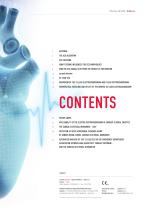
SPECIAL EDITION | ECGmax HOW FILTERING INFLUENCES THE ECG MORPHOLOGY HOW THE ECG SIGNAL GETS FROM THE PATIENT TO THE MONITOR DERIVATION OF THE 12-LEAD ELECTROCARDIOGRAM AND 3-LEAD VECTORCARDIOGRAM MATHEMATICAL MODELING AND UTILITY OF THE DERIVED 22-LEAD ELECTROCARDIOGRAM VECTOR LOOPS APPLICABILITY OF THE ELECTRO-VECTORCARDIOGRAM IN CURRENT CLINICAL PRACTICE THE CARDIAC ELECTRICAL BIOMARKER – CEB® DETECTION OF ACUTE MYOCARDIAL ISCHEMIC INJURY BY GENDER USING A NOVEL CARDIAC ELECTRICAL BIOMARKER AUTOMATED ANALYSIS OF THE 12-LEAD ECG IN THE EMERGENCY DEPARTMENT: ASSOCIATION BETWEEN HIGH-SENSITIVITY...
Open the catalog to page 2
DEAR LADIES AND GENTLEMEN In the second corpuls.science we have chosen one of our most core technologies. This issue will focus on electrocardiograms. It has become the standard in Emergency Medicine to just attached a bunch of electrodes to the patient for monitoring reasons. For at least 25 years, whenever a patient presents with symptoms possibly indicating that something is not quite right with the heart, the patient receives a diagnostic ECG. Nowadays the 12-lead ECG is part of every guideline and recommendation to do with Acute Coronary Syndromes and is usually referred to as the “gold-standard”....
Open the catalog to page 3
SPECIAL EDITION | ECGmax THE ACS ALGORITHM The classic 12-lead ECG represents a snapshot of the electrical activity of the heart. With this snapshot it is possible to diagnose various rhythmological and structural diseases of the heart. Due to this fact, the 12-lead ECG is the most important diagnostic tool for myocardial ischemia and infarction and is the basis for further therapeutic and diagnostic measures (Wagner et al. 2009). Myocardial infarction (MI) leads to muscular injury (scarring) and consequently to a change in the conduction properties in the heart. In the ECG, it is often associated...
Open the catalog to page 4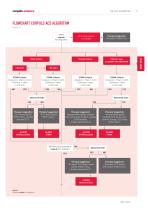
FLOWCHART CORPULS ACS ALGORITHM Version 1.7 START corpuls ACS Algorithm Female Patient Male Patient Therapy Suggestion „No advice (invalid ECG)“ Patient’s age or gender not submitted ST-elevation > 200µV in V2/V3; ST-elevation > 100µV in other leads ST-elevation > 250µV in V2/V3; ST-elevation > 100µV in other leads ST-elevation > 150µV in V2/V3; ST-elevation > 100µV in other leads ST-elevation > 150µV in V2/V3; ST-elevation > 100µV in other leads Therapy Suggestion “ECG meets specific STEMI criteria, consider abnormal ECG” Therapy Suggestion “ECG meets specific STEMI criteria” ALARM STEMI possible...
Open the catalog to page 5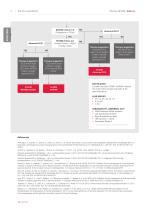
SPECIAL EDITION | ECGmax NSTEMI CHECK YES NSTEMI-Critera 2/2 Inverted T-wave > 100µV in Wilson Leads Therapy Suggestion “ECG shows acute ischemic changes, ECG meets NSTEMI criteria, consider abnormal ECG” ALARM NSTEMI possible Therapy Suggestion “ECG shows acute ischemic changes, ECG meets NSTEMI criteria” ALARM NSTEMI NO Therapy Suggestion “No advice, ECG doesn’t meet specific STEMI or NSTEMI criteria, consider abnormal ECG” Therapy Suggestion “No advice, ECG doesn’t meet specific STEMI criteria” NOTIFICATION Consider that each STEMI- / NSTEMI-Criterion has to be met by at least two leads of...
Open the catalog to page 6
ECG FILTERING With the increase in diseases of the cardiovascular system, the electrocardiogram (ECG) is an essential tool for preclinical diagnostics in modern emergency medicine. It is recommended to continuously monitor patients with such diseases so to quickly detect life-threatening arrhythmias. [1] In the preclinical setting, the recorded ECG may show artifacts due to various environmental factors. These can affect the interpretation of the ECG signal. [5] Artifacts can be caused by the patient’s muscle activity, transport movements or electrical coupling of the mains frequency, for example....
Open the catalog to page 7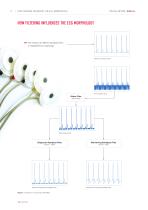
SPECIAL EDITION | ECGmax HOW FILTERING INFLUENCES THE ECG MORPHOLOGY HOW FILTERING INFLUENCES THE ECG MORPHOLOGY The influence of different bandpass filters on displayed ECG morphology Native ECG without noise Diagnostic Bandpass-Filter Monitoring Bandpass-Filter Filtered with diagnostic bandpass filter Figure 1 (as referred to in the text ECG FILTERING) Filtered with monitoring bandpass filte
Open the catalog to page 8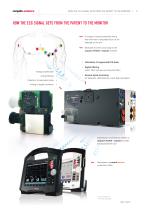
HOW THE ECG SIGNAL GETS FROM THE PATIENT TO THE MONITOR HOW THE ECG SIGNAL GETS FROM THE PATIENT TO THE MONITOR A change in electrical potential arising from the heart’s myocardial tissue can be detected on the skin Electrodes link the human body to the corpuls3 TOUCH / corpuls3 CLASSIC • Calculation of augmented ECG leads Analog amplification Analog filtering Detection of pacemaker spikes Analog to digital conversion • Digital filtering (notch filter, high-pass and low-pass filter) • General signal processing (VF Detection, QRS Detection, Heart Rate calculation) Transmission via infrared or...
Open the catalog to page 9
SPECIAL EDITION | ECGmax corpuls.mission is a medical communication platform designed with the patient as the main focus. It enables knowledge to be collected where it can be best utilised: during a mission. Above anything else, adequate patient treatment requires specific knowledge, often stemming from different disciplines and selected experts. However, this complexity of medicine cannot rest on the shoulders of a single specialist. By combining medical data, chat, video and documentation, all relevant information is found in one place – one software, intuitive and central. Available for web,...
Open the catalog to page 10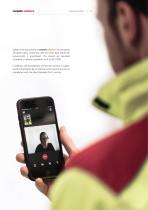
KAPITEL TITEL Safety is the top priority at corpuls.mission. By encrypting all patient data, conformity with the strict data protection requirements is guaranteed. The servers are operated according to relevant standards, such as ISO 27001. In addition, the development of the entire product is subject to strict observation by an external control authority and is in compliance with the latest standards for IT security.
Open the catalog to page 11All Corpuls catalogs and technical brochures
 Corpuls Simulation
7 Pages
 Synchronised CPR
9 Pages
 corpuls control
2 Pages
 C3T
C3T13 Pages
 corpuls.web ANALYSE
6 Pages
 CORPULS3
6 Pages
 CORPULS1 BROCHURE
6 Pages
 corpuls cpr
6 Pages
 corpuls aed
6 Pages
 corPatch CPR Flyer
2 Pages
 corpuls.web flyer
2 Pages
 Brochure corpuls3 for clinic
18 Pages
 Brochure corpuls3 System
9 Pages
 Brochure corpuls1
5 Pages
 corpuls.web
2 Pages
 corpuls3 SLIM
2 Pages
 corpuls³
2 Pages
 corpuls 1
2 Pages

Archived catalogs
 corpuls.web LIVE
6 Pages
- SpO2 sensor
- EKG
- Digital electrocardiograph
- External defibrillator
- Reusable SpO2 sensor
- Automatic external defibrillator
- Biphasic external defibrillator
- External defibrillator with monitor
- Semi-automatic external defibrillator
- Reflectance SpO2 sensor
- External defibrillator with ECG monitor
- Biosignal acquisition system
- Manual external defibrillator
- Oxygen therapy system
- Telemonitoring station
- External defibrillator with multi-parameter monitor
- Research biosignal acquisition system
- Vital sign telemonitoring station
- Auricular SpO2 sensor
- Portable oxygen therapy system