

Temptest

Temptest
- Class IIa medical device.
- Only device defined in guidelines for inducible urticaria.
- Essential for UCARE certification.
- Suitable for adults and children.
- Rare side effects.
- Helps patients avoid symptoms through informed behavior and protection.
Catalog excerpts
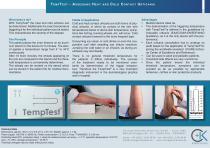
What does it do? With TempTest® the heat and cold urticaria can be determined. Additionally the exact temperature triggering it for the individual patient can be stated. This characterizes the severity of the disease. The Principle The patient places the inner forearm on an aluminum stencil on the device for 5 minutes. The stencil applies a temperature range from 4° to 44°C continuously. After 10 more minutes, the wheals appearing on the arm are compared to the stencil and the threshold temperature is conveniently determined. The wheals can be marked on the stencil which can be stored in the patient file for medical documentation. Fields of Application Cold and heat contact urticaria are both forms of physical urticaria, in which by contact of the skin with temperatures below or above skin temperature, symptoms like itching, burning wheals, etc. will occur. Cold contact urticaria however is the more frequent type. Consuming ice cream or cold drinks or even the evaporative cool after sweating can induce reactions. Jumping into cold water or an infusion, as during anesthesia may end deadly. There is no general threshold temperature for the patients. It differs individually. The success of the treatment needs to be monitored constantly by determination of the trigger temperature. Therefore the TempTest® is a very important diagnostic instrument in the dermatological practice and in hospital. Technical Data Dimensions: approx. 35.5 x 14 x 9.5 cm (L x W x H), Weight: approx. 1.7 kg Power supply: 100-240 V, 50/60 Hz, Power consumption 1,5 -0,5 A, Fuse: T10AH250V, 5 x 20 mm Protecting class IP21, protection rating 1, class IIa medical product, accuracy: +/- 2° C, operation temperature: 10-27°C, max. r.H.: 80%, storage temperature: -10-35°C Technical changes may be made without prior notice. Advantages • Medical device class IIa. • The determination of the triggering temperature with TempTest® is defined in the guidelines for inducable urticaria (EAACI/GA²LEN/EDF/WAO Guideline), as it is the only device with this performance. • Each urticaria consultation has to undergo an audit based on the application of TempTest® for joining the worldwide accepted UCARE (Urticaria Center of Excellence and Reference). • Can be used on adult and pediatric patients. • Unwanted side effects are very uncommon. • Once the patient knows the individual threshold temperature, symptoms can be avoided as far as possible by appropriate behaviour, clothes or skin protection products.
Open the catalog to page 1
Siebenhaar, F., Staubach, P., Metz, M., Magerl, M., Jung, J., & Maurer, Peltier effectbased temperature challenge – an improved method for diagnosing cold urticaria. J.Allergy Clin. Immunol. 2004: 114; 1224-1225. • Magerl, M., Schmolke, J, Siebenhaar, F., Zuberbier, T., Metz, M., & Maurer, Acquired cold urticaria symptoms can be safely prevented by Ebastine. Allergy 2007: 62; 1465-1468. • Siebenhaar, F., Weller, K., Młynek, A., Magerl, M., Altrichter, S., Vieira dos Santos, R., Maurer, M., and Zuberbier, Acquired cold urticaria: clinical picture and update on diagnosis and treatment. Clin. Exp....
Open the catalog to page 2All Courage + Khazaka Electronic catalogs and technical brochures
 Skin-pH-Meter PH 905
1 Page
 Tewitro® TW 24
1 Page
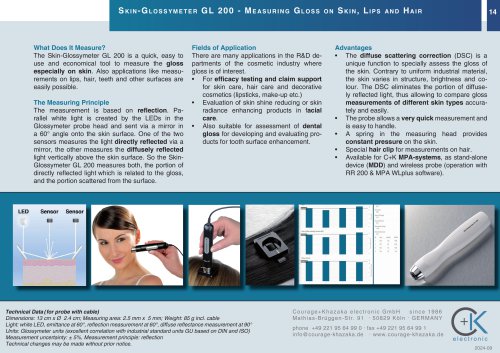 Skin-Glossymeter GL 200
1 Page
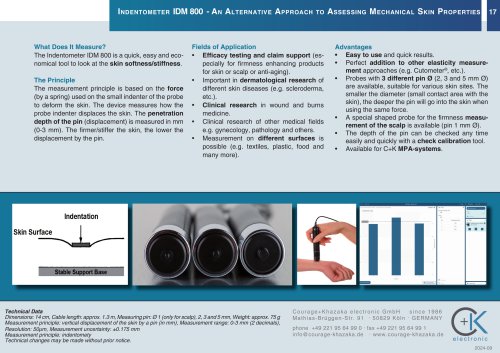 Indentometer IDM 800
1 Page
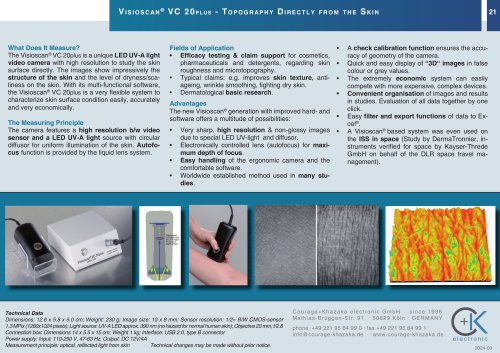 Visioscan® VC 20plus
2 Pages
 DandruffMeter DA 20
1 Page
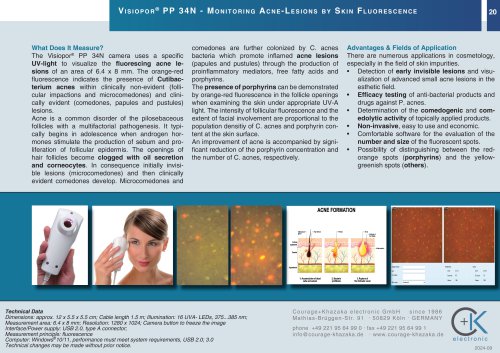 Visiopor® PP 34 N (2025)
1 Page
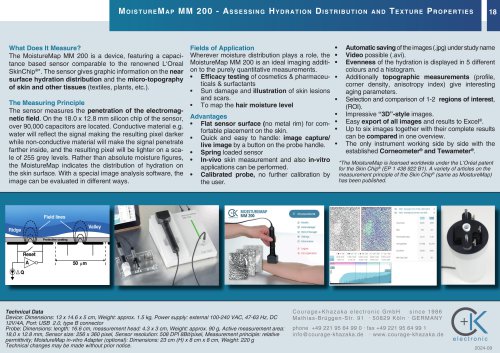 MoistureMap MM 200
1 Page
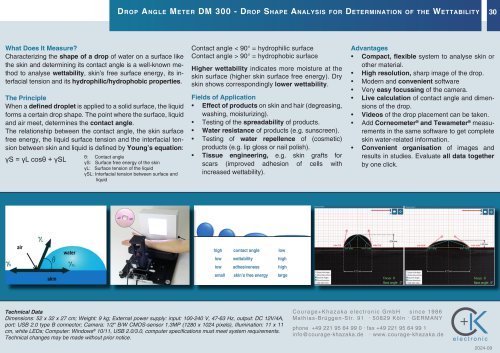 Drop Angle Meter DM 300
1 Page
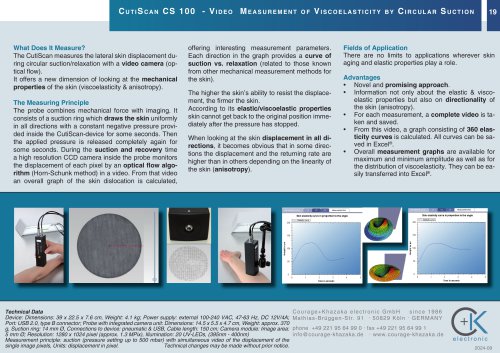 CutiScan CS 100
1 Page
 Cutometer® Dual MPA 580
2 Pages
 Visiopor® PP 34 N
1 Page
 Skin Diagnostic SD 27
1 Page
 Skin Diagnostic SD 202
1 Page
 Ultrascan UC 22
2 Pages
 Mexameter® MX 18
1 Page
 Sebumeter® SM 815
1 Page
 CORNEOMETER ® CM825
1 Page



- Ultrasound system
- Analysis software
- B/W ultrasound system
- Windows software
- Camera with USB port
- On-platform ultrasound system
- Diagnostic software
- Online software
- Automated software
- Design software
- Medical camera
- Treatment software
- Data management software
- Measurement software
- Web-based software
- Test software
- Import software
- Portable camera
- Image analysis software
- Research software