

Osiris-T
Osiris-T
Catalog excerpts

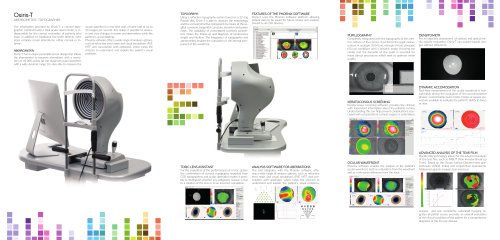
ABERROMETER | TOPOGRAPHER The information provided by Osiris-T, a corneal topographer combined with a total ocular aberrometer, is indispensable for the correct evaluation of patients who have, in addition to traditional low-order defects, even more complex ocular aberrations, either corneal or internal. Osiris-T has a unique pyramidal sensor design that allows the aberrometer to measure aberrations with a resolution of 45,000 points (at the maximum pupil diameter), with a wide dynamic range. It is also able to measure the ocular wavefront in real time with a frame rate of up to 33 images per second: this makes it possible to measure and view changes in power and aberrations while the patient is accomodating. Phoenix software offers a wide range of analysis options, such as refractive error maps and visual simulations (PSF, MTF and convolution with optotype), which helps the clinician to understand and explain the patient’s visual problems. Using a reflection topography system based on a 22 ring Placido disk, Osiris-T is able to measure the morphology and the corneal refractive component by means of the sagittal curvature, tangential curvature, elevation and power maps. The availabilty of consolidated synthesis parameters makes the follow-up and diagnosis of keratoconus simple and intuitive. The integration of topographry and aberrometery enables the calculation of the internal component of the wavefront. FEATURES OF THE PHOENIX SOFTWARE Osiris-T uses the Phoenix software platform allowing patient data to be saved for future review and analysis, shared by all CSO devices. Completely integrated with the topography of the anterior surface of the cornea, it performs the pupil measurement in scotopic (0.04 lux), mesopic (4 lux), photopic (50 lux) conditions and in dynamic mode. Knowing the center and the diameter of the pupil, is essential for many clinical procedures which seek to optimize vision quality. For an objective assessment of cataract and optical media opacity evaluation, Osiris-T can acquire backlit images without reflections. DYNAMIC ACCOMODATION KERATOCONOUS SCREENING Keratoconous screening software, provides the clinician with imporatant information about the patients cornea. Understanding this can help prevent complications associated with ectasia before corneal surgery is undertaken. Real-time measurement of the ocular wavefront is indispensable during the evaluation of the accommodative phases. Customizable exam modes (ramps or square waves) are available to evaluate the patient’s ability to focus at near. ADVANCED ANALYSIS OF THE TEAR FILM OCULAR WAVEFRONT TORIC LENS ASSISTANT For the evaluation of the performances of a toric system the combination of corneal topography imported from CSO topographers and ocular aberration makes it possible to distinguish whether any astigmatic residue is due to a rotation of the lens or to an incorrect calculation. ANALYSIS SOFTWARE FOR ABERRATIONS The tool integrates with the Phoenix software, offering a wide range of analysis options, such as refractive error maps and visual simulations (PSF, MTF and convolution with optotype), which helps the clinician to understand and explain the patient’s visual problems. Phoenix software enables the analysis of the patient’s ocular wavefront, both as a deviation from the wavefront and as a refractive dfference from the ideal. Placido disk technology allows for the advanced analysis of the tear film, such as NIBUT (Non Invasive Break-up Time). Based on the Ocular Surface Disease Index questionnaire (OSDI), limbal and conjunctival hyperaemia, Meibomian glands analysis, tear meniscus analysis and tear osmolarity, calculated merging together all partial scores, provides an owerall evaluation of the clinical condition of the patient for a comprehesive diagnosis of the
Open the catalog to page 1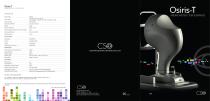
TECHNICAL DATA Data transfer Power supply external power source 24 VCC In: 100-240Vac - 50/60Hz - 0.9-05A - Out: 24Vdc - 40W Dimensions (HxWxD) Chin rest movement Minimum height of the chin cup from the table Working distance LIGHT SOURCES Aberrometer ABERROMETRY Points measured at maximum pupil Spatial resolution Pupil size range Dioptric range YOUR PROFESSIONAL PARTNER SINCE 1967 TOPOGRAPHY Placido rings Measured points Dioptric measurement range Measurement accuracy Compatibility with standard DICOM v3 (IHE integration profile EYECARE Workflow) MINIMUM SYSTEM REQUIREMENT PC: 4 GB RAM - Video...
Open the catalog to page 2All CSO - Costruzione Strumenti Oftalmici catalogs and technical brochures
 VISION CHART
3 Pages
 Vintage
9 Pages
 ETOILE2
2 Pages
 PERSEUS
3 Pages
 Osiris
2 Pages
 ANTARES
6 Pages
 SIRIUS
6 Pages
 MODI’ 02
2 Pages
 MS-39
MS-396 Pages
 Cobra HD
5 Pages
 RETIMAX
6 Pages
 Applanation tonometers
6 Pages
 CONTACTOLOGY WORK TABLE
2 Pages
 JVL/1 ophthalmometer
1 Page
 THE NEW SLIT LAMPS GAMMA
2 Pages
 catalog 2011
9 Pages
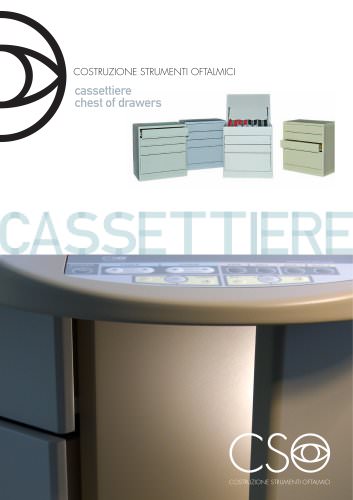 CASSETTIERE
2 Pages
 POLTRONE
2 Pages
 Compact
2 Pages
 ELEGANCE
2 Pages
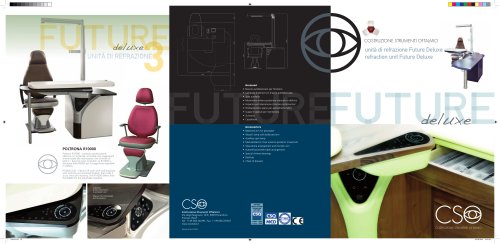 FUTURE DELUXE
2 Pages
 SP02
SP022 Pages
 SERIE ELITE
2 Pages
 MODELLI SL980
2 Pages
 MODELLI SL990
2 Pages

Archived catalogs
 Cobra
Cobra2 Pages
- Examination chair
- Height-adjustable examination chair
- Electric examination chair
- Examination chair with legrest
- 3-section examination chair
- Examination chair with adjustable backrest
- Fixed ophthalmic examination
- Blue examination chair
- Black examination chair
- Slit lamp
- Workstation with chair
- Table slit lamp
- Workstation with light
- Ophthalmoscope
- White examination chair
- Compact workstation
- Ophthalmic workstation
- Red examination chair
- Ophthalmic examination chair
- Ophthalmic instrument table