
- Catalogs
- Cubic Sensor and Instrument Co.,Ltd.
- Comparison between ultrasonic and electro-chemical oxygen sensor in ventilator application

- Company
- Products
- Catalogs
- News & Trends
- Exhibitions
Comparison between ultrasonic and electro-chemical oxygen sensor in ventilator application

Comparison between ultrasonic and electro-chemical oxygen sensor in ventilator application
Ultrasonic and electro-chemical oxygen sensors are used in ventilator applications to measure oxygen concentration. The electrochemical sensor operates by generating a current proportional to the dissolved oxygen in an electrolytic solution, which is then used to determine oxygen concentration. The ultrasonic sensor uses flow detection theory, where the ultrasonic wave's interaction with fluid velocity helps measure flow rate and concentration based on sound speed variations in different gas compositions.
- Ultrasonic Sensor: Offers stability, requires no calibration, has a long lifetime, and can measure both concentration and flow. However, it is limited to binary gases and can be influenced by moisture.
- Electrochemical Sensor: Known for low power consumption and high sensitivity but has a short lifetime of about two years, high cost, and is limited to gas concentration measurement with large drift.
The test report compares the ultrasonic sensor (Gasboard7500C) and the electrochemical sensor (PSR-917-M). The ultrasonic sensor is highlighted for its advantages, including no need for routine calibration, long lifespan, high stability, and the ability to measure both oxygen concentration and flow simultaneously.
The ultrasonic oxygen sensor is preferred due to its long lifespan, stability, and dual measurement capability, making it a more efficient choice for ventilator applications.
Catalog excerpts
Comparison between ultrasonic and electro-chemical oxygen sensor in ventilator application
Open the catalog to page 1
Introduction of ultrasonic and electro-chemical oxygen sensor Advantages comparison between ultrasonic and electrochemical sensor Test report between ultrasonic (Gasboard7500C) and electrochemical sensor ( PSR-917-M)
Open the catalog to page 2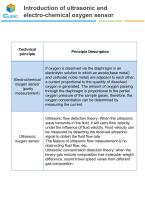
Introduction of ultrasonic and electro-chemical oxygen sensor Technical principle
Open the catalog to page 3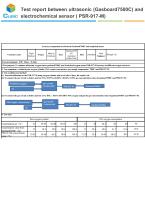
IP Test report between ultrasonic (Gasboard7500C) and Cubic electrochemical sensor ( PSR-917-M)
Open the catalog to page 5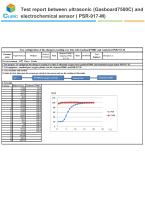
Two con hail ration of the change in reading over time with (>asboard75()0(. and Analytical PSR-9I7-M ( uvlomiT rlight Medical Medical Ventilator Test environment : 26'C FIovm llVmin 1 I cst purpose: To configurate1 he change in reading over lime of ultrasonic oss^cn sensor dinar d .'^IKK and Analytical oex^cn sensor PSR-917-M 2. Test equipment : standard pure oxygen cylinder, test kit. Ciasboard7500C and PSR-9I7-M. 3. Test condition and method; (2) Inlet air first, then open the oxvgcn gas circuit to the sensors and see the reading in 20scconds
Open the catalog to page 6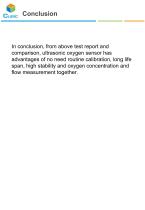
In conclusion, from above test report and comparison, ultrasonic oxygen sensor has advantages of no need routine calibration, long life span, high stability and oxygen concentration and flow measurement together.
Open the catalog to page 7All Cubic Sensor and Instrument Co.,Ltd. catalogs and technical brochures
 About Cubic
1 Page
 Mainstream NDIR ETCO2 Sensor
3 Pages








Archived catalogs
 Fast Response CO2 Sensor
1 Page


- CUBIC medical sensor
- CUBIC monitoring sensor
- CUBIC gas sensor
- Laboratory sensor
- Vitals monitor
- CUBIC flow sensor
- Spirometer
- CUBIC particle counter
- Vital sign sensor
- Calibration sensor
- Electronic spirometer
- Process sensor
- Intensive care vital signs monitor
- Laser particle counter
- Humidity sensor
- Portable vitals monitor
- Clinical vital signs monitor
- CUBIC respiratory device sensor
- CUBIC intensive care sensor