
- Catalogs
- Cubic Sensor and Instrument Co.,Ltd.
- Ultrasonic Technology Introduction

- Company
- Products
- Catalogs
- News & Trends
- Exhibitions
Ultrasonic Technology Introduction

Ultrasonic Technology Introduction
Ultrasonic technology is applied in gas flow meters and gas concentration sensors. This document outlines the principles and benefits of using ultrasonic measurement for detecting gas flow and oxygen concentration, with a focus on Cubic ultrasonic oxygen sensors.
- No need for calibration in application
- Long lifetime, approximately 5-10 years
- Compact size, easy to install
- Low cost, high accuracy, and good stability
- Capability to measure gas concentration and flow simultaneously
The ultrasonic concentration detection theory is based on the variation of sound travel speed due to differences in molecular weight in a binary gas mixture.
The ultrasonic oxygen flow meter measures sound waves in the flow of media, utilizing the relationship between time and flow. The actual propagation velocity of the acoustic wave in the fluid is a combination of the propagation velocity of sound waves in the stationary state of the medium and the axial average velocity of the fluid in the direction of acoustic wave propagation.
Catalog excerpts
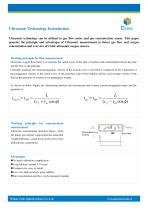
Ultrasonic Technology Introduction Ultrasonic technology can be utilized in gas flow meter and gas concentration sensor. This paper presents the principle and advantages of Ultrasonic measurement to detect gas flow and oxygen concentration and overview of Cubic ultrasonic oxygen sensors. Working principle for flow measurement Ultrasonic oxygen flow meter is to measure the sound waves in the flow of media in the relationship between the time and the flow as the principle. Generally speaking, the actual propagation velocity of the acoustic wave in the fluid is composed of the component of the propagation velocity of the sound waves in the stationary state of the medium and the axial average velocity of the fluid in the direction of acoustic wave propagation weight. As shown in below Figure, the relationship between the downstream and counter current propagation times and the quantities is: Working principle for concentration measurement Ultrasonic concentration detection theory: when the binary gas mixture composition has molecular weight difference, sound travel speed varies from different gas composition. Advantages ◆No need calibration in application ◆Long lifetime, around 5-10 years ◆Compact size, easy to install ◆Low cost, high accuracy, good stability ◆Gas concentration and flow can be measured together Wuhan Cubic Optoelectronics Co., Lt
Open the catalog to page 1All Cubic Sensor and Instrument Co.,Ltd. catalogs and technical brochures
 About Cubic
1 Page
 Mainstream NDIR ETCO2 Sensor
3 Pages








Archived catalogs
 Fast Response CO2 Sensor
1 Page


- CUBIC medical sensor
- CUBIC monitoring sensor
- CUBIC gas sensor
- Laboratory sensor
- Vitals monitor
- CUBIC flow sensor
- Spirometer
- CUBIC particle counter
- Vital sign sensor
- Calibration sensor
- Electronic spirometer
- Process sensor
- Intensive care vital signs monitor
- Laser particle counter
- Humidity sensor
- Portable vitals monitor
- Clinical vital signs monitor
- CUBIC respiratory device sensor
- CUBIC intensive care sensor