- Catalogs
- CyberLogic
- New Desktop Ultrasonic Bone Densitometer

New Desktop Ultrasonic Bone Densitometer

New Desktop Ultrasonic Bone Densitometer
The document discusses a study evaluating the UltraScan 650, a novel ultrasound device designed for estimating bone mineral density (BMD) at the 1/3 radius. This portable device aims to enhance osteoporosis diagnosis, a condition with significant healthcare implications.
Device and Methodology
The UltraScan 650 utilizes ultrasound technology to measure two net time delay parameters, NTDDW and NTDCW, which correlate with BMD as measured by dual-energy X-ray absorptiometry (DXA). It operates by emitting a 3.5 MHz ultrasound signal through the forearm to estimate BMD.
Clinical Study
The study involved 60 adults and demonstrated a strong linear correlation (coefficient of 0.93) between the ultrasound device's measurements and DXA, indicating its potential for clinical application.
Discussion
While DXA is the gold standard for bone assessment, it is costly and less accessible. The ultrasound device offers a non-invasive, cost-effective alternative without ionizing radiation, potentially increasing osteoporosis diagnosis rates.
Conclusion
The study concludes that the ultrasound device could significantly enhance osteoporosis diagnosis and monitoring, providing a practical tool for primary care settings.
The study involved 60 adult subjects to evaluate the UltraScan 650 for estimating BMD at the 1/3 radius, conducted under an IRB-approved protocol with informed consent.
Demographics
The subjects had a mean age of 47 years, with a racial composition of 62% White, 7% African American, 16% Hispanic, and 15% Asian, and 68% were female.
Clinical Measurements
Subjects underwent three to five ultrasound measurements at the 1/3 radius using the UltraScan 650, with isopropyl alcohol as a coupling agent. A minimum of three independent measurements was required for precision.
Results
The study found a high correlation (r = 0.93, p < 0.001) between BMD measured by DXA and the ultrasound device's BMDUS, with a reproducibility study showing a percent coefficient of variation of 2.1%.
Discussion and Conclusion
The UltraScan 650 demonstrated high accuracy and precision in estimating radial BMD, supporting its use in primary care settings to reduce osteoporotic fractures through early intervention.
Figures and Data
The document includes figures showing the correlation between BMD and ultrasound measurements, with strong correlations indicated.
Acknowledgments
The study was supported by grants from the National Institutes of Health, with no influence from the funders on the study design or data interpretation.
Catalog excerpts
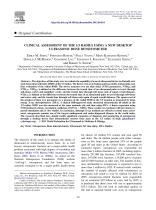
Ultrasound in Med. & Biol., Vol. 39, No. 3, pp. 388–395, 2013 Copyright Ó 2013 World Federation for Ultrasound in Medicine & Biology Printed in the USA. All rights reserved 0301-5629/$ - see front matter Original Contribution CLINICAL ASSESSMENT OF THE 1/3 RADIUS USING A NEW DESKTOP ULTRASONIC BONE DENSITOMETER EMILY M. STEIN,* FERNANDO ROSETE,* POLLY YOUNG,* MAFO KAMANDA-KOSSEH,* DONALD J. MCMAHON,* GANGMING LUO,yz JONATHAN J. KAUFMAN,yx ELIZABETH SHANE,* and ROBERT S. SIFFERTx * Department of Medicine, Columbia University College of Physicians and Surgeons, New York, NY, USA; y CyberLogic, Inc., New York, NY, USA; z Department of Rehabilitation Medicine, New York University School of Medicine, New York, NY, USA; and x Department of Orthopedics, The Mount Sinai School of Medicine, New York, NY, USA (Received 28 March 2012; revised 20 September 2012; in final form 27 September 2012) Abstract—The objectives of this study were to evaluate the capability of a novel ultrasound device to clinically estimate bone mineral density (BMD) at the 1/3 radius. The device rests on a desktop and is portable, and permits realtime evaluation of the radial BMD. The device measures two net time delay (NTD) parameters, NTDDW and NTDCW. NTDDW is defined as the difference between the transit time of an ultrasound pulse to travel through soft-tissue, cortex and medullary cavity, and the transit time through soft tissue only of equal overall distance. NTDCW is defined as the difference between the transit time of an ultrasound pulse to travel through soft-tissue and cortex only, and the transit time through soft tissue only again of equal overall distance. The square root of the product of these two parameters is a measure of the radial BMD at the 1/3 location as measured by dualenergy X-ray absorptiometry (DXA). A clinical IRB-approved study measured ultrasonically 60 adults at the 1/3 radius. BMD was also measured at the same anatomic site and time using DXA. A linear regression using NTD produced a linear correlation coefficient of 0.93 (p , 0.001). These results are consistent with previously reported simulation and in vitro studies. In conclusion, although X-ray methods are effective in bone mass assessment, osteoporosis remains one of the largest undiagnosed and under-diagnosed diseases in the world today. The research described here should enable significant expansion of diagnosis and monitoring of osteoporosis through a desktop device that ultrasonically assesses bone mass at the 1/3 radius. (E-mail: jjkaufman@ cyberlogic.org) Ó 2013 World Federation for Ultrasound in Medicine & Biology. Key Words: Osteoporosis, Bone mineral density, Ultrasound, Net time delay, DXA, Radius. for almost 44 million US women and men aged 50 and older. The 44 million people with either osteoporosis or low bone mass represent 55% of the people aged 50 and older in the United States. According to estimated figures, osteoporosis was responsible for more than 2 million fractures in 2005, including approximately 297,000 hip fractures, 547,000 vertebral fractures, 397,000 wrist fractures, 135,000 pelvic fractures and 675,000 fractures at other sites. The number of fractures attributable to osteoporosis is expected to rise to more than 3 million by 2025. If current trends continue, the number of people affected with osteoporosis or osteopenia will climb to over 61 million by 2020. In 2005, osteoporosis-related fractures were responsible for an estimated $19 billion in costs, and by 2025, it is predicted that these costs will rise to approximately $25.3 billion. The toll both in individual quality of life and in national health care costs of osteoporotic INTRODUCTION The objective of this study is to enhance the ability of ultrasound to noninvasively assess bone. As is well known, osteoporotic fractures are a major public health problem associated with high degrees of morbidity and mortality (Miller 1978; Melton 1988; Anonymous 2001; Kanis 2002; Kanis et al. 2009a). As stated on the National Osteoporosis Foundation (NOF) website ,nof.org., osteoporosis and low bone mass are currently estimated to be a major public health threat Address correspondence to: Jonathan J. Kaufman, Ph.D., CyberLogic, Inc., 611 Broadway, Suite 707, New York, NY 10012. E-mail: [email protected] Conflict of Interest: One of the authors (Jonathan J. Kaufman) is a principal and CEO of the company (CyberLogic, Inc.), which manufactures the UltraScan 650 device, and another of the authors (Gangming Luo) is an employee of the same company. None of the other authors report any conflic
Open the catalog to page 1
Capability of a novel ultrasound device to estimate BMD d E. M. STEIN et al. fractures cannot be overstated. Early detection and assessment is crucial to initiating therapeutic interventions as this is the best way to prevent a fracture from occurring (Kanis et al. 2009b). Presently the gold standard for bone assessment is based on X-ray densitometric techniques, such as with dual-energy X-ray absorptiometry (DXA) (Ott et al. 1987; Kaufman and Siffert 2001; Blake and Fogelman 2003; Bonnick 2004; Johnell et al. 2005). The measurement of bone mass as represented for example by (areal) bone mineral...
Open the catalog to page 2
Ultrasound in Medicine and Biology soft tissue to the array receiver. In water, the received waveform has a nominal center frequency of 3 MHz with a 3 dB bandwidth of 800 kHz. In operation, the source emits a broadband ultrasonic pulse at a rate of 1 kHz, the receiver waveforms are sampled at a 50 MHz sampling rate and for each channel 64 of the received sampled-waveforms are summed to obtain an averaged set of 64 received waveforms. A variable gain under software control (0–40 dB in 5 dB increments) is set independently for each channel to bring the maximum absolute value of each channel as...
Open the catalog to page 3
Capability of a novel ultrasound device to estimate BMD • E. M. Stein et al. the first half-cycle of the signal s^t), and NSW is the number of receiver channels that are associated with propagation through the soft tissue pathway. As noted above, a typical soft-tissue time delay estimate includes about ten channels (dependent on forearm and bone sizes), and the use of the moment computation serves to reduce the influence of noise due to the integrations in (1a). The determinations of tSW and tDW are done entirely analogously to eqns (1a) and (1b), but utilizing a set of (about 5-10) channels...
Open the catalog to page 4Archived catalogs
 Ultrasound Simulation in Bone
14 Pages
 UltraScan™ 650
2 Pages