- Catalogs
- CyberLogic
- Ultrasound Simulation in Bone

Ultrasound Simulation in Bone
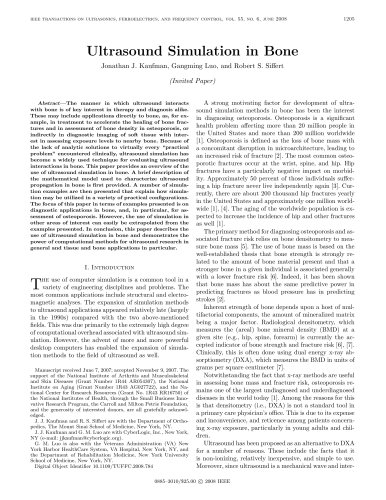
Ultrasound Simulation in Bone
Catalog excerpts
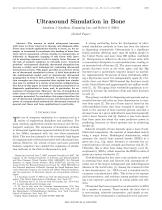
ieee transactions on ultrasonics, ferroelectrics, and frequency control, vol. 55, no. 6, june 2008 Ultrasound Simulation in Bone Jonathan J. Kaufman, Gangming Luo, and Robert S. Siffert (Invited Paper) Abstract—The manner in which ultrasound interacts with bone is of key interest in therapy and diagnosis alike. These may include applications directly to bone, as, for example, in treatment to accelerate the healing of bone fractures and in assessment of bone density in osteoporosis, or indirectly in diagnostic imaging of soft tissue with interest in assessing exposure levels to nearby bone. Because of the lack of analytic solutions to virtually every “practical problem” encountered clinically, ultrasound simulation has become a widely used technique for evaluating ultrasound interactions in bone. This paper provides an overview of the use of ultrasound simulation in bone. A brief description of the mathematical model used to characterize ultrasound propagation in bone is first provided. A number of simulation examples are then presented that explain how simulation may be utilized in a variety of practical configurations. The focus of this paper in terms of examples presented is on diagnostic applications in bone, and, in particular, for assessment of osteoporosis. However, the use of simulation in other areas of interest can easily be extrapolated from the examples presented. In conclusion, this paper describes the use of ultrasound simulation in bone and demonstrates the power of computational methods for ultrasound research in general and tissue and bone applications in particular. I. Introduction he use of computer simulation is a common tool in a variety of engineering disciplines and problems. The most common applications include structural and electromagnetic analyses. The expansion of simulation methods to ultrasound applications appeared relatively late (largely in the 1990s) compared with the two above-mentioned fields. This was due primarily to the extremely high degree of computational overhead associated with ultrasound simulation. However, the advent of more and more powerful desktop computers has enabled the expansion of simulation methods to the field of ultrasound as well. Manuscript received June 7, 2007; accepted November 9, 2007. The support of the National Institute of Arthritis and Musculoskeletal and Skin Diseases (Grant Number 1R44 AR054307), the National Institute on Aging (Grant Number 1R43 AG027722), and the National Center for Research Resources (Grant No. 1R43 RR16750) of the National Institutes of Health, through the Small Business Innovative Research Program, the Carroll and Milton Petrie Foundation, and the generosity of interested donors, are all gratefully acknowledged. J. J. Kaufman and R. S. Siffert are with the Department of Orthopedics, The Mount Sinai School of Medicine, New York, NY. J. J. Kaufman and G. M. Luo are with CyberLogic, Inc., New York, NY (e-mail: [email protected]). G. M. Luo is also with the Veterans Administration (VA) New York Harbor HealthCare System, VA Hospital, New York, NY, and the Department of Rehabilitation Medicine, New York University School of Medicine, New York, NY. Digital Object Identifier 10.1109/TUFFC.2008.784 A strong motivating factor for development of ultrasound simulation methods in bone has been the interest in diagnosing osteoporosis. Osteoporosis is a significant health problem affecting more than 20 million people in the United States and more than 200 million worldwide [1]. Osteoporosis is defined as the loss of bone mass with a concomitant disruption in microarchitecture, leading to an increased risk of fracture [2]. The most common osteoporotic fractures occur at the wrist, spine, and hip. Hip fractures have a particularly negative impact on morbidity. Approximately 50 percent of those individuals suffering a hip fracture never live independently again [3]. Currently, there are about 200 thousand hip fractures yearly in the United States and approximately one million worldwide [1], [4]. The aging of the worldwide population is expected to increase the incidence of hip and other fractures as well [1]. The primary method for diagnosing osteoporosis and associated fracture risk relies on bone densitometry to measure bone mass [5]. The use of bone mass is based on the well-established thesis that bone strength is strongly related to the amount of bone material present and that a stronger bone in a given individual is associated generally with a lower fracture risk [6]. Indeed, it has been shown that bone mass has about the same predictive power in predicting fractures as blood pressure has in predicting strokes [2]. Inherent strength of bone depends upon a host of multifactorial components, the amount of mineralized matrix being a major factor. Radiological densitometry, which measures the (areal) bone mineral density (BMD) at a given site (e.g., hip, spine, forearm) is currently the accepted indicator of bone strength and fracture risk [6], [7]. Clinically, this is often done using dual energy x-ray absorptiometry (DXA), which measures the BMD in units of grams per square centimeter [7]. Notwithstanding the fact that x-ray methods are useful in assessing bone mass and fracture risk, osteoporosis remains one of the largest undiagnosed and underdiagnosed diseases in the world today [1]. Among the reasons for this is that densitometry (i.e., DXA) is not a standard tool in a primary care physician’s office. This is due to its expense and inconvenience, and reticence among patients concerning x-ray exposure, particularly in young adults and children. Ultrasound has been proposed as an alternative to DXA for a number of reasons. These include the facts that it is non-ionizing, relatively inexpensive, and simple to use. Moreover, since ultrasound is a mechanical wave and inter-
Open the catalog to page 1
ieee transactions on ultrasonics, ferroelectrics, and frequency control, vol. 55, no. 6, june 2008 acts with bone in a fundamentally different manner than X-rays, it may be able to provide additional components of bone strength, notably its trabecular architecture [8], [9]. Because, as already noted, analytic solutions to propagation in bone with its associated irregular geometry and heterogeneous character are not available, research studies had until the 1990s been mainly based on experimental data, both in vitro and clinical. However, the development of ultrasound simulation software has enabled...
Open the catalog to page 2Archived catalogs
 UltraScan™ 650
2 Pages