
- Catalogs
- Daiichi Medical
- F-Loupe


- Company
- Products
- Catalogs
- News & Trends
- Exhibitions
F-Loupe
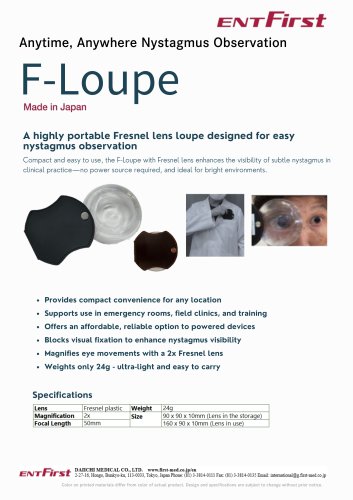
F-Loupe
The F-Loupe is a portable device designed for observing nystagmus in various settings, such as emergency rooms and field clinics. It uses a Fresnel lens to magnify eye movements, enhancing visibility without needing a power source.
Specifications
The device weighs 24g and features a 2x magnification Fresnel lens. Its compact design makes it suitable for bright environments.
Background
Nystagmus observation is essential for distinguishing between peripheral and central vestibular disorders. Traditional methods like Frenzel goggles are effective but costly and less portable. The F-Loupe offers a cost-effective alternative by blocking visual fixation to enhance nystagmus visibility.
Methods
A study compared the F-Loupe with Frenzel goggles by measuring the slow-phase velocity (SPV) of nystagmus induced by the caloric test in 15 participants. The visual impact susceptibility (VIS) of both devices was calculated to assess their effectiveness in reducing visual fixation.
Results
The F-Loupe was as effective as Frenzel goggles in observing nystagmus and significantly improved visibility compared to the naked eye, especially in bright lighting.
Conclusions
The F-Loupe is a practical, portable, and affordable tool for nystagmus observation in emergency medical settings, providing a viable alternative to conventional devices like Frenzel goggles, particularly for rapid assessments.
Keywords
Fresnel loupe, Frenzel goggles, Nystagmus, Slow-phase velocity, Visual impact susceptibility, Visual fixation, Acute vestibular syndrome.
Catalog excerpts
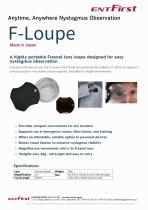
Anytime, Anywhere Nystagmus Observation Compact and easy to use, the F-Loupe with Fresnel. Lens enhances the visibility of subtle nystagmus in clinical practice—no power source required, and ideal for bright environments. • Provides compact convenience for any location • Supports use in emergency rooms, field clinics, and training • Offers an affordable, reliable option to powered devices • Blocks visual fixation to enhance nystagmus visibility • Magnifies eye movements with a 2x Fresnel lens • Weights only 24g - ultra-light and easy to carry _ mf-- _ m DAIICHI MEDICAL CO., LTD. wwn.first-med.co.jp/en E/V I f llsl 2-27-16, Hongo, Bunkyo-ku, 113-0033, Tokyo, Japan Phone: (SI) 3-3814-0111 Fax: (81) 3-3814-0135 Email: international'2g.first-med.co.jp Color on printed materials differ from color of actual product. Design and specifications are subject to change without prior notice.
Open the catalog to page 1
Tsunoda et al. International Journal of Emergency Medicine https://doi.org/10.1186/s12245-024-00791-2 International Journal of Emergency Medicine Open Access New Fresnel lens loupe for nystagmus observation suitable for use by medical staff in emergency departments Reiko Tsunoda1,2*, Yumi Dobashi1, Masao Noda1,3 and Hiroaki Fushiki1,2 Abstract Background Reduction of spontaneous nystagmus by fixation, a characteristic feature of peripheral nystagmus, is important for differentiating between peripheral and central vestibular disorders. In the emergency room, Frenzel goggles are recommended to...
Open the catalog to page 2
Tsunoda et al. International Journal of Emergency Medicine Background Peripheral vestibular disorders are the most common cause of vertigo; however, at diagnosis, central disorders must be ruled out. The Head Impulse, Nystagmus, Test of Skew (HINTS) and the STANDING algorithm are well known bedside tests for differentiating between central and peripheral dizziness in patients with acute vestibular syndrome [1–3]. However, the accuracy of the results of the HINTS examination administered by emergency physicians is lower than that achieved by neurologists and otolaryngologists [4, 5]. A study investigating...
Open the catalog to page 3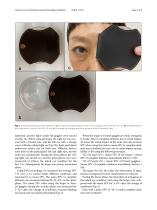
Tsunoda et al. International Journal of Emergency Medicine Fig. 1 Portable loupe based on the Fresnel lens. (a) The size of the loupe when the lens is in the storage cover is 90 × 90 × 10 mm. (b) The dimensions of the loupe when in use are 160 × 90 × 10 mm. (c) Its storage size is appropriate for covering one eye in the test of skew darkened, and the lights inside the goggles were turned on (Fig. 2a). When using the loupe, the right eye was covered with a Fresnel lens, and the left eye with a storage cover, with the ceiling-light on (Fig. 2b). Each participant underwent caloric test for both...
Open the catalog to page 4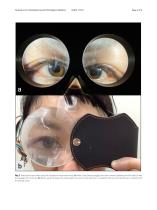
Tsunoda et al. International Journal of Emergency Medicine Fig. 2 Participants’ eyes when using the nystagmus observation tools. (a) When using Frenzel goggles, the room remains darkened, and the lights inside the goggles are turned on. (b) When using the loupe, the ceiling light is turned on, the right eye is covered by the lens and the left eye is covered with the storage cover
Open the catalog to page 5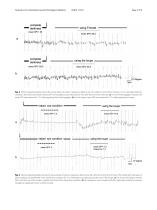
Tsunoda et al. International Journal of Emergency Medicine Fig. 3 Electronystagmography during the active phase of caloric nystagmus. Black arrow, 30 s after the end of the stimulus. In the complete darkness condition, the mean slow-phase velocity (SPV) of nystagmus was measured 25–30 s after the end of the stimulus. (a) For the Frenzel goggles (Frenzel), the mean SPV was measured 5–10 s after applying the Frenzel goggles. (b) For the loupe, mean SPV was measured 5–10 s after applying the loupe Fig. 4 Electronystagmography during the decay phase of caloric nystagmus. Black arrow, 60 s after the...
Open the catalog to page 6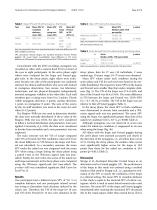
Tsunoda et al. International Journal of Emergency Medicine Table 1 Mean SPV and VIS of the loupe vs. the Frenzel Tool Ears Mean SPV of Mean SPV VIS Mean dif- complete of mean ference darkness using tool (SD) in VIS Data are presented as the mean (standard deviation) and mean difference in VIS (95% confidence interval) SPV, slow-phase velocity (deg/s); SD, standard deviation; Frenzel, Frenzel goggles; VIS, visual impact susceptibility; mean difference in VIS, mean difference in VIS between the loupe and Frenzel; 95%CI, 95% confidence interval Concomitant with the ENG recording, nystagmus was recorded...
Open the catalog to page 7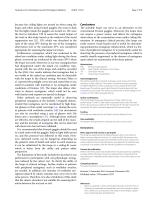
Tsunoda et al. International Journal of Emergency Medicine because the ceiling lights are turned on when using the loupe, and when using Frenzel goggles, the room is dark but the lights inside the goggles are turned on. We were the first to introduce VIS to assess the visual impact of the tools in this study, based on the method of the visual suppression test [11]. VIS, which was described as the ratio of the mean SPV during the use of the nystagmus observation tool to the maximum SPV, was considered appropriate for assessing the impact of vision. Furthermore, nystagmus, which was weakened in...
Open the catalog to page 8
2. Gottlieb M, Peksa GD, Carlson JN. Head impulse, nystagmus, and test of skew examination for diagnosing central causes of acute vestibular syndrome. Cochrane Database Syst Rev. 2023;11:CD015089. 3. Gerlier C, Hoarau M, Fels A, Vitaux H, Mousset C, Farhat W, et al. Differentiating central from peripheral causes of acute vertigo in an emergency setting with the HINTS, STANDING, and ABCD2 tests: a diagnostic cohort study. Acad Emerg Med. 2021;28:1368-78. 4. Dmitriew C, Regis A, Bodunde O, Lepage R, Turgeon Z, Mclsaac S, et al. Diagnostic accuracy of the HINTS exam in an emergency department: a...
Open the catalog to page 9All Daiichi Medical catalogs and technical brochures
 NOSE CATALOG
43 Pages
 EAR INSTRUMENTS CATALOG
54 Pages
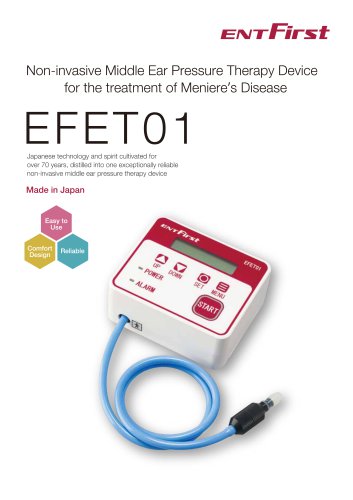 EFET01
2 Pages
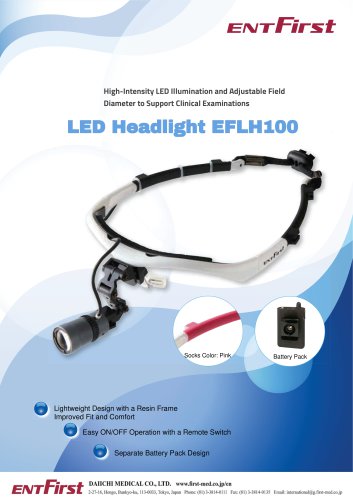 LED Headlight EFLH100
2 Pages
 Surgical Instruments for EES
2 Pages
 ENT microscope EFM08
2 Pages
 Frenzel Goggles S5
2 Pages
 Transparent Ear Speculum
2 Pages
 LED operating otoscope FSS60
2 Pages
 LED Headlight EFLH300
2 Pages
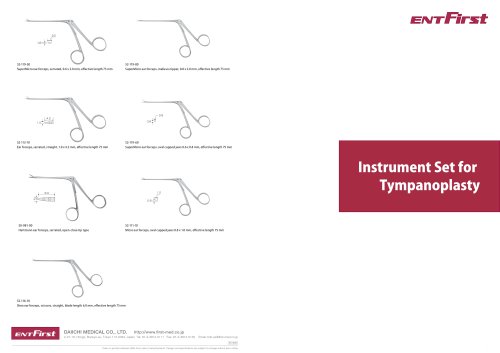



Archived catalogs

- Surgery forceps
- Grasping forceps
- Stainless steel forceps
- Straight forceps
- Retractor
- Endoscopy forceps
- Surgical retractor
- Head-lamp
- LED headlamp
- Stainless steel retractor
- Autoclavable retractor
- ENT forceps
- Vestibular testing system
- ENT headlight
- Examination microscope
- Examination microscope on casters
- ENT examination microscope
- ENT surgery retractor