- Catalogs
- Denfotex Research Ltd.
- Desensitisation with Sylc

Desensitisation with Sylc

Desensitisation with Sylc
Dentinal hypersensitivity (DH) is a condition characterized by pain arising from exposed dentine in response to stimuli. The etiology is multifactorial, involving structural changes in dentine, such as increased patency of dentine tubules in sensitive areas. The hydrodynamic theory suggests that fluid movement within these tubules activates sensory nerves, causing pain.
Methods of Desensitization:
Two primary approaches are used to treat DH: tubule occlusion and blocking nerve activity. Tubule occlusion involves creating a barrier to prevent fluid movement, while nerve activity is blocked by increasing potassium ion concentration to reduce nerve sensitivity. Common treatments include chemical agents in toothpastes and varnishes that either occlude tubules or depolarize nerve synapses.
Challenges and Limitations:
While current treatments can reduce hypersensitivity, their effects are often temporary due to factors like abrasion and chemical erosion. There is a need for materials that can chemically bond with tissues to provide longer-lasting relief.
Role of Bioactive Glass:
Bioactive glass, such as Sylc, has emerged as a promising material for treating DH. It deposits calcium phosphate on the tooth surface, occluding tubules and reducing sensitivity. Sylc has been shown to clean, polish, and repair dental tissues effectively, providing a longer-term desensitizing effect compared to other materials.
Comparative Studies:
Studies have demonstrated that Sylc is more effective than other air polishing powders, such as sodium bicarbonate and EMS Perio Powder, in reducing dentinal hypersensitivity. It also offers better patient comfort and a higher level of tubule occlusion when applied with a damp rubber cup.
Conclusion:
Bioactive glass, particularly Sylc, represents a significant advancement in the treatment of dentinal hypersensitivity, offering both immediate and long-term relief by effectively occluding dentine tubules and enhancing patient comfort.
Catalog excerpts
Aran Batth, Julian Zeolla, Hannah Gorgui-Naguib and Ian Thompson investigate how bioactive glass can help dentists combat sensitivity Expected outcomes! Education aims and objectives This article aims to describe some of the currently understood causes and mechanisms of dentinal hypersensitivity and discuss some of the proposed treatments. Correctly answering the questions of page 54, worth one hour of verifiable CPD, will demonstrate that the reader understands the causes and mechanisms of dentinal hypersensitivity and how bioactive glass plays a part in possible treatment for it. The aetiology of dentinal hypersensitivity (DH) is multi-factorial and not completely understood, although it has been demonstrated that the structure of dentine in the affected areas is altered, containing a larger number of patent dentine tubules than unaffected areas (Absi et al 1987). Yoshiyama et al (1989 and 1990) reported that a greater proportion of the tubules were patent in the sensitive areas and noted the presence of tubule-like structures situated superficially beneath the surface of sensitive dentine. Not all exposed dentine, however, is sensitive; evidence from SEM investigation of extracted teeth would suggest that there are differences between ‘sensitive’ and ‘non- Aran Batth is a research fellow at King's College London Julian Zeolla is a research fellow at King's College London Hannah Gorgui-Naguib is a research fellow at King's College London. Dr Ian Thompson is a senior lecturer at King's College London and the product director of Denfotex Research. sensitive’ dentine in that there are more open dentinal tubules (with a greater mean orifice diameter) in sensitive dentine (Absi et al 1987). According to Gillam (2009), these findings appear to be consistent with Brannstrom’s 1963 hydrodynamic theory of stimulus transmission across dentine (1984). This theory proposes that minute rapid shifts (in either direction) of the fluid within the dentine tubules (following stimulus application) may result in activation of the sensory nerves in the pulp/inner dentine region of the tooth. Methods of desensitisation Currently there are two main approaches for the treatment of DH based on the hydrodynamic theory Namely, these are: 1. Tubule occlusion 2. Blocking nerve activity through direct ionic diffusion (increased potassium ions concentration acting on the pulpal sensory nerve activity) (Berkstein et al 1987). Banerjee and colleagues (2010) suggest that there are many approaches to the treatment and prevention of dentinal hypersensitivity. Treatment of the tooth with a chemical agent, which penetrates into the dentinal tubules and depolarises the nerve synapse, reducing sensitivity by preventing the conduction of pain impulses, is a method used in daily use toothpastes (eg potassium nitrate) (Markowitz and Kim 1992; Schiff et al 1998). An alternative approach is to treat the tooth with a chemical or physical agent, which creates a layer that mechanically occludes the exposed dentinal tubules, thus reducing sensitivity by preventing dentinal fluid flow - a method used by prophylaxis pastes and varnishes (eg potassium oxalate, ferric oxalate) adt October 2015 23
Open the catalog to page 1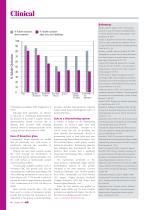
Clinical References Absi EG, Addy M, Adams D (1987). Dentine hyper- % Tubule occlusion after treatment sensitivity. A study of the patency of dentinal tubules % Tubule occlusion after citric acid challenge in sensitive and non-sensitive cervical dentine. J Clin Periodontol 14: 280-4 Banerjee A, Hajatdoost-Sani M, Farrell S, Thompson I tive glass and sodium bicarbonate air polishing powders. % Tubule Occlusion Berkstein S, Reiff RL, McKenney JF, Kilroy WJ (1987): (2010). A clinical evaluation and comparison of bioacJ Dent 38: 475 – 479 Supragingival root surface removal during maintenance procedures...
Open the catalog to page 2