


- Company
- Products
- Catalogs
- News & Trends
- Exhibitions
Advice and guidelines in the field of
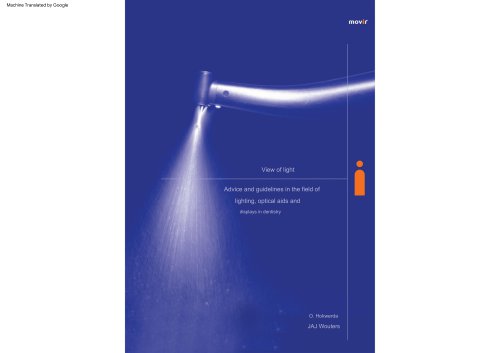
Advice and guidelines in the field of
This document provides comprehensive guidelines on lighting and optical aids in dentistry, emphasizing the importance of proper lighting for optimal visual perception and comfort. It is based on research by TNO Human Engineering and expert contributions.
Lighting Specifications
The document underscores the importance of both daylight and artificial light in dental practices. Consistent color and brightness levels are crucial to reduce eye strain and enhance visual comfort. Optimal luminance for detail work ranges from 200 to 2,000 cd/m2, with 1,000 cd/m2 being ideal for visual acuity.
Visual Ergonomics
Visual comfort is essential for dentists due to the need to observe small details. The document explains the relationship between visual acuity, luminance, and contrast, highlighting the necessity of timely optical aid correction as vision declines with age.
Impact of Age on Vision
Vision typically declines from age 40, affecting accommodative ability and contrast sensitivity. The document recommends using reading glasses, screen glasses, and special work glasses to maintain visual acuity.
Glare and Reflection
Glare from glossy surfaces and reflections can cause eye fatigue and reduce visual acuity. The document advises using matte instruments and proper lighting design to minimize glare and improve contrast perception.
Color Temperature
Color temperature, measured in Kelvin, affects light perception in dental practices. The document suggests using light sources with appropriate color temperatures to enhance visual comfort and reduce glare.
Conclusion
Proper lighting and optical aids are essential for maintaining visual comfort and performance in dental practices. The guidelines aim to optimize lighting conditions and reduce eye strain and fatigue for dentists.
This section discusses the use of various types of glasses and magnification tools in dental practice, focusing on ergonomics and visual requirements for dentists.
Specifications and Recommendations
- Glasses: Bifocal and multifocal glasses are recommended to maintain correct working posture, allowing for near correction of 35-60 cm. Multifocal glasses provide a gradual transition between near and far vision but may require head movement for sharp focus.
- Loupes: Offering magnification from 1.5 to 5 times, loupes improve visual acuity and posture but require a fixed posture, potentially leading to muscle strain.
- Microscopes: Used for greater magnification, microscopes have their own light source and require careful posture management to avoid strain.
Ergonomics and Posture
Dentists should maintain a natural cervical spine inclination (flexion up to 20-25°) to avoid strain. Lightweight loupes with an adapted focus distance are recommended to minimize static muscle load. Incorporating movement into the work process is essential to prevent muscle fatigue and strain.
Visual Aids and Tools
- Anti-reflective coatings: Not necessary in dental practice due to the illuminated environment.
- Screen Use: Screens should be at least 18” with a matte surface to reduce reflections. Positioning should avoid direct light sources to prevent glare.
- Intraoral Cameras: These should be used with caution to avoid glare and ensure clear image capture.
Conclusion
Proper selection and use of visual aids, along with maintaining ergonomic posture, are crucial for effective dental practice. Dentists should choose tools that enhance visual acuity while minimizing physical strain.
Catalog excerpts
Machine Translated by Google View of light Advice and guidelines in the field of lighting, optical aids and displays in dentistry
Open the catalog to page 1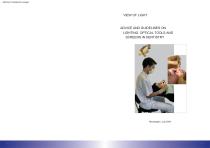
Machine Translated by Google ADVICE AND GUIDELINES ON LIGHTING, OPTICAL TOOLS AND SCREENS IN DENTISTRY
Open the catalog to page 2
Machine Translated by Google In the Prevention Study funded by Movir Probe are in the second half of the nineties The work in the dental practice is high The dentist's work places high demands on it 1,249 dentists visited. Based on the time requirements for the dentist's eyesight and on Based on existing insights into lighting, light measurements were the eye-hand coordination. This turns on the lighting performed. It was found in 75% of the measurements the practice room must meet special requirements. That that the method of lighting and the associated use of colors in the treatment room also...
Open the catalog to page 3
Machine Translated by Google RELIEF Good lighting contributes to optimal visual task performance, visual comfort, working method and attitude to work. To be able to understand more of the opinions that come out the TNO research, will first be briefly discussed number of basic concepts. Optimal visual perception perceiving on the border of what is visual Often the dentist has to observe on the border of what With regard to the concept of light, a distinction can be made between daylight and artificial light. visually possible. Light is primarily a facility to make the human environment clearly...
Open the catalog to page 4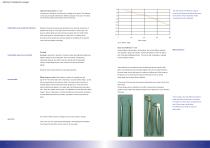
Machine Translated by Google The table shows the influence of age on Light and visual acuity An image 1,4 consisting of a collection of luminances is imaged on the retina. This depends on the amount of light reflected from different surfaces to the eyes. The retina can therefore locally process high and low luminances. visual acuity. Because dentists perform work on the border of the perceivable, timely correction with aids is important. relationship visual acuity and luminance Research shows that visual acuity decreases at low and high luminances. It appears that using too much light causes...
Open the catalog to page 5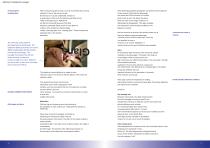
Machine Translated by Google annoying glare masking glare When using strong light sources, such as the dentist's lamp, strong reflection is due to the use of too high illuminance is of course undesirable. Instead of a good picture of the tooth, the dentist would after all one image of the light source. Reflections are bad for the dentist because of the flare because it adversely affects vision and can lead to it to glare, which entails two disadvantages, namely “annoying glare” and “masking glare”. These concepts are explained later in this booklet discussed. Each afterimage gradually disappears,...
Open the catalog to page 6
Machine Translated by Google daylight is important for good color perception White light has a high color temperature and yellow to orange light has a low color temperature (this light contains relatively little blue). At very high color temperatures the color turns slightly blue. In the dental office lighting for good color perception needed that contains all the colors (especially enough blue) and therefore approaches daylight. Color Rendering Index The color rendering index of the light source indicates in to what extent with the light of this colors true to life to be displayed. A good color...
Open the catalog to page 7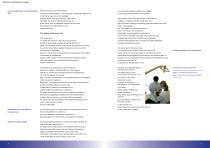
Machine Translated by Google Napkins that also cover both shoulders covered are recommended. This is because of brightness differences in the field of view due to, for example become dark or very light clothing for the patient cancelled. By using a cofferdam that does not gloss can be quite a brightness reduction in the mouth be obtained. Don't use reflective ones suction cannulas. The lighting of the work area The dentist lamp To enable the dentist to clean the mouth properly be able to work needs a certain amount of light from it stand out in the field of work. In the mouth, the reflections...
Open the catalog to page 8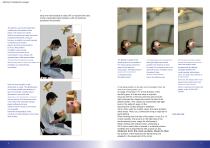
Machine Translated by Google lamp arm that extends to about 45 cm beyond the back of the unextended head restraint, with the backrest positioned horizontally. The dentist is used to the dental lamp usually above the patient's chest places. The result is an uneven relief in the mouth (see inset) and on the preparation field which is tiring for the eyes. In addition, the mouth opening is directed too far forward placed, which forces the dentist in to sit in a bent position. In addition, when moving the hands, by the hands or the instrumentation, cast a shadow with reduced view of the work surface....
Open the catalog to page 9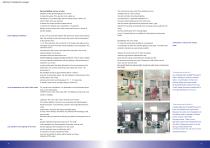
Machine Translated by Google General lighting and use of color basic lighting conditions This could be the case when the luminaires are too Objective of the general lighting is the whole installed close to a wall. Using it to make the space of the practice room usable as of a light controller for ambient lighting workspace. This includes light wall and ceiling colours. White, off- are important for a particular adaptation to a white or light colors are required stronger outdoor lighting (but one should avoid to obtain the correct luminance ratios and the that the outside light disturbs the luminance...
Open the catalog to page 10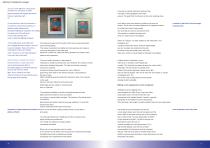
Machine Translated by Google You can see the difference in these photos the effect of a wall before and after to be able to maintain luminance ratios and thus fitting the lighting with daylight fluorescent a stronger or tiring adaptation of the eyes tubes and applying a light prevent. This apart from the influence on the color rendering index. On the left picture, with the old situation is In the field of view of the dentist it is better not to have any window. This is due to the strong differences in brightness caused the reflection of the fluorescent lighting in it a window in the field of...
Open the catalog to page 11
Machine Translated by Google It is therefore not immediately certain whether the existing dental lamp is suitable for a color determination. Also steps changes due to the aging of halogen lamps on. This can also be the case when other than before the lamp manufactured halogen lamps are used. Fluorescence must be taken into account of fillings in people exposed to fluorescent light (disco) stay. This can be done with blue (UV) fluorescent tubes being watched. However, these should not be on for too long due to the harmful UV radiation. There sometimes a counterfeit money detector is used. 5 OPTICAL...
Open the catalog to page 12All DentLed catalogs and technical brochures
 Dentled Brochure 2026
4 Pages
 PHL18
2 Pages
 PHW Laboratory light
2 Pages


Archived catalogs

- Medical lamp
- LED lighting
- Ceiling-mounted lighting
- Hospital lighting
- Dental facility lighting
- Dental clinic lighting
- Dental laboratory lamp
- Clinic lighting
- Laboratory lamp
- Veterinary clinic lighting
- Laboratory lighting
- Sterilization lamp
- Built-in lighting
- Dental laboratory lighting
- Operating room lighting
- Pendant lighting
- Wall-mounted lighting
- Ceiling-mounted LED panel
- Dimmable lighting
- Treatment room lighting