
- Catalogs
- Depuy Synthes
- Craniomaxillofacial (CMF) Distraction System


Craniomaxillofacial (CMF) Distraction System
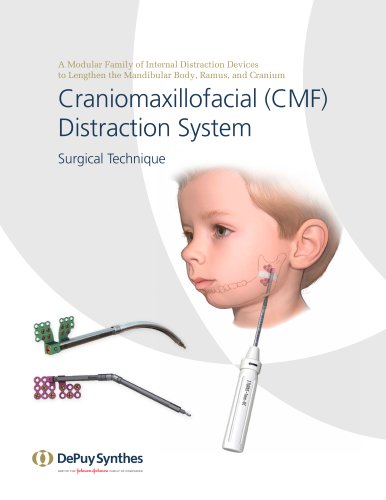
Craniomaxillofacial (CMF) Distraction System
The document provides a comprehensive guide on the surgical technique for the DePuy Synthes Craniomaxillofacial (CMF) Distraction System, which is used for lengthening the mandibular body, ramus, and cranium. It includes detailed instructions on preoperative planning, distractor assembly, and specific procedures for mandibular and cranial distraction.
The CMF Distraction System is designed for bone stabilization and lengthening in cases of congenital deficiencies or post-traumatic defects. It is suitable for both adults and pediatric patients. Contraindications include sensitivities to Nickel, Cobalt Chromium, Silicone, or Molybdenum.
Preoperative Planning: Involves evaluating craniofacial pathology through clinical exams and imaging. Virtual surgical planning is recommended for complex cases.
Distractor Assembly: Selection of appropriate footplates and screws based on patient anatomy and treatment plan.
Mandibular and Cranial Distraction: Detailed steps for distraction procedures, emphasizing correct placement and alignment to avoid complications.
Guidelines for extension arm and device removal, emphasizing monitoring for potential complications such as device loosening or bone damage.
Details on implants and instruments included in the CMF Distraction System Set, with specifications for different footplate and screw sizes.
Highlights the need for careful patient selection, consideration of pre-existing conditions, and the importance of proper surgical technique to avoid complications such as TMJ displacement or device breakage.
Lists potential risks associated with the procedure, including infection, nerve damage, and device-related complications.
The safety of the CMF Distraction System in the MR environment is unknown, and scanning patients with this device may result in injury.
The document provides comprehensive guidance on the use of the CMF Distraction System, emphasizing the importance of thorough planning and adherence to surgical protocols to ensure successful outcomes.
This document outlines the surgical technique for mandibular body and ramus distraction using the DePuy Synthes Craniomaxillofacial (CMF) Distraction System. It provides detailed procedural steps, technique tips, and precautions to ensure successful outcomes.
Cheek Retractor and Drill Guide Insertion
The cheek retractor is secured with forceps through holes designed for a firm grip. The drill guide is inserted through the buccal soft tissue, and the cheek retractor is positioned intraorally. The knurled collar on the drill guide is rotated to adjust the cheek retractor ring, and the forceps are disengaged.
Technique Tips
- Maintain pressure on the drill guide during pediatric trocar use.
- Consider using a DePuy Synthes CMF 90° Screwdriver Set for intraoral approaches.
- Use specific drill bits with the pediatric trocar.
Mandibular Body Distraction
1. Perform Buccal Corticotomy: Remove the distractor, perform corticotomy on the buccal side of the mandible, and ensure bone segment stability.
2. Reattach Distractor: Align footplates with pre-drilled holes, insert screws at right angles, and tighten carefully.
3. Device Activation: Use a surgeon activation instrument to confirm device stability and mandible movement.
Mandibular Ramus Distraction
1. Incision and Exposure: Make a mandibular vestibular or submandibular incision and expose the mandible.
2. Osteotomy Marking: Mark the osteotomy site based on distractor placement.
3. Distractor Fitting: Fit the distractor to the ramus, considering factors like occlusal plane and nerve location.
4. Footplate Cutting and Contouring: Cut unnecessary screw holes, contour footplates, and ensure proper screw placement.
Precautions and Warnings
- Avoid excessive torque on screws to prevent breakage.
- Ensure proper irrigation and suction post-procedure.
- Consider patient anatomy and potential interference with eating or breathing.
- Use appropriate screw and drill bit sizes to prevent complications.
Conclusion
This document provides comprehensive guidance on the surgical technique for mandibular distraction using the CMF Distraction System. Adhering to the outlined steps, tips, and precautions is crucial for successful surgical outcomes.
- Screw Insertion: Ensure screws are inserted at a right angle to the footplate to prevent improper engagement and potential hazards. Use the appropriate drill bit and screwdriver blade for the selected footplate size.
- Drill and Screw Sizes: Specific sizes and color codes are provided for PlusDrive and Raised Head screwdriver blades, ensuring compatibility with footplate and screw sizes.
- Mandibular Bone Transport: Detailed steps for performing transport disk osteotomy and reattaching the distractor are outlined, emphasizing the importance of complete osteotomy and proper alignment of footplates.
- Screw and Drill Bit Usage: Incorrect sizes may lead to screw pullout and choking hazards. Confirm lengths before use.
- Device Handling: Use appropriate instruments and techniques to avoid damage to bone, soft tissue, and critical structures. Ensure adequate irrigation during drilling to prevent overheating.
- Distractor Placement: Careful consideration of anatomical structures is necessary to avoid nerve damage and ensure device stability.
- Use of Color-Coded Screws: PlusDrive and Raised Head screws are color-coded for easy identification and proper use.
- Device Activation: Use the surgeon activation instrument for precise control and to prevent unintended device reversal.
- Footplate Contouring: Use bending pliers carefully to contour footplates without compromising their integrity.
- Do not use Raised Head screwdriver blades in patients with poor bone quality.
- Ensure screws are not fully tightened before completing the osteotomy.
- Do not exceed a drill rate of 1800 RPM to avoid thermal necrosis and oversized holes.
The document outlines the materials and design options for craniomaxillofacial (CMF) distraction systems. The distractor bodies are available with or without a universal joint and are made from various alloys including cobalt-chromium, cobalt-nickel, and titanium. The AB distractor bodies are compatible with A-style and B-style footplates and are available in lengths of 15 mm, 20 mm, 25 mm, and 30 mm.
Extension Arms:
Extension arms facilitate the activation of the distractor and can be placed intraorally or percutaneously. They are available in rigid and flexible forms, with lengths ranging from 20 mm to 60 mm. The materials used include cobalt-nickel alloy and silicone for flexible arms, and cobalt-chromium alloy and titanium for rigid arms.
Screws:
The system includes PlusDrive and Raised Head Screws, available in self-drilling, self-tapping, and emergency types. These screws are made from commercially pure titanium or titanium alloy and are color-coded for easy identification. The document provides detailed specifications for screw diameters and lengths.
Instruments:
A variety of instruments are listed for use with the CMF distraction system, including surgeon activation instruments, drill guides, and screwdriver blades. These instruments are designed to facilitate the installation and adjustment of the distraction system.
Implants:
The document details various implant options, including AB and BC distractor bodies, both with and without universal joints, and in various lengths. It also lists different types of mesh and cloverleaf feet for the distractor.
Additional Components:
The document includes information on graphic cases, trays, and modules for organizing and storing the components of the CMF distraction system. It also provides details on screw length markers and additional accessories.
Recommendations:
For detailed cleaning and sterilization instructions, users are directed to the DePuy Synthes website or the instructions for use provided with the system.
The document details various titanium screws used in craniomaxillofacial (CMF) surgeries, including self-drilling and self-tapping screws with PlusDrive recess. The screws are available in different lengths and quantities, with specific color coding for identification (green-gray, gold, blue).
Product Variants:
- 1.5 mm Titanium Cortex Screws: Available in self-drilling and self-tapping variants, packaged in quantities of 5.
- 2.0 mm and 2.4 mm Titanium Emergency Screws: Available in various lengths, with PlusDrive recess.
- 2.0 mm Titanium Locking Screws: Self-tapping with PlusDrive recess, available in blue.
CMF Distraction System:
The document references the CMF Distraction System Set (01.315.000) and surgical techniques associated with it.
References:
The document cites several studies related to mandibular distraction osteogenesis, highlighting its clinical applications and outcomes.
Warranty and Legal Information:
DePuy Synthes products come with a limited warranty against defects. The document disclaims other warranties and notes that some products may not be available in all markets or licensed in Canada.
Contact Information:
For orders in the USA and Canada, contact numbers are provided. The document also lists the manufacturing locations in the USA and Switzerland.
Catalog excerpts
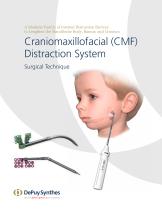
A Modular Family of Internal Distraction Devices to Lengthen the Mandibular Body, Ramus, and Cranium Craniomaxillofacial (CMF) Distraction System Surgical Technique
Open the catalog to page 1
Introduction Indications and Contraindications 2 Surgical Technique Preoperative Planning 5 ■ Mandibular Body Distraction 19 ■ Mandibular Ramus Distraction 32 ■ Mandibular Bone Transport 45 ■ Posterior Cranial Vault Distraction 56 Product Information Implants 75 £ Image intensifier control Craniomaxillofacial (CMF) Distraction System Surgical Technique DePuy Synthes 1
Open the catalog to page 3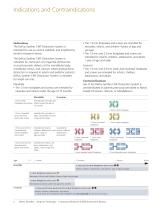
The DePuy Synthes CMF Distraction System is intended for use as a bone stabilizer and lengthening (and/or transport) device. The DePuy Synthes CMF Distraction System is indicated for correction of congenital deficiencies or post-traumatic defects of the mandibular body, mandibular ramus, and cranium where gradual bone distraction is required in adults and pediatric patients. DePuy Synthes CMF Distraction System is intended for single use only. • The 1.0 mm footplates and screws are intended for neonates and infants under the age of 12 months. • The 1.3 mm footplates and screws are intended for...
Open the catalog to page 4
General warnings • When selecting patients for treatment with mandibular distraction, the surgeon should take into account any pre-existing conditions such as central apnea, multi-level airway obstruction, severe reflux, or other etiologies of airway obstruction that are not tongue based and would not respond to advancement of the mandible. Patients with these conditions may require a tracheostomy. • When selecting patients for treatment with cranial distraction, the surgeon should take into account any pre-existing conditions such as non-syndromic craniosynostosis that would not be treated as...
Open the catalog to page 5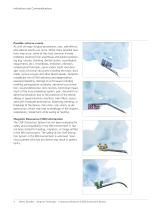
Possible adverse events As with all major surgical procedures, risks, side effects, and adverse events can occur. While many possible reactions may occur, some of the most common include: problems resulting from anesthesia and patient positioning (e.g. nausea, vomiting, dental injuries, neurological impairments, etc.), thrombosis, embolism, infection, cerebrospinal fluid leak, nerve and/or tooth root damage, injury of critical structures including the brain, dura mater, venous sinuses and other blood vessels, Temporomandibular Joint (TMJ) ankylosis and degeneration, excessive bleeding, damage...
Open the catalog to page 6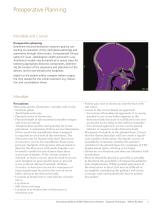
Preoperative planning Determine the post-distraction anatomic goal by conducting an evaluation of the craniofacial pathology and asymmetry through clinical exam, Computerized Tomography (CT) scan, cephalogram and/or panoramic x-ray. Anatomical models may be beneficial in severe cases for selecting appropriate distractor components, determining the location of the osteotomy and placement of the devices, and for pre-bending the footplates. Explain to the patient and/or caregiver before surgery the time needed for the whole treatment (e.g. distraction and consolidation times). When placing the distractors,...
Open the catalog to page 7
Preoperative Planning Mandible and Cranial Cranial Precautions When placing the distractors, consider and verify: • Planned vector of distraction • Planned length of advancement (consider relapse and overcorrection) • Adequate bone quality and quantity for screw placement. A minimum of three screws is required on each side of the osteotomy. The distractor may be fixed with more than three screws per footplate. If large bone advancement is desired, the distractor with mesh footplate can be used to enable the use of more than three screws per footplate. • Dura mater • Venous sinuses and other blood...
Open the catalog to page 8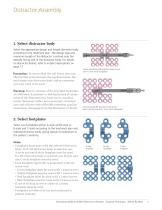
Distractor Assembly 1. Select distractor body Select the appropriate design and length distractor body according to the treatment plan. The design type and maximum length of the distractor is etched onto the laterally facing side of the distractor body. For details on distractor bodies, refer to implant descriptions on page 77. Precaution: To ensure that the soft tissue does not obstruct the activation hex during distraction, the next longer size distractor body and/or extension arm may need to be used. Warning: Ensure all steps of the provided technique are followed. It presents a choking hazard...
Open the catalog to page 9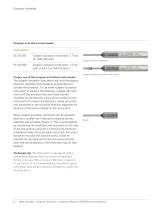
Distractor Assembly Surgeon activation instruments Instruments 03.315.001 Surgeon Activation Instrument, 1.7 mm, for CMF Distractor Surgeon activation instrument 03.315.005 Surgeon Activation Instrument, 1.7 mm with U-Joint, for CMF Distractor Proper use of the surgeon activation instruments The surgeon activation instruments are used throughout distractor assembly and procedure to assemble and activate the distractor. To use either surgeon activation instrument to advance the distractor, engage the instrument with the activation hex and rotate counter clockwise (in the direction of the arrow...
Open the catalog to page 10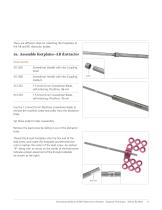
There are different steps for attaching the footplates to the AB and BC distractor bodies. 311.005 Screwdriver Handle with Hex Coupling, small 311.006 Screwdriver Handle with Hex Coupling, medium 313.252 1.5 mm/2.0 mm Screwdriver Blade, self-retaining, PlusDrive, 96 mm 313.253 1.5 mm/2.0 mm Screwdriver Blade, self-retaining, PlusDrive, 76 mm Use the 1.5 mm/2.0 mm PlusDrive screwdriver blade to remove the machine screw and collar from the distractor body. Set these aside for later reassembly. Remove the lead screw by sliding it out of the distractor body. Thread the B-style footplate onto the...
Open the catalog to page 11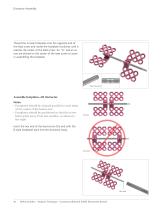
Distractor Assembly Thread the A-style footplate onto the opposite end of the lead screw and rotate the footplate clockwise until it reaches the center of the lead screw. An “A” and an arrow are etched on the center of the lead screw to assist in assembling the footplate. Assemble footplates–AB distractor Notes: • Footplates should be aligned parallel to each other at the center of the lead screw. • Footplates should be positioned so that the screw holes point away from one another, as shown to the right. Insert the hex end of the lead screw (the end with the B-style footplate) back into the...
Open the catalog to page 12All Depuy Synthes catalogs and technical brochures
 Titanium Sternal Fixation System
34 Pages
 Small Battery Drive II
4 Pages
 Introducing The Variable Angle
12 Pages

Archived catalogs
 MatrixRIB®FixationSystem
86 Pages
 HEALIX ADVANCE
4 Pages
 HEALIX Anchor™ 3.4 mm
2 Pages
 3.5 mm LCP™ Medial
15 Pages
 RADIUS OF CURVATURE
3 Pages
 Building on Success
16 Pages
 2.0 mm LCP® Distal Ulna Plate
20 Pages
 2.4 mm VA LCP™
4 Pages
 Mandible Trauma Solutions
2 Pages
 Power line II
4 Pages
 Concorde
28 Pages
 LCP Intercarpal
31 Pages
 LCS® COMPLETE™
2 Pages
 Synthes TPLO.
8 Pages
 SynFix-LR System
56 Pages
 ATB Anterior Tension Band Plate
32 Pages
 CONDUIT™
15 Pages
 Brochure_FINAL
2 Pages
 DePuy Synthes
81 Pages
 Anspach
3 Pages
 Orthopedic Foot Instruments
32 Pages
 PINNACLE® Hip Solutions
12 Pages
 Corail
24 Pages
 S-ROM® NOILES™
68 Pages
 TRI-LOCK® Product Rationale
12 Pages
 Reclaim Surgical Technique
44 Pages
 Speed
Speed2 Pages
 attune
80 Pages
 HAMMERLOCK® 2
2 Pages
 DePuy Glenoid Solutions
2 Pages
 Trauma Solutions. Elbow
4 Pages
 Polar
Polar4 Pages
 Alveolar Distractor.
4 Pages
 Piezoelectric System
4 Pages
 Air Power Line II
6 Pages
 LCP Clavicle Hook Plate
4 Pages
 TruMatch Pin Guides
16 Pages
 P F N A
8 Pages
 SKILL, DEDICATION,
16 Pages
 Orthopaedics. Overview
20 Pages
 DURALOC
16 Pages
 Marathon Cemented Cup
20 Pages
 REEF Surgical Technique
16 Pages
 MatrixNEURO
8 Pages
 Anspach XMax
4 Pages
 Anspach eMax 2 Plus
4 Pages
 Small Electric Drive
4 Pages
 Air Pen Drive
4 Pages
 Colibri II
4 Pages
 Spine
Spine25 Pages
 Expert Hindfoot Arthrodesis Nail
48 Pages
 LCP Distal Fibula Plates
32 Pages
 TomoFix
60 Pages
 Expert Tibial Nail PROtect
16 Pages
 Expert Tibia Nail
84 Pages
 Sacral Bars
16 Pages
 Pelvic C-Clamp
20 Pages
 Low Profile Pelvic System
16 Pages
 Proximal Femoral (Hook) Plate
24 Pages
 LCP
LCP24 Pages
 PFNA
PFNA112 Pages
 HCS 1.5, 2.4, 3.0
36 Pages
 LCP Wrist Fusion
32 Pages
 LCP Compact Hand
28 Pages
 VA-LCP Elbow
48 Pages
 Distal Radius
44 Pages
 Olecranon
30 Pages
 LCP Hook Plate
28 Pages
 DHP & Olecranon
4 Pages
 LCP S-A
4 Pages
 Epoca
Epoca4 Pages
 Philos
32 Pages
 MultiLoc
68 Pages




- DePuy Synthes bone plate
- Compression plate
- Metallic compression plate
- Locking compression plate
- Titanium compression plate
- Orthopedic surgery instrument kit
- Distal compression plate
- Interbody fusion cage
- Sterilization container
- Instrument sterilization container
- Arthrodesis nail
- Bone substitute
- Metallic intramedullary nail
- Femoral stem
- Anterior interbody fusion cage
- Arthrodesis plate
- Orthopedic surgery bone substitute
- Femoral intramedullary nail
- Knee prosthesis
- Metallic arthrodesis plate