
- Catalogs
- Depuy Synthes
- Epoca Shoulder Arthroplasty System


Epoca Shoulder Arthroplasty System

Epoca Shoulder Arthroplasty System
In shoulder surgery, achieving an optimal approach is crucial due to the complex anatomical structures involved. Special surgical strategies and instruments are necessary to preserve soft tissue while ensuring adequate exposure of the humeral head and glenoid.
Instrument Overview
The document details various retractors and spreaders designed for shoulder surgery, emphasizing their role in facilitating deltoid retraction and exposure of the humeral head and glenoid.
Deltoid Retraction
- Instruments are designed for gentle retraction of the deltoid muscle to expose the proximal humerus and anterior glenoid rim.
- Specific retractors, such as the Delta Retractor and Ring Retractor, prevent slippage and provide stable retraction.
Humeral Head Exposure
- Retractors are used for moderate posterior humeral retraction to release the anterior and inferior capsules and expose the axillary nerve.
- Instruments like the Bone Retractor and Ring Retractor offer optimal grip and working space.
Glenoid Exposure
- Drop-shaped retractors provide orthogonal glenoid exposure with slight distal angulation for better retraction.
- The design facilitates comfortable working space for reaming.
Ordering Information
The document includes a list of instruments available in the General Shoulder Instruments Set, along with their respective quantities.
Conclusion
These specialized instruments are essential for effective shoulder surgery, ensuring both optimal exposure and preservation of soft tissue.
Catalog excerpts
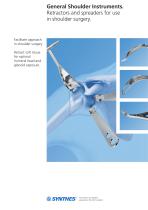
General Shoulder Instruments Facilitate approach Retract soft tissue glenoid exposure
Open the catalog to page 1
Introduction In shoulder surgery, the approach is of primary importance. The challenge arises from the regional complexity of anatomical structures and layers, which impede wide access to bony structures. Therefore, special surgical strategies are necessary for preservation of soft tissue and careful exposure. Various dedicated shoulder instruments are now available to facilitate deltoid retraction, and humeral head and glenoid exposure, while assisting in preserving the soft tissue during surgery.
Open the catalog to page 3
General Shoulder Instruments. Retractors and spreaders for use in shoulder surgery. Deltoid retraction – For gentle retraction of the deltoid muscle in order to expose the proximal humerus. – For subscapularis retraction in order to expose the anterior glenoid rim. Delta Retractor – For gentle, superior retraction of the deltoid muscle. Levered against the acromion, the pointed tip slides under the deltoid to expose the subacromial space. Delta Retractor, pointed – For stable deltoid retraction. The ring engages the greater tuberosity, thus preventing distal slippage of the retractor. Ring Retractor,...
Open the catalog to page 4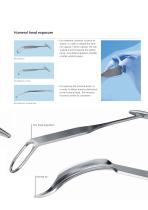
Humeral head exposure – For moderate, posterior humeral retraction in order to release the anterior capsule, inferior capsule, the subscapularis and to expose the axillary nerve. Very distal angulation provides a better working space. Ring Retractor Ring Retractor, narrow – For exposing the humeral head, i.e.: in order to obtain anterior dislocation of the humeral head. This retractor functions similar to a shoehorn. Bone Retractor, humeral head Very distal angulation
Open the catalog to page 5
General Shoulder Instruments. Retractors and spreaders for use in shoulder surgery. Glenoid exposure Shoulder Spreader, left bend – For lateral retraction of the humeral head in order to gain access to the posterior capsule. – For distal retraction of the humerus in order to gain access to the subacromial space. – For posterior retraction of the humerus in order to gain access to the subacromial space. Shoulder Spreader, right bend Teeth and ring opening for optimal grip
Open the catalog to page 6
– For orthogonal glenoid exposure. Slight distal angulation provides better retraction of the humeral head. The drop shape creates a comfortable working space for the reamer. Ring Retractor, drop-shaped Ring Retractor, drop-shaped, narrow Delta Retractor Drop shape for additional reamer guidance Slight distal angulation
Open the catalog to page 7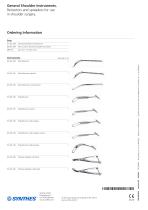
General Shoulder Instruments. Retractors and spreaders for use in shoulder surgery. Ordering Information Sets 01.401.039 General Shoulder Instruments Set Vario Case for General Shoulder Instruments Lid, size 1⁄1, for Vario Case Bone Retractor, Humeral Head Ring Retractor Ring Retractor, narrow Ring Retractor, drop-shaped Ring Retractor, drop-shaped, narrow Ring Retractor, delta-shaped Shoulder Spreader, left bend Shoulder Spreader, right bend Delta Retractor, pointed Synthes and Vario Case are trademarks of Synthes, Inc. or its affiliates Delta Retractor All technique guides are available as...
Open the catalog to page 8All Depuy Synthes catalogs and technical brochures
 Titanium Sternal Fixation System
34 Pages
 Small Battery Drive II
4 Pages
 Introducing The Variable Angle
12 Pages


Archived catalogs
 MatrixRIB®FixationSystem
86 Pages
 HEALIX ADVANCE
4 Pages
 HEALIX Anchor™ 3.4 mm
2 Pages
 3.5 mm LCP™ Medial
15 Pages
 RADIUS OF CURVATURE
3 Pages
 Building on Success
16 Pages
 2.0 mm LCP® Distal Ulna Plate
20 Pages
 2.4 mm VA LCP™
4 Pages
 Mandible Trauma Solutions
2 Pages
 Power line II
4 Pages
 Concorde
28 Pages
 LCP Intercarpal
31 Pages
 LCS® COMPLETE™
2 Pages
 Synthes TPLO.
8 Pages
 SynFix-LR System
56 Pages
 ATB Anterior Tension Band Plate
32 Pages
 CONDUIT™
15 Pages
 Brochure_FINAL
2 Pages
 DePuy Synthes
81 Pages
 Anspach
3 Pages
 Orthopedic Foot Instruments
32 Pages
 PINNACLE® Hip Solutions
12 Pages
 Corail
24 Pages
 S-ROM® NOILES™
68 Pages
 TRI-LOCK® Product Rationale
12 Pages
 Reclaim Surgical Technique
44 Pages
 Speed
Speed2 Pages
 attune
80 Pages
 HAMMERLOCK® 2
2 Pages
 DePuy Glenoid Solutions
2 Pages
 Trauma Solutions. Elbow
4 Pages
 Polar
Polar4 Pages
 Alveolar Distractor.
4 Pages
 Piezoelectric System
4 Pages
 Air Power Line II
6 Pages
 LCP Clavicle Hook Plate
4 Pages
 TruMatch Pin Guides
16 Pages
 P F N A
8 Pages
 SKILL, DEDICATION,
16 Pages
 Orthopaedics. Overview
20 Pages
 DURALOC
16 Pages
 Marathon Cemented Cup
20 Pages
 REEF Surgical Technique
16 Pages
 MatrixNEURO
8 Pages
 Anspach XMax
4 Pages
 Anspach eMax 2 Plus
4 Pages
 Small Electric Drive
4 Pages
 Air Pen Drive
4 Pages
 Colibri II
4 Pages
 Spine
Spine25 Pages
 Expert Hindfoot Arthrodesis Nail
48 Pages
 LCP Distal Fibula Plates
32 Pages
 TomoFix
60 Pages
 Expert Tibial Nail PROtect
16 Pages
 Expert Tibia Nail
84 Pages
 Sacral Bars
16 Pages
 Pelvic C-Clamp
20 Pages
 Low Profile Pelvic System
16 Pages
 Proximal Femoral (Hook) Plate
24 Pages
 LCP
LCP24 Pages
 PFNA
PFNA112 Pages
 HCS 1.5, 2.4, 3.0
36 Pages
 LCP Wrist Fusion
32 Pages
 LCP Compact Hand
28 Pages
 VA-LCP Elbow
48 Pages
 Distal Radius
44 Pages
 Olecranon
30 Pages
 LCP Hook Plate
28 Pages
 DHP & Olecranon
4 Pages
 LCP S-A
4 Pages
 Epoca
Epoca4 Pages
 Philos
32 Pages
 MultiLoc
68 Pages


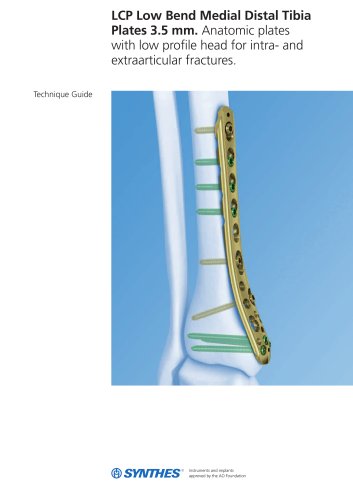


- DePuy Synthes bone plate
- Compression plate
- Metallic compression plate
- Locking compression plate
- Titanium compression plate
- Orthopedic surgery instrument kit
- Distal compression plate
- Interbody fusion cage
- Sterilization container
- Instrument sterilization container
- Arthrodesis nail
- Bone substitute
- Metallic intramedullary nail
- Femoral stem
- Anterior interbody fusion cage
- Arthrodesis plate
- Orthopedic surgery bone substitute
- Femoral intramedullary nail
- Knee prosthesis
- Metallic arthrodesis plate