
- Catalogs
- Depuy Synthes
- LCP Hook Plate


LCP Hook Plate
1 /28Pages

LCP Hook Plate
1 /28Pages
Catalog excerpts

LCP Hook Plate 3.5. The simple fixation system for tension band plating. Technique Guide
Open the catalog to page 1
Table of Contents 2 4 Indications Surgical Technique LCP Hook Plate 3.5 AO Principles Introduction 5 Implantation 6 Implant Removal Implants 20 Instruments 21 Sets Product Information 18 22 Bibliography 23 Image intensier control Warning This description alone does not provide sufficient background for direct use of the instrument set. Instruction by a surgeon experienced in handling these instruments is highly recommended. Reprocessing, Care and Maintenance of Synthes Instruments For general guidelines, function control and dismantling of multi-part instruments, please refer to: www.synthes.com/reprocessing...
Open the catalog to page 3
LCP Hook Plate 3.5. The simple fixation system for tension band plating. Features and Benefits Tension band plating – Elongated LCP-holes make the plate and its placement more flexible and allow for controlled compression – The spring effect facilitates reduction and a stable tension band technique – Hooks allow optimal fixation in small bone fragments and increase stability – LCP technology for increased stability in osteoporotic bone Simple and proven solution – State of the art solution for a commonly performed one third tubular plate modification* – Intuitive and easy-to-perform technique...
Open the catalog to page 4
Part of the modular Synthes LCP Elbow System LCP Hook Plate 3.5 – Pre-shaped hooks for fast and easy application – Small inventory, no left and right version needed Indications – Simple fractures of the olecranon (AO Types 21–B1, 21–B3, 21–C1) – Osteotomies of the olecranon for distal humerus fracture treatment – Avulsion fractures of the distal tibia and fibula LCP Olecranon Plates 3.5 – Left and right version – Choice of six lengths with 2, 4, 6, 8, 10 or 12 LCP combi-holes in the shaft – Proximal portion of the plate with 8 locking holes allows to set a maximum number of locking screws. Guide...
Open the catalog to page 5
AO Principles In 1958, the AO formulated four basic principles1, which have become the guidelines for internal fixation: Anatomic reduction The plate with its hooks, its pre-bent shape and its elongated combi-holes facilitates anatomic reduction. Stable fixation The plate hooks and the spring-effect on the dorsal cortex provide an optimal tension band mechanism. Preservation of blood supply The plate design preserves the blood supply through minimal plate to bone contact and due to a reduced number of screws. Furthermore, the plate design permits indirect reduction, thus resulting in reduced...
Open the catalog to page 6
Indications – Simple fractures of the olecranon (AO Types 21–B1, 21–B3, 21–C1) – Osteotomies of the olecranon for distal humerus fracture treatment – Avulsion fractures of the distal tibia and fibula Synthes 5
Open the catalog to page 7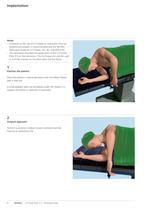
Implantation Notes – Familiarity in the use of LCP plates or instruction from an experienced surgeon is recommended (see the Synthes Technique Guide for LCP Plates, Art. No. 036.000.019). – This technique describes the application of the LCP Hook Plate 3.5 on the olecranon. The technique can also be used in a similar manner on the distal tibia and the fibula. 1 Position the patient Place the patient in lateral decubitus with the elbow flexed over a side rest. A small padded table can be placed under the forearm to support the elbow in extension if necessary. 2 Surgical approach Perform a posterior...
Open the catalog to page 8
Prepare olecranon For fractures: Reduce the fracture 292.710 Kirschner Wire 0 1.6 mm with threaded tip, length 150/5 mm, Stainless Steel Reduce the fracture cirealy or ndireclly depending on the type of fracture, lempo'ari y fis the fragment using Kirjchner wires and/or forceps. Esamine -he redi.et on of the olecranon C n:j Í!-:-í¡¡- int,-nsitirat on. Ensire That Kirschner wires or forceps will not interfere with subsequent piale placement.
Open the catalog to page 9
Implantation 3b 1 For osteotomies Instrument 292.560 Kirschner Wire л 1.6 mm with double tip, length 150 mm, Stainless Steel Perform an incomplete osteotomy of the dorsal cortex of the olecranon using a thin oscillating saw blade to allow access to the distal humerus (1). Complete the osteotomy with a chisel in order to obtain an interdigitating fracture line. The fracture line should ideally run through the bare area of the sigmoid notch (2). 2 8 Synthes LCP Hook Plate 3.5 Technique Guide
Open the catalog to page 10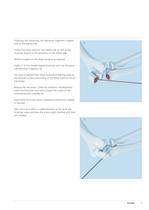
Following the osteotomy, the olecranon fragment is tipped over to the lateral side. 3 Protect the ulnar nerve on the medial side as well as the muscular branch to the anconeus on the lateral side. Perform surgery on the distal humerus as required. Insert a 1.6 mm double-tipped Kirschner wire into the proximal olecranon fragment (3). The wire is inserted from distal to proximal starting close to the articular surface and ending at the distal insertion line of the triceps. Reduce the olecranon. Check for anatomic interdigitation. Insert the Kirschner wire until it passes the cortex of the coronoid...
Open the catalog to page 11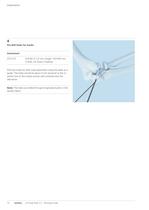
Implantation 4 Pre-drill holes for hooks Instrument 310.210 Drill Bit л 2.0 mm, length 125/100 mm, 2-flute, for Quick Coupling Drill two holes for later hook placement using the plate as a guide. The holes should lie about 4 mm proximal to the insertion line of the triceps and be well centered over the olecranon. Note: The holes are drilled through longitudinal splits in the tendon fibers. 10 Synthes LCP Hook Plate 3.5 Technique Guide
Open the catalog to page 12
5 Place the LCP Hook Plate 3.5 Instruments 0X.113.103 LCP Hook Plate 3.5, 3 holes, length 62 mm X = 2: Stainless Steel X = 4: TAN Optional instruments 03.100.031 Bending Pliers for Reconstruction Plates 3.5 329.150 Bending Pliers for Plates 2.4 to 4.0, length 230 mm 329.040/ 329.050 Bending Irons for Plates 2.4 to 3.5, length 145 mm Place the plate on the olecranon, sinking the hooks into the appropriate pre-drilled holes. Align the plate with the axis of the proximal ulna. Consider the physiological varus bend of the proximal third of the ulna. 1 Note: If required, the plate shaft can be bent...
Open the catalog to page 13All Depuy Synthes catalogs and technical brochures
 Titanium Sternal Fixation System
34 Pages
 Small Battery Drive II
4 Pages
 Introducing The Variable Angle
12 Pages

Archived catalogs
 MatrixRIB®FixationSystem
86 Pages
 HEALIX ADVANCE
4 Pages
 HEALIX Anchor™ 3.4 mm
2 Pages
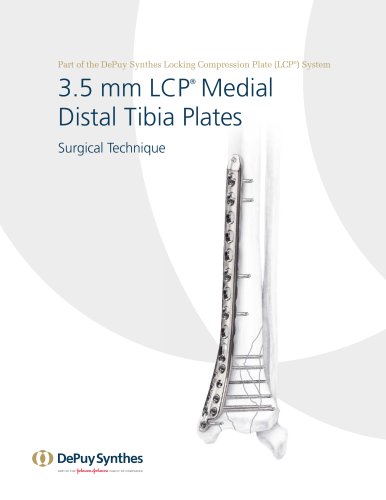 3.5 mm LCP™ Medial
15 Pages
 RADIUS OF CURVATURE
3 Pages
 Building on Success
16 Pages
 2.0 mm LCP® Distal Ulna Plate
20 Pages
 2.4 mm VA LCP™
4 Pages
 Mandible Trauma Solutions
2 Pages
 Power line II
4 Pages
 Concorde
28 Pages
 LCP Intercarpal
31 Pages
 LCS® COMPLETE™
2 Pages
 Synthes TPLO.
8 Pages
 SynFix-LR System
56 Pages
 ATB Anterior Tension Band Plate
32 Pages
 CONDUIT™
15 Pages
 Brochure_FINAL
2 Pages
 DePuy Synthes
81 Pages
 Anspach
3 Pages
 Orthopedic Foot Instruments
32 Pages
 PINNACLE® Hip Solutions
12 Pages
 Corail
24 Pages
 S-ROM® NOILES™
68 Pages
 TRI-LOCK® Product Rationale
12 Pages
 Reclaim Surgical Technique
44 Pages
 Speed
Speed2 Pages
 attune
80 Pages
 HAMMERLOCK® 2
2 Pages
 DePuy Glenoid Solutions
2 Pages
 Trauma Solutions. Elbow
4 Pages
 Polar
Polar4 Pages
 Alveolar Distractor.
4 Pages
 Piezoelectric System
4 Pages
 Air Power Line II
6 Pages
 LCP Clavicle Hook Plate
4 Pages
 TruMatch Pin Guides
16 Pages
 P F N A
8 Pages
 SKILL, DEDICATION,
16 Pages
 Orthopaedics. Overview
20 Pages
 DURALOC
16 Pages
 Marathon Cemented Cup
20 Pages
 REEF Surgical Technique
16 Pages
 MatrixNEURO
8 Pages
 Anspach XMax
4 Pages
 Anspach eMax 2 Plus
4 Pages
 Small Electric Drive
4 Pages
 Air Pen Drive
4 Pages
 Colibri II
4 Pages
 Spine
Spine25 Pages
 Expert Hindfoot Arthrodesis Nail
48 Pages
 LCP Distal Fibula Plates
32 Pages
 TomoFix
60 Pages
 Expert Tibial Nail PROtect
16 Pages
 Expert Tibia Nail
84 Pages
 Sacral Bars
16 Pages
 Pelvic C-Clamp
20 Pages
 Low Profile Pelvic System
16 Pages
 Proximal Femoral (Hook) Plate
24 Pages
 LCP
LCP24 Pages
 PFNA
PFNA112 Pages
 HCS 1.5, 2.4, 3.0
36 Pages
 LCP Wrist Fusion
32 Pages
 LCP Compact Hand
28 Pages
 VA-LCP Elbow
48 Pages
 Distal Radius
44 Pages
 Olecranon
30 Pages
 DHP & Olecranon
4 Pages
 LCP S-A
4 Pages
 Epoca
Epoca4 Pages
 Philos
32 Pages
 MultiLoc
68 Pages


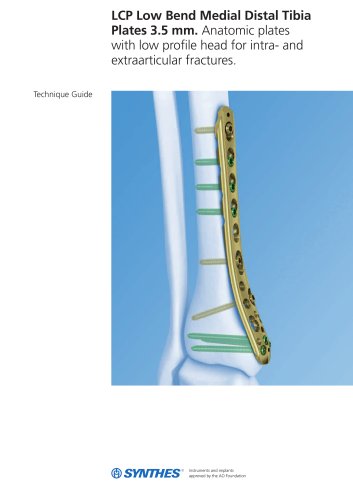


- DePuy Synthes bone plate
- Compression plate
- Metallic compression plate
- Locking compression plate
- Titanium compression plate
- Orthopedic surgery instrument kit
- Distal compression plate
- Interbody fusion cage
- Sterilization container
- Instrument sterilization container
- Arthrodesis nail
- Bone substitute
- Metallic intramedullary nail
- Femoral stem
- Anterior interbody fusion cage
- Arthrodesis plate
- Orthopedic surgery bone substitute
- Femoral intramedullary nail
- Knee prosthesis
- Metallic arthrodesis plate