
- Catalogs
- Depuy Synthes
- LCP Intercarpal


LCP Intercarpal

LCP Intercarpal
The document details the surgical technique for the 2.4 mm Variable Angle Locking Intercarpal Fusion System, intended for partial wrist arthrodesis. This system features low-profile plates allowing stable fixation with up to 15° angulation, reducing soft tissue irritation.
The system's safety in the MR environment is not evaluated, posing potential risks if scanned.
The technique follows AO principles: anatomic reduction, stable fixation, blood supply preservation, and early mobilization.
Indicated for small bone fusion in the hand, revision of failed wrist fusions, and conditions like osteoarthritis, rheumatoid arthritis, and carpal instability.
Preoperative planning includes radiographic assessment. The patient is positioned supine with the forearm on a hand table.
A dorsal longitudinal approach is used. Rotational deformity is corrected with Kirschner wires for provisional fixation, verified with radiographic imaging.
Reaming guides prepare the bone for plate placement, ensuring the plate does not protrude over the bone.
The plate is positioned with a holder, and bone graft is inserted. VA Locking screws are inserted, starting with the lunate, ensuring not to exceed 15° angulation. Final fixation uses a combination of VA Locking and cortex screws.
VA Locking screws are secured into the plate using a torque limiting attachment to prevent overtightening.
- Implants: Includes 2.4 mm VA Locking Intercarpal Fusion Plates in stainless steel and titanium, with various configurations.
- Screws: 2.4 mm Cortex and VA Locking Screws, self-tapping, available in different lengths with T8 StarDrive Recess.
- Includes reamers, reaming guides, Kirschner wires, plate holders, and various drill guides and screwdrivers.
- Details standard and optional instruments, including torque limiting attachments and positioning aids.
- Torque Limiting Attachment (TLA): Used for torque limiting, not recommended for screw removal.
- Postoperative Treatment: Advises a removable wrist splint, with protected range-of-motion exercises post-swelling, continuing until fusion is achieved.
- Graphic cases and trays for organizing instruments and implants, with modular system configurations.
- Label sheets and push pins for screw types and lengths for system organization.
- Devices are restricted to sale by or on the order of a physician, with legal disclaimers on warranty and market availability.
Catalog excerpts
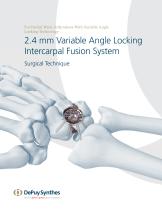
For Partial Wrist Arthrodesis With Variable Angle Locking Technology 2.4 mm Variable Angle Locking Intercarpal Fusion System PART OF THE ^mtrtm^ofvWllOn FAMILY OF COMPANIES
Open the catalog to page 1
Introduction 2.4 mm Variable Angle Locking Intercarpal 2 Fusion System AO Principles 4 Surgical Technique Preparation 6 Product Information Implants 20 MR Information The 2.4 mm Variable Angle Locking Intercarpal Fusion System has not been evaluated for safety and compatibility in the MR environment. It has not been tested for heating, migration or image artifact in the MR environment. The safety of the 2.4 mm Variable Angle Locking Intercarpal Fusion System in the MR environment is unknown. Scanning a patient who has this device may result in patient injury. £ Image intensifier control 2.4 mm...
Open the catalog to page 2
2.4 mm Variable Angle Locking Intercarpal Fusion System. For partial wrist arthrodesis with variable angle locking technology. Low-profile, variable angle locking plates – Low-profile circular plate with smooth surface and rounded edges to minimize soft tissue irritation – Variable angle locking technology allows stable fixation with up to 15° angulation in all directions – Adapt to the specific anatomy – K-wire holes for temporary fixation – Plate diameters: 15 mm (6 holes) and 17 mm (7 holes) – Available in stainless steel and titanium alloy (Ti-6Al-7Nb) VA Locking holes accept both 2.4 mm...
Open the catalog to page 3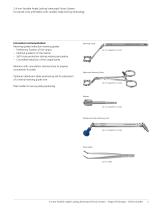
2.4 mm Variable Angle Locking Intercarpal Fusion System. For partial wrist arthrodesis with variable angle locking technology. Innovative instrumentation: Reaming guides/ reduction reaming guides – Preliminary fixation of the carpus – Optimal guidance of the reamer – Soft tissue protection during reaming procedure – Controlled reduction of the carpal bones Reamers with cannulation remove bone to prepare countersink for plate Reduction Reaming Guide Optional radiolucent plate positioning aid for placement of a central reaming guide wire 03.111.042/03.111.043 Plate holder for secure plate positioning...
Open the catalog to page 4
In 1958, the AO formulated four basic principles, which have become the guidelines for internal fixation.1, 2 In 1958, the AO formulated four basic principles, which have become the guidelines for internal xation1, 2. Anatomic Anatomic reduction reduction Fracture reduction and fixation to Fracture reduction and xation to restore anatomical relationships. restore anatomical relationships. 1 Early, active mobilization Early, active mobilization Early and safe mobilization and Early and safe mobilization and rehabilitation of the injured part rehabilitation of the injured part and the the patient...
Open the catalog to page 5
The 2.4 mm VA Locking Intercarpal Fusion System is indicated for fusion of small bones of the hand including hamate, capitate, lunate, and triquetrum, for the revision of failed partial wrist fusions, and is indicated for use in patients suffering pain and/or loss of function due to: – Osteoarthritis – Rheumatoid arthritis – Post-traumatic or degenerative wrist arthritis – Carpal instability 2.4 mm Variable Angle Locking Intercarpal Fusion System Surgical Technique DePuy S
Open the catalog to page 6
2.4 mm Variable Angle LCP (VA-LCP) Distal Radius System Set (stainless steel or titanium) 2/3 Instrument Tray for LCP and VA-LCP Distal Radius Systems (stainless steel or titanium) 1 /3 Instrument Tray for 2.4 mm Cortex and VA-LCP Screws for Modular Case System plus Required screw set (unless using 01.111.478/01.111.479) 2.4 mm and 2.7 mm Variable Angle Locking Screw Module for Distal Radius (stainless steel or titanium) 2.4 mm and 2.7 mm LCP and Variable Angle Locking Screw Module for Distal Radius (stainless steel or titanium) 2.4 mm LCP and Variable Angle Locking Screw Module for Distal Radius...
Open the catalog to page 7
1 Preoperative planning Complete a preoperative radiographic assessment, to confirm the presence of sufficient bone stock for the four-corner fusion procedure, and intact joint surfaces between the radius and the lunate. Determine the angle of the extension deformity of the lunate. 2 Position patient Position the patient supine, with the forearm positioned on a hand table in full pronation. Use a rolled towel to support the palm of the hand. The use of a tourniquet and magnifying loops is recommended. 2.4 mm Variable Angle Locking Intercarpal Fusion System Surgical Technique DePuy Synthes
Open the catalog to page 8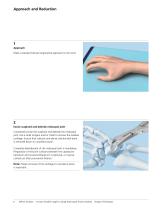
1 Approach Make a standard dorsal longitudinal approach to the wrist. 2 Excise scaphoid and debride midcarpal joint Completely excise the scaphoid and debride the midcarpal joint. Use a small rongeur and/or chisel to remove the residual cartilage. Ensure that sclerotic and dense subchondral bone is removed down to cancellous bone. Complete debridement of the midcarpal joint is mandatory. Preparation of the joint surfaces between the capitatum/ hamatum and lunatum/triquetrum is optional, or may be carried out after provisional fixation. Note: Proper removal of the cartilage to cancellous bone...
Open the catalog to page 9
3 Reduce rotational deformity and provisionally fix carpus Instrument 02.111.304.10 1.25 mm Kirschner Wire, with trocar tip, 80 mm If necessary, use a Kirschner wire as a joystick in the lunate to correct the position of the lunate. Temporarily fix the lunate in the neutral position with a Kirschner wire from distal through the capitate and remove the joystick K-wire. Intraoperatively check residual mobility. In general, more extension than flexion is recommended. Notes: – Verify correct alignment with radiographic imaging. – If performing reaming technique without the reaming guide, ensure K-wire...
Open the catalog to page 10
1 Position reaming guide Instruments 02.111.304.10 1.25 mm Kirschner Wire, with trocar tip, 80 mm Reaming Guide, for 2.4 mm VA Locking Intercarpal Fusion Plate, 15 mm Reaming Guide, for 2.4 mm VA Locking Intercarpal Fusion Plate, 17 mm Choose the appropriate reaming guide (15 mm or 17 mm) according to the selected plate, and fix it temporarily, with at least one Kirschner wire per carpal bone, over the center of the four-bone junction. If necessary, remove the volar lunocapitate Kirschner wire, to avoid later interference with the reamer. Note: The shape of the reaming guide is adapted to the...
Open the catalog to page 11All Depuy Synthes catalogs and technical brochures
 Titanium Sternal Fixation System
34 Pages
 Small Battery Drive II
4 Pages
 Introducing The Variable Angle
12 Pages


Archived catalogs
 MatrixRIB®FixationSystem
86 Pages
 HEALIX ADVANCE
4 Pages
 HEALIX Anchor™ 3.4 mm
2 Pages
 3.5 mm LCP™ Medial
15 Pages
 RADIUS OF CURVATURE
3 Pages
 Building on Success
16 Pages
 2.0 mm LCP® Distal Ulna Plate
20 Pages
 2.4 mm VA LCP™
4 Pages
 Mandible Trauma Solutions
2 Pages
 Power line II
4 Pages
 Concorde
28 Pages
 LCS® COMPLETE™
2 Pages
 Synthes TPLO.
8 Pages
 SynFix-LR System
56 Pages
 ATB Anterior Tension Band Plate
32 Pages
 CONDUIT™
15 Pages
 Brochure_FINAL
2 Pages
 DePuy Synthes
81 Pages
 Anspach
3 Pages
 Orthopedic Foot Instruments
32 Pages
 PINNACLE® Hip Solutions
12 Pages
 Corail
24 Pages
 S-ROM® NOILES™
68 Pages
 TRI-LOCK® Product Rationale
12 Pages
 Reclaim Surgical Technique
44 Pages
 Speed
Speed2 Pages
 attune
80 Pages
 HAMMERLOCK® 2
2 Pages
 DePuy Glenoid Solutions
2 Pages
 Trauma Solutions. Elbow
4 Pages
 Polar
Polar4 Pages
 Alveolar Distractor.
4 Pages
 Piezoelectric System
4 Pages
 Air Power Line II
6 Pages
 LCP Clavicle Hook Plate
4 Pages
 TruMatch Pin Guides
16 Pages
 P F N A
8 Pages
 SKILL, DEDICATION,
16 Pages
 Orthopaedics. Overview
20 Pages
 DURALOC
16 Pages
 Marathon Cemented Cup
20 Pages
 REEF Surgical Technique
16 Pages
 MatrixNEURO
8 Pages
 Anspach XMax
4 Pages
 Anspach eMax 2 Plus
4 Pages
 Small Electric Drive
4 Pages
 Air Pen Drive
4 Pages
 Colibri II
4 Pages
 Spine
Spine25 Pages
 Expert Hindfoot Arthrodesis Nail
48 Pages
 LCP Distal Fibula Plates
32 Pages
 TomoFix
60 Pages
 Expert Tibial Nail PROtect
16 Pages
 Expert Tibia Nail
84 Pages
 Sacral Bars
16 Pages
 Pelvic C-Clamp
20 Pages
 Low Profile Pelvic System
16 Pages
 Proximal Femoral (Hook) Plate
24 Pages
 LCP
LCP24 Pages
 PFNA
PFNA112 Pages
 HCS 1.5, 2.4, 3.0
36 Pages
 LCP Wrist Fusion
32 Pages
 LCP Compact Hand
28 Pages
 VA-LCP Elbow
48 Pages
 Distal Radius
44 Pages
 Olecranon
30 Pages
 LCP Hook Plate
28 Pages
 DHP & Olecranon
4 Pages
 LCP S-A
4 Pages
 Epoca
Epoca4 Pages
 Philos
32 Pages
 MultiLoc
68 Pages




- DePuy Synthes bone plate
- Compression plate
- Metallic compression plate
- Locking compression plate
- Titanium compression plate
- Orthopedic surgery instrument kit
- Distal compression plate
- Interbody fusion cage
- Sterilization container
- Instrument sterilization container
- Arthrodesis nail
- Bone substitute
- Metallic intramedullary nail
- Femoral stem
- Anterior interbody fusion cage
- Arthrodesis plate
- Orthopedic surgery bone substitute
- Femoral intramedullary nail
- Knee prosthesis
- Metallic arthrodesis plate