
- Catalogs
- Depuy Synthes
- P F N A


P F N A

P F N A
The document provides detailed information about the Proximal Femoral Nail Antirotation (PFNA) system with an augmentation option, designed for superior anchoring in osteoporotic bone. It emphasizes a simple and reproducible procedure through a standardized technique, allowing intraoperative decisions for augmentation.
The PFNA system includes a nail with an anatomical design for optimal fit in the femur, proven in over 450,000 cases. It offers several distal locking options, including static and dynamic locking, and features a medial-lateral angle of 6° for insertion at the greater trochanter. The product range includes PFNA nails in various lengths and sizes, ensuring rotational and angular stability with a single element.
The PFNA blade compacts cancellous bone, providing additional anchoring, crucial for osteoporotic bone. It offers increased stability by preventing rotation and varus collapse, with biomechanical tests showing higher cut-out resistance compared to screw systems. The blade is inserted through a lateral incision and automatically locks to prevent rotation.
The guide wire positioning is crucial for correct PFNA blade placement. The system includes a guide wire aiming device for AP orientation and a radiolucent insertion handle for lateral view adjustments. Intraoperative compression is possible with new PFNA blades and a compression instrument.
SureLock is a C-arm guided distal targeting device for precise distal locking of long nails, reducing radiation exposure and increasing working space.
The PFNA Augmentation system offers controlled cement augmentation through the implant, enhancing rotational stability and increasing cycles to cut-out. The Traumacem V+ Cement is ready-to-use with no waiting time, providing approximately 27 minutes of application time. The cement kit includes a side-opening cannula for controlled injection and visual control under x-ray imaging.
For detailed ordering information, refer to the PFNA Technique Guide or the Synthes eCatalog. The publication is not intended for distribution in the USA.
Catalog excerpts
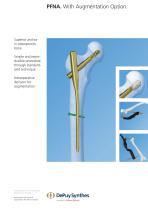
PFNA. With Augmentation Option. Superior anchor ducible procedure through standard- ized technique This publication is not intended for approved by the AO Foundation. COMPANIES OF p»»oH^ofc««m
Open the catalog to page 1
PFNA. Proximal Femoral Nail Antirotation. PFNA Nail Optimal fit The anatomical design guarantees an optimal fit in the femur. The nail design has been well proven in over 450,000 cases performed with the PFN and PFNA. The PFNA has a medial-lateral angle of 6° This allows insertion at the tip of the greater trochanter. Optimal stress distribution The flexible PFNA tip eases insertion and reduces stress on the bone at the tip of the PFNA. Several distal locking options Static or dynamic locking can be performed via the aiming arm with PFNA standard, small and xs. The PFNA long additionally allows...
Open the catalog to page 2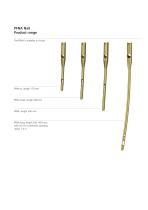
PFNA Nail Product range The PFNA is available in 4 sizes PFNA small, length 200 mm PFNA long, length 300 – 420 mm, with 20 mm increments, bending radius 1.5 m
Open the catalog to page 3
PFNA. Proximal Femoral Nail Antirotation. PFNA Blade Rotational and angular stability achieved with one single element Compaction of cancellous bone Inserting the PFNA blade compacts the cancellous bone providing additional anchoring, which is especially important in osteoporotic bone. Bone structure before insertion of the PFNA blade. Bone structure after PFNA blade insertion – cancellous bone is compacted providing additional anchoring to the PFNA blade. PFNA blade unlocked PFNA blade locked Large surface and increasing core diameter guarantee maximum compaction and optimal hold in bone Increased...
Open the catalog to page 4
PFNA. Instrumentation. Easier guide wire positioning and insertion Correct positioning of the guide wire and finally the PFNA blade in the femoral head is crucial. The guide wire aiming device allows for AP orientation, which permits correction of the nail’s insertion depth prior to guide wire insertion. In the lateral view, rotation of the nail can be adjusted with the two orientation lines in the radiolucent insertion handle for PFNA. Intraoperative compression In good bone quality the new PFNA blades (0X.027.010S – 0X.027.021S and 0X.027.030S – 0X.027.041S) together with the compression instrument...
Open the catalog to page 5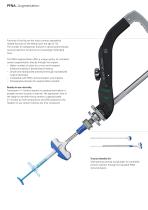
PFNA. Augmentation. Fractures of the hip are the most common operatively treated fractures of the elderly (over the age of 70). The number of osteoporotic fractures is growing dramatically causing treatment to become an increasingly challenging issue. The PFNA Augmentation offers a unique system of controlled cement augmentation directly through the implant: – Higher number of cycles to cut-out and increased rotational stability in biomechanical testing – Simple and reproducible procedure through standardized surgical technique – Compatible with PFNA instrumentation and implants – Intraoperative...
Open the catalog to page 6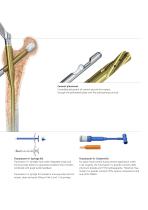
Cement placement Controlled placement of cement around the implant, through the perforated blade with the side-opening cannula. Traumacem V+ Syringe Kit Traumacem V+ Syringes have wide integrated wings and strong syringe pistons to guarantee excellent force transfer, combined with good tactile feedback. Traumacem V+ Syringe Kit includes a one-way stop-cock for simple, clean and quick filling of the 2 and 1 ml syringes. Traumacem V+ Cement Kit For good visual control during cement application under x-ray imaging, the Traumacem V+ powder contains 40% zirconium dioxide and 15% hydroxyapatite. Therefore...
Open the catalog to page 7
PFNA. With Augmentation Option. Product information This publication is not intended for distribution in the USA. All surgical techniques are available as PDF files at www.synthes.com/lit © DePuy Synthes Trauma, a division of Synthes GmbH. 2015. For ordering information for all implants and instruments associated with the PFNA system (and augmentation option), please refer to the ”PFNA. With Augmentation Option” Technique Guide 036.001.143, or the Synthes eCatalog at catalog.synthes.com.
Open the catalog to page 8All Depuy Synthes catalogs and technical brochures
 Titanium Sternal Fixation System
34 Pages
 Small Battery Drive II
4 Pages
 Introducing The Variable Angle
12 Pages

Archived catalogs
 MatrixRIB®FixationSystem
86 Pages
 HEALIX ADVANCE
4 Pages
 HEALIX Anchor™ 3.4 mm
2 Pages
 3.5 mm LCP™ Medial
15 Pages
 RADIUS OF CURVATURE
3 Pages
 Building on Success
16 Pages
 2.0 mm LCP® Distal Ulna Plate
20 Pages
 2.4 mm VA LCP™
4 Pages
 Mandible Trauma Solutions
2 Pages
 Power line II
4 Pages
 Concorde
28 Pages
 LCP Intercarpal
31 Pages
 LCS® COMPLETE™
2 Pages
 Synthes TPLO.
8 Pages
 SynFix-LR System
56 Pages
 ATB Anterior Tension Band Plate
32 Pages
 CONDUIT™
15 Pages
 Brochure_FINAL
2 Pages
 DePuy Synthes
81 Pages
 Anspach
3 Pages
 Orthopedic Foot Instruments
32 Pages
 PINNACLE® Hip Solutions
12 Pages
 Corail
24 Pages
 S-ROM® NOILES™
68 Pages
 TRI-LOCK® Product Rationale
12 Pages
 Reclaim Surgical Technique
44 Pages
 Speed
Speed2 Pages
 attune
80 Pages
 HAMMERLOCK® 2
2 Pages
 DePuy Glenoid Solutions
2 Pages
 Trauma Solutions. Elbow
4 Pages
 Polar
Polar4 Pages
 Alveolar Distractor.
4 Pages
 Piezoelectric System
4 Pages
 Air Power Line II
6 Pages
 LCP Clavicle Hook Plate
4 Pages
 TruMatch Pin Guides
16 Pages
 SKILL, DEDICATION,
16 Pages
 Orthopaedics. Overview
20 Pages
 DURALOC
16 Pages
 Marathon Cemented Cup
20 Pages
 REEF Surgical Technique
16 Pages
 MatrixNEURO
8 Pages
 Anspach XMax
4 Pages
 Anspach eMax 2 Plus
4 Pages
 Small Electric Drive
4 Pages
 Air Pen Drive
4 Pages
 Colibri II
4 Pages
 Spine
Spine25 Pages
 Expert Hindfoot Arthrodesis Nail
48 Pages
 LCP Distal Fibula Plates
32 Pages
 TomoFix
60 Pages
 Expert Tibial Nail PROtect
16 Pages
 Expert Tibia Nail
84 Pages
 Sacral Bars
16 Pages
 Pelvic C-Clamp
20 Pages
 Low Profile Pelvic System
16 Pages
 Proximal Femoral (Hook) Plate
24 Pages
 LCP
LCP24 Pages
 PFNA
PFNA112 Pages
 HCS 1.5, 2.4, 3.0
36 Pages
 LCP Wrist Fusion
32 Pages
 LCP Compact Hand
28 Pages
 VA-LCP Elbow
48 Pages
 Distal Radius
44 Pages
 Olecranon
30 Pages
 LCP Hook Plate
28 Pages
 DHP & Olecranon
4 Pages
 LCP S-A
4 Pages
 Epoca
Epoca4 Pages
 Philos
32 Pages
 MultiLoc
68 Pages




- DePuy Synthes bone plate
- Compression plate
- Metallic compression plate
- Locking compression plate
- Titanium compression plate
- Orthopedic surgery instrument kit
- Distal compression plate
- Interbody fusion cage
- Sterilization container
- Instrument sterilization container
- Arthrodesis nail
- Bone substitute
- Metallic intramedullary nail
- Femoral stem
- Anterior interbody fusion cage
- Arthrodesis plate
- Orthopedic surgery bone substitute
- Femoral intramedullary nail
- Knee prosthesis
- Metallic arthrodesis plate