
- Catalogs
- Depuy Synthes
- Sacral Bars


Sacral Bars

Sacral Bars
This document is a technique guide for the use of Sacral Bars in the fixation of the posterior pelvis, specifically in cases of fractures or sacroiliac joint dislocations. It emphasizes the importance of instruction by an experienced surgeon for proper use.
Product Information
Sacral Bars are designed with features such as sacral washers to prevent pressure on cortical bone, a trocar tip for easy passage through soft tissues, and full threading available in 200 mm or 260 mm lengths. They are designed to avoid direct contact with neurological structures, reducing the risk of iatrogenic injuries.
AO Principles
The guide follows the AO principles of internal fixation: anatomic reduction, stable fixation, preservation of blood supply, and early, active mobilization. These principles ensure proper anatomical relationships, stability, preservation of blood supply, and an environment conducive to bone healing.
Indications
Synthes Sacral Bars are indicated for fixation of the posterior pelvis, including areas of the posterior superior and inferior iliac spine, sacral fractures, and fracture dislocations of the sacroiliac joint.
Preoperative Planning
Preoperative planning involves selecting the appropriate sacral bar length and ensuring stable reduction on at least one side in cases of bilateral fracture.
Surgical Technique
The surgical procedure involves several steps:
- Positioning the patient in the prone position.
- Making bilateral incisions for direct visualization and reduction.
- Reducing and stabilizing the fracture using reduction forceps and Kirschner wires.
- Drilling gliding holes for sacral bar placement.
- Inserting the first sacral bar and ensuring it passes dorsal to the sacral lamina.
- Applying washers and rounded nuts to prevent bone pressure.
- Adding hexagonal nuts for compression maintenance.
- Placing a second sacral bar to prevent rotation.
- Trimming the sacral bars flush with the hexagonal nuts.
Sacral Bar Sets
Each set contains sterile implants and a drill bit for one surgical procedure. Two sets are available, with bar lengths of 200 mm and 260 mm.
Additional Instruments
Additional instruments required include a combination wrench, ratchet wrench, bolt cutter, universal chuck with T-handle, pelvic reduction forceps, and oscillating drill attachment.
Synthes Biomaterials Overview
Synthes offers a range of synthetic and allogenic bone replacement materials, which provide uniform quality and reduce surgery duration. Products include chronOS and DBX, with various application forms and biological properties.
Catalog excerpts
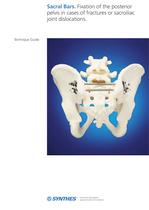
Sacral Bars. Fixation of the posterior pelvis in cases of fractures or sacroiliac joint dislocations. Technique Guide
Open the catalog to page 1
Introduction Sacral Bars 2 Surgical Technique Preoperative Planning 5 Product Information Sacral Bar Sets 11 Synthes Biomaterials Overview 13 This description alone does not provide sufficient background for direct use of the product. Instruction by a surgeon experienced in handling this product is highly recommended Reprocessing, Care and Maintenance of Synthes Instruments For general guidelines, function control and dismantling of multi-part instruments, please refer to: www.synthes.com/reprocessing
Open the catalog to page 3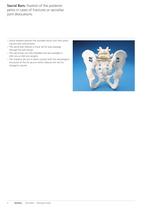
Sacral Bars. Fixation of the posterior pelvis in cases of fractures or sacroiliac joint dislocations. − Sacral washers prevent the rounded sacral nuts from pressing into the cortical bone − The sacral bars feature a trocar tip for easy passage through the soft tissues − The sacral bars are fully threaded and are available in 200 mm or 260 mm lengths − The implants are not in direct contact with the neurological structures of the Os sacrum which reduces the risk for iatrogenic injuries 2 Synthes Sacral Bars Technique Guide
Open the catalog to page 4
AO Principles In 1958, the AO formulated four basic principles, which have become the guidelines for internal fixation.1, 2 Those principles as applied to the sacral bars are: Anatomic reduction Fixation of sacral fractures and fracture dislocations of the sacroiliac joint with the threaded sacral bars allows the restoration of anatomical relationships. Stable fixation Hexagonal and rounded sacral nuts can be wedged against each other and thus compression can be achieved. The recommended two-bar technique adds stability to the construct. Preservation of blood supply The sacral bars bridge the...
Open the catalog to page 5
The Synthes Sacral Bars are indicated for fixation of the pos- terior pelvis, in areas of the posterior superior iliac spine, posterior inferior iliac spine, for sacral fractures, and fracture dislocations of the sacroiliac joint. 4 Synthes Sacral Bars Technique Guide
Open the catalog to page 6
Preoperative Planning 321.200 Ratchet Wrench for Nut, hexagonal, This procedure can be performed manually using a universal chuck with T-handle, or with power equipment. Note: In the case of bilateral fracture, it is necessary to have at least one side of stable reduction using a sacroiliac screw or posterior plate in addition to inserting sacral bars. The correct length of the sacral bar should extend 25-30 mm on either side of the posterior iliac crest (bar will For additionally required instruments, please see page 12.
Open the catalog to page 7
Surgical Technique The patient is placed in the prone position. Make slightly curved bilateral incisions just lateral to the pos- terior superior iliac spine. The incision on the fracture side should be large enough to allow for direct visualization and 6 Synthes Sacral Bars Technique Guide
Open the catalog to page 8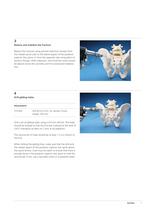
Reduce and stabilize the fracture Reduce the fracture using pointed reduction forceps from the medial sacral crest to the lateral aspect of the posterior superior iliac spine, or from the opposite side using pelvic re- duction forceps. After reduction, two Kirschner wires should be placed across the sacroiliac joint for provisional stabiliza- Drill gliding holes 310.60J Drill Bit 6.0 mm, for Jacobs Chuck, Drill a set of gliding holes using a 6.0 mm drill bit. The holes should be located so that the first bar is placed at the level of L5/S1 interspace as seen on C-arm or by palpation. The second...
Open the catalog to page 9
Surgical Technique 5 Insert first sacral bar Instruments 296.763 or 296.766 Threaded Sacral Bar, length 200 mm, Stainless Steel Threaded Sacral Bar, length 260 mm, Stainless Steel Drive the sharp trocar tip of the threaded sacral bar through the predrilled hole in the contralateral iliac spine. The sacral lamina must be seen, to ensure that the bar passes dorsal to it and does not enter the sacral canal; it may pass through the medial sacral crest. 6 Apply washers and rounded nuts Instruments 296.758 Washer л 6.0 mm 296.757 Nut, rounded, л 6.0 mm 321.160 or 321.200 Combination Wrench л 11.0 mm...
Open the catalog to page 10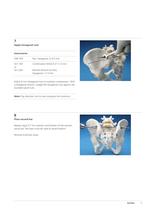
7 Apply hexagonal nuts Instruments 296.759 Nut, hexagonal, л 6.0 mm 321.160 or 321.200 Combination Wrench л 11.0 mm Ratchet Wrench for Nut, hexagonal, 11.0 mm Add 6.0 mm hexagonal nuts to maintain compression. With a hexagonal wrench, wedge the hexagonal nuts against the rounded sacral nuts. Note: Pay attention not to over-compress the construct. 8 Place second bar Repeat steps 5–7 for insertion and fixation of the second sacral bar. Two bars must be used to avoid rotation. Remove Kirschner wires. Synthes 9
Open the catalog to page 11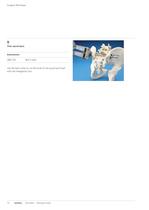
Surgical Technique 9 Trim sacral bars Instrument 388.720 Bolt Cutter Use the bolt cutter to cut the ends of the sacral bars flush with the hexagonal nuts. 10 Synthes Sacral Bars Technique Guide
Open the catalog to page 12
Each set contains the necessary sterile implants and drill bit for one surgical procedure as described in the technique Bar Length 200 mm, sterile Bar Length 260 mm, sterile 01.100.763 contains the following implants and instruments: 296.763S* Threaded Sacral Bar, length 200 mm, 0 6.0 mm. Stainless Steel, sterile 2 310.60JS Drill Bit 6.0 mm, for Jacobs Chuck, 01.100.766 contains the following implants and instruments: 296.766S* Threaded Sacral Bar, length 260 mm, 0 6.0 mm. Stainless Steel, sterile 2 310.60JS Drill Bit 6.0 mm, for Jacobs Chuck,
Open the catalog to page 13
Additional Instruments The following instruments are additionally required: Ratchet Wrench for Nut, hexagonal, Bolt Cutter Universal Chuck with T-Handle Also available: 398.860 Pelvic Reduction Forceps, long, with pointed ball tips, speed lock, Oscillating Drill Attachment 12 Synthes Sacral Bars Technique Guide
Open the catalog to page 14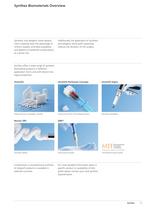
Synthes Biomaterials Overview Synthetic and allogenic bone replacement materials have the advantage of uniform quality, unlimited availability and absence of potential complications at a donor site. Additionally, the application of synthetic and allogenic bone graft substitutes reduces the duration of the surgery. Synthes offers a wide range of synthetic biomaterial products in different application forms and with distinct biological properties: chronOS chronOS Perfusion Concept chronOS Inject Osteoconductive, resorbable, synthetic Enhancing chronOS with biological factors Injectable remodelling...
Open the catalog to page 15All Depuy Synthes catalogs and technical brochures
 Titanium Sternal Fixation System
34 Pages
 Small Battery Drive II
4 Pages
 Introducing The Variable Angle
12 Pages

Archived catalogs
 MatrixRIB®FixationSystem
86 Pages
 HEALIX ADVANCE
4 Pages
 HEALIX Anchor™ 3.4 mm
2 Pages
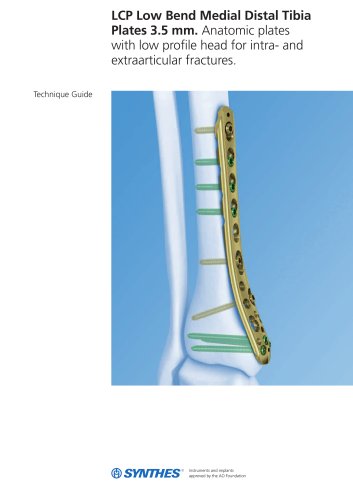
 3.5 mm LCP™ Medial
15 Pages
 RADIUS OF CURVATURE
3 Pages
 Building on Success
16 Pages
 2.0 mm LCP® Distal Ulna Plate
20 Pages
 2.4 mm VA LCP™
4 Pages
 Mandible Trauma Solutions
2 Pages
 Power line II
4 Pages
 Concorde
28 Pages
 LCP Intercarpal
31 Pages
 LCS® COMPLETE™
2 Pages
 Synthes TPLO.
8 Pages
 SynFix-LR System
56 Pages
 ATB Anterior Tension Band Plate
32 Pages
 CONDUIT™
15 Pages
 Brochure_FINAL
2 Pages
 DePuy Synthes
81 Pages
 Anspach
3 Pages
 Orthopedic Foot Instruments
32 Pages
 PINNACLE® Hip Solutions
12 Pages
 Corail
24 Pages
 S-ROM® NOILES™
68 Pages
 TRI-LOCK® Product Rationale
12 Pages
 Reclaim Surgical Technique
44 Pages
 Speed
Speed2 Pages
 attune
80 Pages
 HAMMERLOCK® 2
2 Pages
 DePuy Glenoid Solutions
2 Pages
 Trauma Solutions. Elbow
4 Pages
 Polar
Polar4 Pages
 Alveolar Distractor.
4 Pages
 Piezoelectric System
4 Pages
 Air Power Line II
6 Pages
 LCP Clavicle Hook Plate
4 Pages
 TruMatch Pin Guides
16 Pages
 P F N A
8 Pages
 SKILL, DEDICATION,
16 Pages
 Orthopaedics. Overview
20 Pages
 DURALOC
16 Pages
 Marathon Cemented Cup
20 Pages
 REEF Surgical Technique
16 Pages
 MatrixNEURO
8 Pages
 Anspach XMax
4 Pages
 Anspach eMax 2 Plus
4 Pages
 Small Electric Drive
4 Pages
 Air Pen Drive
4 Pages
 Colibri II
4 Pages
 Spine
Spine25 Pages
 Expert Hindfoot Arthrodesis Nail
48 Pages
 LCP Distal Fibula Plates
32 Pages
 TomoFix
60 Pages
 Expert Tibial Nail PROtect
16 Pages
 Expert Tibia Nail
84 Pages
 Pelvic C-Clamp
20 Pages
 Low Profile Pelvic System
16 Pages
 Proximal Femoral (Hook) Plate
24 Pages
 LCP
LCP24 Pages
 PFNA
PFNA112 Pages
 HCS 1.5, 2.4, 3.0
36 Pages
 LCP Wrist Fusion
32 Pages
 LCP Compact Hand
28 Pages
 VA-LCP Elbow
48 Pages
 Distal Radius
44 Pages
 Olecranon
30 Pages
 LCP Hook Plate
28 Pages
 DHP & Olecranon
4 Pages
 LCP S-A
4 Pages
 Epoca
Epoca4 Pages
 Philos
32 Pages
 MultiLoc
68 Pages




- DePuy Synthes bone plate
- Compression plate
- Metallic compression plate
- Locking compression plate
- Titanium compression plate
- Orthopedic surgery instrument kit
- Distal compression plate
- Interbody fusion cage
- Sterilization container
- Instrument sterilization container
- Arthrodesis nail
- Bone substitute
- Metallic intramedullary nail
- Femoral stem
- Anterior interbody fusion cage
- Arthrodesis plate
- Orthopedic surgery bone substitute
- Femoral intramedullary nail
- Knee prosthesis
- Metallic arthrodesis plate