
- Catalogs
- Depuy Synthes
- TRI-LOCK® Product Rationale


TRI-LOCK® Product Rationale

TRI-LOCK® Product Rationale
The TRI-LOCK Bone Preservation Stem is an advanced hip implant system designed to optimize implant geometry, preserve natural anatomy, and deliver stable performance. It builds on the legacy of the original TRI-LOCK Stem introduced in 1981, which has shown a 98% survivorship at 10 years.
Specifications and Features
The implant features a reduced lateral shoulder, thin geometry, and optimized length to minimize bone removal. It incorporates GRIPTION® fixation technology for consistent implant seating and stability, enhancing long-term bony ingrowth. The neck geometry is optimized for improved range-of-motion and soft tissue tension, with a wide range of sizes to ensure proper fit and leg length recreation.
Bearing Options
The 12/14 ARTICUL/EZE® taper allows the use of various high-performance bearing options, including the PINNACLE® Acetabular Cup System, offering choices in bearing materials and screw fixation.
Surgical Technique
The TRI-LOCK system supports both traditional and minimally invasive surgical approaches. Pre-operative planning involves determining leg length discrepancy and acetabular cup sizing using radiographic analysis. Femoral stem selection is based on achieving cortical contact and equalizing leg lengths.
Procedure Steps
1. Neck Osteotomy: Align the neck resection guide with the femur's long axis and mark the resection line.
2. Femoral Canal Preparation: Use broaches to prepare the canal, ensuring proper alignment and stability.
3. Calcar Preparation: Optional calcar planing is performed with the final broach seated.
4. Trial Reduction: Assess component position, joint stability, and leg length using trial neck segments and heads.
5. Femoral Component Insertion: Insert the stem with proper alignment and version, ensuring stability without excessive force.
6. Femoral Head Impaction: Clean and dry the taper, then impact the femoral head.
Technical Specifications
The document provides detailed specifications for standard and high offset implants, broaches, neck segments, and instruments, including ordering information.
Conclusion
The TRI-LOCK Bone Preservation Stem offers a comprehensive solution for hip replacement, emphasizing performance, efficiency, and surgical flexibility. It is supported by extensive clinical research and a range of instrumentation to accommodate various surgical approaches.
Catalog excerpts

JOINT RECONSTRUCTION tri-lock'JF BONE PRESERVATION STEM jjjfflr Featuring era/^T/OAf Technology Surgical Technique
Open the catalog to page 1
Optimum implant geometry Extending proven TRI-LOCK® heritage The original TRI-LOCK Stem was introduced in 1981. This implant was the first proximally coated tapered-wedge hip stem available to orthopaedic surgeons and their patients. Since its introduction, the original TRI-LOCK Stem has demonstrated 98% survivorship at 10 years.1-4 Preserving the natural anatomy The reduced lateral shoulder, thin geometry and optimised length of the TRI-LOCK Bone Preservation Stem minimise the amount of bone removed from the patient. These same features, along with approach enabling instrumentation, allow the...
Open the catalog to page 3
Determination of leg length discrepancy Perform a clinical evaluation in conjunction with a radiographic analysis to determine preoperative leg length discrepancy and use both to determine intraoperative leg length management. To estimate leg length discrepancy radiographically, draw a reference line across the bottom of the ischium. Measure the distance from the lesser trochanter (or greater trochanter) landmark to the reference line on each side. The difference between the two is the radiographic leg length discrepancy. Clinical examination should help determine the actual leg length irregularity....
Open the catalog to page 4
Femoral stem selection The TRI-LOCK Bone Preservation Stem is designed to achieve intimate cortical contact proximally at the medial and lateral endosteal cortices. Select the template size that fits the proximal femur and equalises leg lengths. The femoral template should be in line with the long axis of the femur, and the neck resection line drawn at the point where the selected stem provides the desired amount of leg length. The vertical distance between the planned centre of rotation of the acetabular component and the centre of rotation of the femoral head constitutes the distance the leg...
Open the catalog to page 5
Neck osteotomy Align the neck resection guide with the long axis of the femur. This establishes the angle of resection at a proper 50˚ from the femoral axis. Determine the resection level by aligning the top of the guide with the tip of the greater trochanter or by measuring a pre-operatively determined distance above the lesser trochanter. Mark the resection line using electrocautery or methylene blue. Resect the femoral head. Femoral canal initiation Use the modular box osteotome to enter the femoral canal and to establish version. If needed the box osteotome can be used to clear bone laterally....
Open the catalog to page 6
Femoral canal preparation The TRI-LOCK Bone Preservation Stem offers several broach handles that enable the many surgical approaches for hip replacement. Select the handle that best suits the needs of the performed approach. Begin using a broach at least two sizes smaller than the preoperatively templated stem size. The starter broach can be used when needed for small femoral geometries, or for clearing bone laterally. While taking care to maintain proper alignment and version, sequentially advance the broaches down the femoral canal. Continue to increase broach size until intimate contact is...
Open the catalog to page 7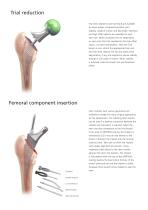
Trial reduction Trial neck segments and trial heads are available to assess proper component position, joint stability, range-of-motion and leg length. Standard and high offset options are available for each stem size. Offset increases 6-8 mm (depending on stem size) from the standard to the high offset option, via direct lateralisation. With the final broach in-situ, attach the appropriate trial neck and trial head. Reduce the hip and assess what adjustments, if any, are required to ensure stability through a full range of motion. When stability is achieved, note the broach size and head/neck...
Open the catalog to page 8
Femoral head impaction Following the final trial reduction, clean and dry the taper to ensure it is free of debris. Place the appropriate femoral head onto the taper. Using the head impactor, engage the head with light taps. Clean the bearing surfaces, and reduce the hip.
Open the catalog to page 9
High Offset Size Standard Offset Size TRI-LOCK Bone Preservation Stem Case Broaches Size starter 0 1 2 3 4 5 6 7 8 9 10 11 12 Neck resection guide TRI-LOCK Bone Preservation Stem case Neck Segments Standard Offset Size High Offset Size Tissue Sparing Solutions Femoral Core Case 1 Case accommodates two sets of PINNACLE trial heads Case accommodates any two broach handles Tissue Sparing Solutions Femoral Core Case 2 Standard straight broach handle Long straight broach handle Curved broach handle Dual-Offset broach handle (left) Dual-Offset broach handle (right) Modular box osteotome Universal...
Open the catalog to page 11
References 1. Burt CF et al. A Femoral Component Inserted without Cement in Total Hip Arthroplasty. A Study of the TRI-LOCK Component with an Average Ten Year Duration of Followup. J. Bone Joint Surg. 1998;80-A:952-60. 2. Purtill JJ et al. Total Hip Arthroplasty Using Two Different Cementless Tapered Stems. Clinical Orthopaedics and Related Research. 2001;393:121-127. 3. Teloken MA et al. Ten to Fifteen Year Follow-up After Total Hip Arthroplasty with a Tapered Cobalt-Chromium Femoral Component (TRI-LOCK) Inserted without Cement. J. Bone Joint Surg. 2002;84-A:2140-2144. 4. Sakalkale DP et al....
Open the catalog to page 12All Depuy Synthes catalogs and technical brochures
 Titanium Sternal Fixation System
34 Pages
 Small Battery Drive II
4 Pages
 Introducing The Variable Angle
12 Pages

Archived catalogs
 MatrixRIB®FixationSystem
86 Pages
 HEALIX ADVANCE
4 Pages
 HEALIX Anchor™ 3.4 mm
2 Pages
 3.5 mm LCP™ Medial
15 Pages
 RADIUS OF CURVATURE
3 Pages
 Building on Success
16 Pages
 2.0 mm LCP® Distal Ulna Plate
20 Pages
 2.4 mm VA LCP™
4 Pages
 Mandible Trauma Solutions
2 Pages
 Power line II
4 Pages
 Concorde
28 Pages
 LCP Intercarpal
31 Pages
 LCS® COMPLETE™
2 Pages
 Synthes TPLO.
8 Pages
 SynFix-LR System
56 Pages
 ATB Anterior Tension Band Plate
32 Pages
 CONDUIT™
15 Pages
 Brochure_FINAL
2 Pages
 DePuy Synthes
81 Pages
 Anspach
3 Pages
 Orthopedic Foot Instruments
32 Pages
 PINNACLE® Hip Solutions
12 Pages
 Corail
24 Pages
 S-ROM® NOILES™
68 Pages
 Reclaim Surgical Technique
44 Pages
 Speed
Speed2 Pages
 attune
80 Pages
 HAMMERLOCK® 2
2 Pages
 DePuy Glenoid Solutions
2 Pages
 Trauma Solutions. Elbow
4 Pages
 Polar
Polar4 Pages
 Alveolar Distractor.
4 Pages
 Piezoelectric System
4 Pages
 Air Power Line II
6 Pages
 LCP Clavicle Hook Plate
4 Pages
 TruMatch Pin Guides
16 Pages
 P F N A
8 Pages
 SKILL, DEDICATION,
16 Pages
 Orthopaedics. Overview
20 Pages
 DURALOC
16 Pages
 Marathon Cemented Cup
20 Pages
 REEF Surgical Technique
16 Pages
 MatrixNEURO
8 Pages
 Anspach XMax
4 Pages
 Anspach eMax 2 Plus
4 Pages
 Small Electric Drive
4 Pages
 Air Pen Drive
4 Pages
 Colibri II
4 Pages
 Spine
Spine25 Pages
 Expert Hindfoot Arthrodesis Nail
48 Pages
 LCP Distal Fibula Plates
32 Pages
 TomoFix
60 Pages
 Expert Tibial Nail PROtect
16 Pages
 Expert Tibia Nail
84 Pages
 Sacral Bars
16 Pages
 Pelvic C-Clamp
20 Pages
 Low Profile Pelvic System
16 Pages
 Proximal Femoral (Hook) Plate
24 Pages
 LCP
LCP24 Pages
 PFNA
PFNA112 Pages
 HCS 1.5, 2.4, 3.0
36 Pages
 LCP Wrist Fusion
32 Pages
 LCP Compact Hand
28 Pages
 VA-LCP Elbow
48 Pages
 Distal Radius
44 Pages
 Olecranon
30 Pages
 LCP Hook Plate
28 Pages
 DHP & Olecranon
4 Pages
 LCP S-A
4 Pages
 Epoca
Epoca4 Pages
 Philos
32 Pages
 MultiLoc
68 Pages




- DePuy Synthes bone plate
- Compression plate
- Metallic compression plate
- Locking compression plate
- Titanium compression plate
- Orthopedic surgery instrument kit
- Distal compression plate
- Interbody fusion cage
- Sterilization container
- Instrument sterilization container
- Arthrodesis nail
- Bone substitute
- Metallic intramedullary nail
- Anterior interbody fusion cage
- Arthrodesis plate
- Orthopedic surgery bone substitute
- Femoral intramedullary nail
- Knee prosthesis
- Metallic arthrodesis plate