
- Catalogs
- Depuy Synthes
- VA-LCP Elbow Plating System Promotional


VA-LCP Elbow Plating System Promotional

VA-LCP Elbow Plating System Promotional
Introduction
The VA-LCP Elbow Plating System builds on Synthes LCP technology and first-generation elbow plates. It aims to reduce soft tissue irritation, offer simplicity and adaptability, and address specific fracture requirements.
Plate Design
The system features an optimized metaphyseal plate profile with rounded edges to minimize implant prominence and soft tissue irritation. The plate-screw interface is designed for minimal screw-head prominence, with variable angle locking screws that sit flush with the plate surface.
Simplicity and Adaptability
The system uses predefined optimized screw angles to reduce the risk of screw collisions and improve safety. Variable angle locking screws allow for +/-15° off-axis angulation, enabling adaptation to patient anatomy and specific fracture fragments.
Proximal Ulna Specifics
Fracture-specific proximal ulna plates address biomechanical requirements while minimizing soft tissue irritation. Features include long proximal extensions, multiple screw options, and reduced shaft thickness.
Plate Configurations
The system offers three main double-plating configurations for the distal humerus: perpendicular, perpendicular with lateral support, and parallel. Each configuration provides multiple screw options for medial and lateral columns and the articular block.
Conclusion
The VA-LCP Elbow Plating System enhances patient care by improving implant design, offering adaptable solutions, and addressing specific fracture needs.
Catalog excerpts
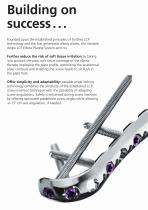
Building on success . . . Founded upon the established principles of Synthes LCP technology and the first generation elbow plates, the Variable Angle LCP Elbow Plating System aims to: Further reduce the risk of soft tissue irritation by taking into account the poor soft tissue coverage of the elbow, thereby improving the plate profile, optimizing the anatomical plate contours and enabling the screw heads to sit flush in the plate hole. Offer simplicity and adaptability: variable angle locking technology combines the simplicity of the established LCP screw insertion technique with the possibility...
Open the catalog to page 2
Respond to the specifics of proximal ulna fractures by recognizing the particular biomechanical requirements of each fracture type and therefore offering specific implants with optimized shapes and screw configurations. Provide multiple distal humerus plate configurations including parallel and perpendicular plating, thereby allowing surgeons to choose their preferred solution. . . . improving patient care.
Open the catalog to page 3
Reduce the risk of soft tissue irritation Poor soft tissue coverage of the elbow makes the area prone to implant prominence. The VA-LCP Elbow Plating System reduces the risk of soft tissue irritation through focused improvements to the implant design and profile. Plate design Optimized metaphyseal plate profile, together with rounded edges and an improved anatomical plate fit minimize the prominence of the construct without compromising stability. Cross-section of the VA-LCP Distal Humerus Plate, medial (1) and the LCP Distal Humerus Plate, medial (2) at the level of the medial epicondyle.
Open the catalog to page 4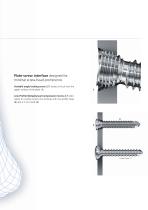
Plate-screw interface designed for minimal screw-head prominence Variable angle locking screw 2.7: heads sit flush with the upper surface of the plate (1). Low-Profile Metaphyseal Compression Screw 2.7: alternative to a cortex screw (non-locking) with low-profile head (2) and 2.7 mm shaft (3).
Open the catalog to page 5
An established approach to instrumentation and implantation reduces complexity and ensures a familiar technique. Predefined optimized screw angles 1 The predefined angles are optimized for common fracture patterns for average anatomy. 2 Use of the predefined angles reduces the risk of screw collisions within the same plate and improves safety during screw insertion.
Open the catalog to page 6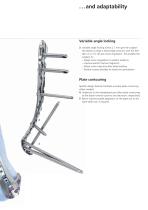
Variable angle locking 3 Variable angle locking screws 2.7 mm give the surgeon the ability to create a fixed-angle construct with the freedom of +/-15° off-axis screw angulation. This enables the surgeon to: – Adapt screw angulations to patient anatomy – Capture specific fracture fragments – Adjust screw trajectory after plate bending – Position screws precisely to avoid joint penetration Plate contouring Specific design features facilitate accurate plate contouring where needed: 4 Undercuts in the metaphyseal part allow plate contouring to the distal humeral columns and olecranon, respectively....
Open the catalog to page 7
Responding to the specifics of the proximal ulna Fracture-specific proximal ulna plates enable the surgeon to address the specific biomechanical requirements of each fracture pattern while minimizing irritations of the adjacent soft tissue. Proximal Olecranon Plate Olecranon Plate 1 Long proximal extension and multiple screw options secure small olecranon fragments and neutralize the forces of the triceps muscle. 2 Notches minimize interference with the triceps tendon. 3 Reduced shaft thickness minimizes plate prominence. 1 Proximal extension with multiple screw options secures the olecranon...
Open the catalog to page 8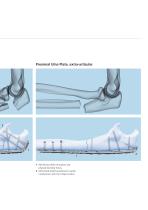
Proximal Ulna Plate, extra-articular 1 Reinforced shaft neutralizes diaphyseal bending forces. 2 Minimized proximal extension avoids interference with the triceps tendon.
Open the catalog to page 9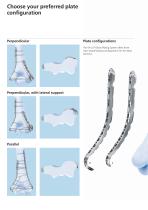
Choose your preferred plate configuration Plate configurations The VA-LCP Elbow Plating System offers three main double-plating configurations for the distal humerus. Perpendicular, with lateral support
Open the catalog to page 10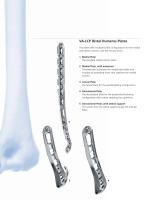
VA-LCP Distal Humerus Plates The plates offer multiple screw configurations for the medial and lateral columns, and the articular block. 1 Medial Plate The standard medial column plate. 2 Medial Plate, with extension The extension buttresses the medial epicondyle and includes an ascending screw that stabilizes the medial column. 3 Lateral Plate The lateral plate for the parallel-plating configuration. 4 Dorsolateral Plate The dorsolateral plate for the perpendicular-plating configuration with screws targeting the capitellum. 5 Dorsolateral Plate, with lateral support The screws from the lateral...
Open the catalog to page 11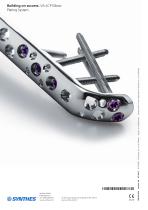
All technique guides are available as PDF files at www.synthes.com/lit Synthes and LCP are trademarks of Synthes, Inc. or its affiliates Building on success. VA-LCP Elbow Plating System.
Open the catalog to page 12All Depuy Synthes catalogs and technical brochures
 Titanium Sternal Fixation System
34 Pages
 Small Battery Drive II
4 Pages
 Introducing The Variable Angle
12 Pages

Archived catalogs
 MatrixRIB®FixationSystem
86 Pages
 HEALIX ADVANCE
4 Pages
 HEALIX Anchor™ 3.4 mm
2 Pages
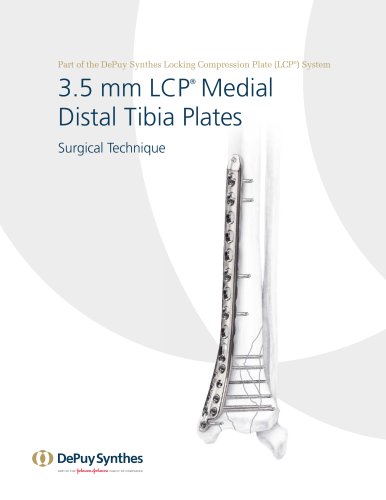 3.5 mm LCP™ Medial
15 Pages
 RADIUS OF CURVATURE
3 Pages
 Building on Success
16 Pages
 2.0 mm LCP® Distal Ulna Plate
20 Pages
 2.4 mm VA LCP™
4 Pages
 Mandible Trauma Solutions
2 Pages
 Power line II
4 Pages
 Concorde
28 Pages
 LCP Intercarpal
31 Pages
 LCS® COMPLETE™
2 Pages
 Synthes TPLO.
8 Pages
 SynFix-LR System
56 Pages
 ATB Anterior Tension Band Plate
32 Pages
 CONDUIT™
15 Pages
 Brochure_FINAL
2 Pages
 DePuy Synthes
81 Pages
 Anspach
3 Pages
 Orthopedic Foot Instruments
32 Pages
 PINNACLE® Hip Solutions
12 Pages
 Corail
24 Pages
 S-ROM® NOILES™
68 Pages
 TRI-LOCK® Product Rationale
12 Pages
 Reclaim Surgical Technique
44 Pages
 Speed
Speed2 Pages
 attune
80 Pages
 HAMMERLOCK® 2
2 Pages
 DePuy Glenoid Solutions
2 Pages
 Trauma Solutions. Elbow
4 Pages
 Polar
Polar4 Pages
 Alveolar Distractor.
4 Pages
 Piezoelectric System
4 Pages
 Air Power Line II
6 Pages
 LCP Clavicle Hook Plate
4 Pages
 TruMatch Pin Guides
16 Pages
 P F N A
8 Pages
 SKILL, DEDICATION,
16 Pages
 Orthopaedics. Overview
20 Pages
 DURALOC
16 Pages
 Marathon Cemented Cup
20 Pages
 REEF Surgical Technique
16 Pages
 MatrixNEURO
8 Pages
 Anspach XMax
4 Pages
 Anspach eMax 2 Plus
4 Pages
 Small Electric Drive
4 Pages
 Air Pen Drive
4 Pages
 Colibri II
4 Pages
 Spine
Spine25 Pages
 Expert Hindfoot Arthrodesis Nail
48 Pages
 LCP Distal Fibula Plates
32 Pages
 TomoFix
60 Pages
 Expert Tibial Nail PROtect
16 Pages
 Expert Tibia Nail
84 Pages
 Sacral Bars
16 Pages
 Pelvic C-Clamp
20 Pages
 Low Profile Pelvic System
16 Pages
 Proximal Femoral (Hook) Plate
24 Pages
 LCP
LCP24 Pages
 PFNA
PFNA112 Pages
 HCS 1.5, 2.4, 3.0
36 Pages
 LCP Wrist Fusion
32 Pages
 LCP Compact Hand
28 Pages
 VA-LCP Elbow
48 Pages
 Distal Radius
44 Pages
 Olecranon
30 Pages
 LCP Hook Plate
28 Pages
 DHP & Olecranon
4 Pages
 LCP S-A
4 Pages
 Epoca
Epoca4 Pages
 Philos
32 Pages
 MultiLoc
68 Pages


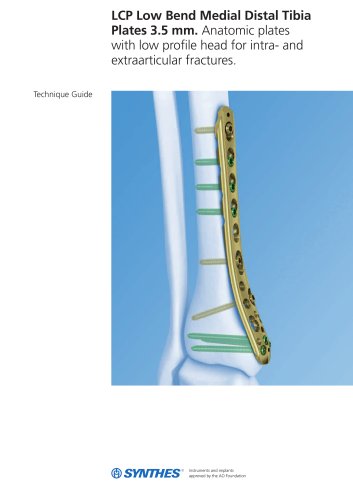


- DePuy Synthes bone plate
- Compression plate
- Metallic compression plate
- Locking compression plate
- Titanium compression plate
- Orthopedic surgery instrument kit
- Distal compression plate
- Interbody fusion cage
- Sterilization container
- Instrument sterilization container
- Arthrodesis nail
- Bone substitute
- Metallic intramedullary nail
- Femoral stem
- Anterior interbody fusion cage
- Arthrodesis plate
- Orthopedic surgery bone substitute
- Femoral intramedullary nail
- Knee prosthesis
- Metallic arthrodesis plate