
- Catalogs
- Depuy Synthes
- VA-LCP Elbow


VA-LCP Elbow

VA-LCP Elbow
The VA-LCP Distal Humerus Plates 2.7/3.5 are designed for low-profile fixation using variable angle locking technology. This guide provides an overview of the surgical technique, product information, and AO principles.
The AO principles focus on anatomic reduction, stable fixation, early mobilization, and preservation of blood supply to ensure optimal recovery during internal fixation.
The plates are indicated for intra-articular fractures, supracondylar fractures, nonunions, and osteotomies of the distal humerus.
Preoperative planning involves radiographic assessment and selecting the appropriate plate type and length. The patient is positioned in prone or lateral decubitus, with a posterior incision approach. Identifying the ulnar and radial nerves is crucial.
Plate type and length selection is based on fracture characteristics. The guide emphasizes using trial implants for lateral and medial columns and the importance of different plate lengths to prevent stress.
Lateral-Column Plate: Positioned on the dorsolateral aspect, avoiding impingement. Bending may be necessary to fit patient anatomy.
Medial-Column Plate: Positioned on the medial column, with options for extension to stabilize the medial epicondyle.
Variable angle locking screws allow for a fixed-angle construct with up to 15° off-axis angulation. Detailed steps for inserting lateral and medial column plates are provided, including temporary fixation and low-profile metaphyseal compression screws.
The VA-LCP system offers three configurations: perpendicular, perpendicular with lateral support, and parallel. The plates are designed to minimize prominence while maintaining stability.
The guide specifies using a 2.4 mm universal drill guide and a 1.8 mm drill bit for 2.4 mm cortex screws. For 2.7 mm variable angle locking screws, a VA-LCP Drill Sleeve 2.7 and a 2.0 mm drill bit are recommended. Various instruments required for the procedure are listed, including depth gauges, screwdrivers, and torque limiters.
Steps for inserting screws at nominal angles to avoid collisions with other screws are outlined. The importance of using correct drill sleeves and angles for proper fixation is emphasized. Alternative techniques for measuring screw length and inserting distal screws in lateral and medial column plates are provided.
Key recommendations include avoiding threaded drill guides in variable angle locking holes, ensuring screws do not protrude into the olecranon or coronoid fossa, and using torque limiters to maintain the plate-screw interface strength. Careful drilling to prevent interference with screws in adjacent plates is advised.
Instructions for implant removal include unlocking all locking screws before complete removal to prevent plate rotation and potential soft tissue damage. Extraction screws are recommended if screws cannot be removed with a screwdriver.
Various plates and screws are available in different lengths and materials (stainless steel or titanium), with options for sterile packaging. Specific product codes for ordering are provided.
The guide highlights the importance of not angulating more than 15° from the central axis of the screw hole and ensuring the correct instrumentation is available for trouble-free implant removal.
Includes various configurations for VA-LCP Distal Humeral Plates, such as dorsolateral, lateral, and medial, with specific dimensions and materials (stainless steel).
Complete sets for VA-LCP Elbow Plates in modular trays, available in stainless steel or titanium. Optional sets include trial implants and small fragment reduction instruments.
References studies and articles related to the treatment of distal humerus fractures using LCP Distal Humerus Plates, highlighting different techniques and their outcomes.
All technique guides are available as PDF files on the Synthes website.
Catalog excerpts

VA-LCP Distal Humerus Plates 2.7/3.5 The low-profile fixation system with variable angle locking technology. Technique Guide
Open the catalog to page 1
Image intensier control Warning This description alone does not provide sufficient background for direct use of the instrument set. Instruction by a surgeon experienced in handling these instruments is highly recommended. Reprocessing, Care and Maintenance of Synthes Instruments For general guidelines, function control and dismantling of multi-part instruments, please contact your local sales representative or refer to: www.synthes.com/reprocessing
Open the catalog to page 2
Introduction VA-LCP Distal Humerus Plates 2.7/3.5 2 Surgical Technique Preparation and Approach 6 Determination of Fixation Technique 10 Insert Lateral-Column Plate 14 Insert Distal Screws in Lateral-Column Plate 20 Insert Medial-Column Plate 25 Insert Distal Screws in Medial-Column Plate 28 Insert Plate-Shaft Screws 29 Fixation of Olecranon Osteotomy 32 Product Information Implants 34 VA-LCP Distal Humerus Plates 2.7/3.5 Technique Guide Synthes
Open the catalog to page 3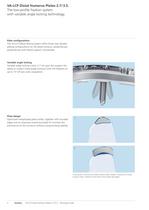
VA-LCP Distal Humerus Plates 2.7/ 3.5. The low-profile fixation system with variable angle locking technology. Plate configurations The VA-LCP Elbow Plating System offers three main doubleplating configurations for the distal humerus: perpendicular, perpendicular with lateral support, and parallel. Variable angle locking Variable angle locking screws 2.7 mm give the surgeon the ability to create a fixed-angle construct with the freedom of up to 15° off-axis screw angulation. Plate design Optimized metaphyseal plate profile, together with rounded edges and an improved anatomical plate fit minimize...
Open the catalog to page 4
VA-LCP Distal Humerus Plates The plates offer multiple screw configurations for the medial and lateral columns, and the articular block. 3 2 1 1 Medial Plate The standard medial column plate. 2 Medial Plate, with extension The extension buttresses the medial epicondyle and includes an ascending screw that stabilizes the medial column. 5 4 3 Lateral Plate The lateral plate for the parallel-plating configuration. 4 Dorsolateral Plate The dorsolateral plate for the perpendicular-plating configuration with distal screws targeting the capitellum. 5 Dorsolateral Plate, with lateral support The screws...
Open the catalog to page 5
AO Principles In 1958, the AO formulated four basic principles, which have become the guidelines for internal fixation1, 2. Anatomic reduction Fracture reduction and fixation to restore anatomical relationships. 1 4 Early, active mobilization Early and safe mobilization and rehabilitation of the injured part and the patient as a whole. 2 3 Copyright © 2007 by AO Foundation 1 Müller ME, Allgöwer M, Schneider R, Willenegger H: Manual of Internal Fixation, 3rd Edition. Berlin: Springer-Verlag. 1991. 2 Rüedi TP, Buckley RE, Moran CG. AO Principles of Fracture Management. 2nd ed. Stuttgart, New York:...
Open the catalog to page 6
Indications – – – – Intra-articular fractures of the distal humerus Supracondylar fractures of the distal humerus Nonunions of the distal humerus Osteotomies of the distal humerus (e.g. due to malunions, deformities) VA-LCP Distal Humerus Plates 2.7/ 3.5 Technique Guide Synthes 5
Open the catalog to page 7
Preoperative planning Complete the preoperative radiographic assessment and prepare the preoperative plan. Use the x-ray templates for theVA-LCP Distal Humerus Plates (Art. No. 034.000.721, 034.000.722 and 034.000.723) to determine the plate type, length, and the position of the screws. 6 Synthes VA-LCP Distal Humerus Plates 2.7/3.5 Technique Guide
Open the catalog to page 8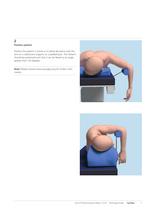
Position patient Position the patient in prone or in lateral decubitus with the arm on a radiolucent support, or a padded post. The forearm should be positioned such that it can be flexed to an angle greater than 120 degrees. Note: Please consult www.aosurgery.org for further infor- VA-LCP Distal Humerus Plates 2.7/3.5 Technique Guide Synthes
Open the catalog to page 9
Fractures are approached through a slightly curved posterior ncision just radial to the olecranon. - Identify the ulnar nerve and elevate it at the ulnar epi- - When using longer plates, ensure that the radial nerve is carefully identified. The type of approach is determined by the character of the fracture, and the preference and experience of the surgeon. For comminuted fractures, a distally pointed chevron ole- cranon osteotomy exposes the fracture best. Note: Please consult www.aosurgery.org for further infor- 8 Synthes VA-LCP Distal Humerus Plates 2.7/3.5 Technique Guide
Open the catalog to page 10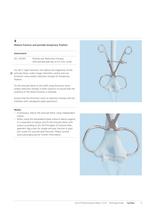
4 Reduce fracture and provide temporary fixation Instrument 03.118.001 Periarticular Reduction Forceps, with pointed ball tips л 6.5 mm, small For AO C-type fractures, first reduce the fragments of the articular block under image intensifier control and use Kirschner wires and/or reduction forceps for temporary fixation. Fix the articular block to the shaft using Kirschner wires and/or reduction forceps in both columns to ensure that the anatomy of the distal humerus is restored. Ensure that the Kirschner wires or reduction forceps will not interfere with subsequent plate placement. Notes: –...
Open the catalog to page 11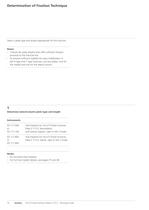
Determination of Fixation Technique Select a plate type and length appropriate for the fracture. - Choose the plate lengths that offer sufficient fixation proximal to the fracture line. - To achieve sufficient stability for early mobilization in AO A-type and C-type fractures, use two plates: one for the medial and one for the lateral column. Determine lateral-column plate type and length 03.117.004 Trial Implants for VA-LCP Distal Humeral 03.1 17.104 with lateral support, right or left, 4 holes 03.1 17.802 Trial Implants for VA-LCP Distal Humeral or Plate 2.7/3.5, lateral, right or left, 2 holes...
Open the catalog to page 12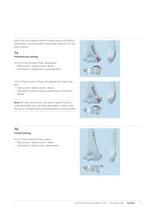
Use of the trial implants and/or the descriptions and illustrations below is recommended to aid implant selection for the lateral column. 1a Perpendicular plating VA-LCP Distal Humerus Plate, dorsolateral – Plate position: lateral column, dorsal – Orientation of distal screws: posteroanterior VA-LCP Distal Humerus Plate, dorsolateral with lateral support – Plate position: lateral column, dorsal – Orientation of distal screws: posteroanterior and lateromedial Note: On very small humeri, the lateral support may protrude extensively over the lateral epicondyle, in which case the use of the plate...
Open the catalog to page 13All Depuy Synthes catalogs and technical brochures
 Titanium Sternal Fixation System
34 Pages
 Small Battery Drive II
4 Pages
 Introducing The Variable Angle
12 Pages

Archived catalogs
 MatrixRIB®FixationSystem
86 Pages
 HEALIX ADVANCE
4 Pages
 HEALIX Anchor™ 3.4 mm
2 Pages
 3.5 mm LCP™ Medial
15 Pages
 RADIUS OF CURVATURE
3 Pages
 Building on Success
16 Pages
 2.0 mm LCP® Distal Ulna Plate
20 Pages
 2.4 mm VA LCP™
4 Pages
 Mandible Trauma Solutions
2 Pages
 Power line II
4 Pages
 Concorde
28 Pages
 LCP Intercarpal
31 Pages
 LCS® COMPLETE™
2 Pages
 Synthes TPLO.
8 Pages
 SynFix-LR System
56 Pages
 ATB Anterior Tension Band Plate
32 Pages
 CONDUIT™
15 Pages
 Brochure_FINAL
2 Pages
 DePuy Synthes
81 Pages
 Anspach
3 Pages
 Orthopedic Foot Instruments
32 Pages
 PINNACLE® Hip Solutions
12 Pages
 Corail
24 Pages
 S-ROM® NOILES™
68 Pages
 TRI-LOCK® Product Rationale
12 Pages
 Reclaim Surgical Technique
44 Pages
 Speed
Speed2 Pages
 attune
80 Pages
 HAMMERLOCK® 2
2 Pages
 DePuy Glenoid Solutions
2 Pages
 Trauma Solutions. Elbow
4 Pages
 Polar
Polar4 Pages
 Alveolar Distractor.
4 Pages
 Piezoelectric System
4 Pages
 Air Power Line II
6 Pages
 LCP Clavicle Hook Plate
4 Pages
 TruMatch Pin Guides
16 Pages
 P F N A
8 Pages
 SKILL, DEDICATION,
16 Pages
 Orthopaedics. Overview
20 Pages
 DURALOC
16 Pages
 Marathon Cemented Cup
20 Pages
 REEF Surgical Technique
16 Pages
 MatrixNEURO
8 Pages
 Anspach XMax
4 Pages
 Anspach eMax 2 Plus
4 Pages
 Small Electric Drive
4 Pages
 Air Pen Drive
4 Pages
 Colibri II
4 Pages
 Spine
Spine25 Pages
 Expert Hindfoot Arthrodesis Nail
48 Pages
 LCP Distal Fibula Plates
32 Pages
 TomoFix
60 Pages
 Expert Tibial Nail PROtect
16 Pages
 Expert Tibia Nail
84 Pages
 Sacral Bars
16 Pages
 Pelvic C-Clamp
20 Pages
 Low Profile Pelvic System
16 Pages
 Proximal Femoral (Hook) Plate
24 Pages
 LCP
LCP24 Pages
 PFNA
PFNA112 Pages
 HCS 1.5, 2.4, 3.0
36 Pages
 LCP Wrist Fusion
32 Pages
 LCP Compact Hand
28 Pages
 Distal Radius
44 Pages
 Olecranon
30 Pages
 LCP Hook Plate
28 Pages
 DHP & Olecranon
4 Pages
 LCP S-A
4 Pages
 Epoca
Epoca4 Pages
 Philos
32 Pages
 MultiLoc
68 Pages




- DePuy Synthes bone plate
- Compression plate
- Metallic compression plate
- Locking compression plate
- Titanium compression plate
- Orthopedic surgery instrument kit
- Distal compression plate
- Interbody fusion cage
- Sterilization container
- Instrument sterilization container
- Arthrodesis nail
- Bone substitute
- Metallic intramedullary nail
- Femoral stem
- Anterior interbody fusion cage
- Arthrodesis plate
- Orthopedic surgery bone substitute
- Femoral intramedullary nail
- Knee prosthesis
- Metallic arthrodesis plate