

From minuscule amounts to magnificent results: reliable ChIP-seq data from 10,000 cells with the True MicroChIP™ and the MicroPlex Library Preparation™ kits

From minuscule amounts to magnificent results: reliable ChIP-seq data from 10,000 cells with the True MicroChIP™ and the MicroPlex Library Preparation™ kits
Catalog excerpts
From minuscule amounts to magnificent results: reliable ChIP-seq data from 10,000 cells with the True MicroChIP™ and the MicroPlex Library Preparation™ kits Abstract Diagenode has developed groundbreaking solutions for epigenetic studies on very low sample amounts. In this application note, we introduce our unique True MicroChIP Kit and the MicroPlex Library Preparation™ Kit, which enable the reliable detection of protein-DNA interactions by ChIP-PCR or ChIP-seq starting from inputs as low as 10,000 cells. Introduction As Next-Generation Sequencing (NGS) technologies have become widespread and more accessible, the primary method for genome-wide mapping of protein-DNA interactions is now chromatin immunoprecipitation followed by NGS detection (ChIP-seq), which enables the discovery of transcription factor binding sites or patterns of histone modifications. ChIP-seq is advantageous in providing high-throughput data of the whole genome that can be used for quantitative and qualitative analysis of the protein-DNA interactions (measured through the enrichment of bound DNA fragments), but it is not without its disadvantages. A major limitation is the requirement for high amounts of starting material, usually millions of cells. For scientists who work with limited sample amounts, such as ancient samples or difficult cell types, ChIP-seq has not been a viable analysis method. Diagenode has addressed this limitation with novel technology and kits optimized specifically for ChIP-seq from extremely low amount of starting materials. Diagenode has a complete suite of ChIP and ChIP-seq solutions including extensively validated ChIP-seq grade antibodies, cell lysis and chromatin shearing devices (Bioruptor®), kits for high and low cell numbers, automated epigenetics sample prep, and kits specialized for ChIP-seq. For ChIP-seq with limited sample amounts, the solutions of choice are the True MicroChIP kit used in conjunction with the MicroPlex Library Preparation™ kit and our Premium grade antibodies, enabling ChIP-seq with just a few picograms of input. The MicroPlex kit is an exceptionally fast, user-friendly, and automatable solution with multiplexing capability optimized for ChIP-seq libraries from picogram inputs of chromatin. The library preparation requires only three simple steps, with no tube transfers or intermediate purifications required. Additionally, the True MicroChIP kit has been validated on the Illumina® sequencing platforms, Diagenode’s IP-Star® Compact Automated Workstation, and with our Premium ChIP-seq grade antibodies, the most extensively validated antibodies on the market, selected specifically for ChIP-seq applications. This application note demonstrates a successful example of using the True MicroChIP Kit followed by library preparation with the MicroPlex kit on as low as 10,000 cells. The True MicroChIP Kit contains everything you need for ChIP: buffers for lysis, washing, elution, precipitants, magnetic beads, and controls (antibody, IgG, PCR primers). Similarly the MicroPlex kit provides reagents necessary to perform a successful amplification and library preparation: buffers and enzymes for DNA synthesis and amplification, plus reagents for indexing. The overview of the simple and efficient protocols can be seen in Figure 1. Europe - Diagenode s.a. / [email protected] / [email protected] // North America - Diagenode Inc. / [email protected] / [email protected]
Open the catalog to page 1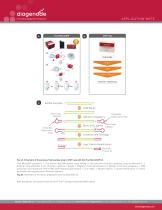
•• diagendae Innovating Epigenetic Solutions APPLICATION NOTE True MicroChIP dsDNA template DNA Repair Stem-loop Adaptor Cleavable Addition of Adaptors ^ Replication stop + Cleavable Replication Stop A ■=o Extension and Cleavage Primer A ♦ High Fidelity Amplification -Barcode Primer B Fig.lA: Schematic of the process from sample prep to ChIP-seq with the True MicroChIP kit. True MicroChIP procedure: 1. Cell fixation and DNA-protein cross-linking, 2. Cell lysis and chromatin shearing using the Bioruptor®, 3. Binding of the antibodies to the chromatin, addition of beads, 4. Magnetic immunoprecipitation,...
Open the catalog to page 2
Materials and methods For the ChIP experiments, 10,000 HeLa-S3 cells were harvested in addition to a higher cell number (~100,000 cells) for comparison). Using the True MicroChIP Kit, the cells were fixed with formaldehyde and lysed. For chromatin shearing, 5 x 5 cycles of 30 seconds on/30 seconds off on the high power setting were done on the Bioruptor® Plus. Shearing efficiency was analyzed on 1.5% agarose gel. The protein-DNA complexes were captured with Diagenode’s ChIP-seq grade H3K4me3 antibody. Magnetic beads were used for easy isolation and elution. During washes with optimized buffers,...
Open the catalog to page 3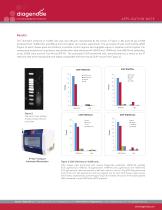
Results The chromatin shearing of 10,000 cells was very efficient, represented by the smear in Figure 2. We used 30 pg of DNA extracted from 10,000 cells and 300 pg from the higher cell number experiment. The successful IP was confirmed by qPCR (Figure 3) which shows good enrichments in positive control regions and negligible signal in negative control regions. For comparison and proof of consistency, we provide other data obtained with H3K27me3, H3K9me3, and H3K27me3 antibodies, using 10,000 cells and the True MicroChIP Kit. The automated ChIP performed well, demonstrated by a series of ten...
Open the catalog to page 4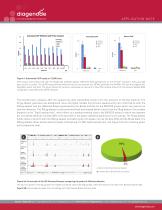
Innovating Epigenetic Solutions APPLICATION NOTE Figure 4: Automated ChIP assay on 10,000 cells. ChIP assays were performed with the Diagenode antibody against H3K4me3 (0.25 pg/reaction) on the IP-Star® Compact. 0.25 pg of IgG was used as a control. The qPCR was performed with primers for the positive loci EIF4A2 promoter and GAPDH TSS and the negative loci Myoglobin exon2 and Sat2. The figure shows the recovery, expressed as a percent of input (the relative amount of immunoprecipitated DNA compared to input DNA after qPCR analysis). The bioinformatics analyses after the sequencing show outstanding...
Open the catalog to page 5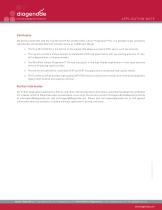
Conclusion We demonstrated that with the True MicroChIP Kit and MicroPlex Library Preparation™ Kit, it is possible to get consistent, reproducible and reliable data from samples as low as 10,000 cells (30 pg). o The True MicroChIP kit is the first kit on the market that allows successful ChIP-seq on such low amounts o The two kits provide a unique solution to standardize ChIP-seq experiments with low starting amounts of cells, cell subpopulations, or biopsy samples o The MicroPlex Library Preparation™ Kit was successful in the high fidelity amplification of low input amounts without introducing...
Open the catalog to page 6All Diagenode catalogs and technical brochures
 DNA Methylation Solutions
16 Pages
 BIORUPTOR® MEGARUPTOR®
24 Pages


- Detection kit
- Solvent reagent
- Blood detection kit
- Molecular biology reagent
- Plasma detection kit
- Molecular detection kit
- Sample preparation system
- Automatic sample processor
- Real-time PCR assay kit
- Laboratory sample preparation system
- Benchtop sample preparation system
- Cell detection kit
- Oncology detection kit
- Genetic detection kit
- Next-generation sequencing reagent kit
- High-sensitivity reagent
- Cellular biology test kit
- Nucleic acid sample preparation system
- DNA sample preparation system
- Sequencing test kit