- Products
- Catalogs
- News & Trends
- Exhibitions
RRS2
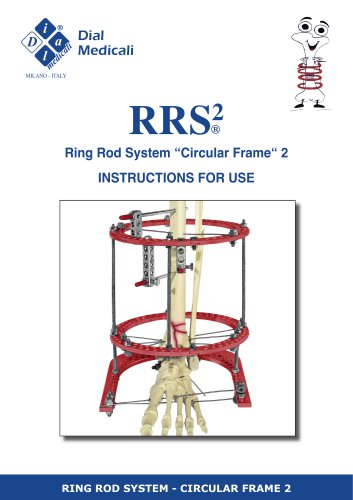
RRS2
The Ring Rod System (RRS) "Circular Frame" 2 is a versatile external fixator used for bone support in various orthopedic procedures such as fracture treatment, deformity correction, and limb lengthening. It features customizable, pre-assembled components for efficient assembly.
Rings are available in full, half, and 5/8 configurations, made from anodized aluminum alloy, and come in pediatric and adult sizes. Proper sizing is crucial to prevent skin compression and ulceration.
Arches are designed for the proximal femur, while foot rings are horseshoe-shaped and available in multiple sizes. Maintaining a 2 cm distance from the skin is essential.
Threaded rods and linear spacers connect rings to form stable frames. A "ring block" stabilizes bone segments using two rings and four connection elements.
Plates and spacers are used to connect rings in parallel or aligned blocks, ensuring stability and proper alignment.
Includes various bolts, nuts, and washers for secure assembly, with special washers for specific alignments and wire fixation.
K-wires and half-pins ensure stable fixation to the bone, with safe insertion corridors to avoid neurovascular injury.
Detailed instructions are provided for inserting wires and half-pins in different bones, emphasizing safety and anatomical considerations.
K-wires and half-pins are used for bone fixation, with specific insertion techniques to minimize tissue irritation and ensure stability. Limb lengthening and angular correction procedures are outlined, requiring precise planning and execution.
A list of necessary tools and components, including drill bits, spacers, hinges, and other hardware, is provided for the procedures.
The document serves as a comprehensive guide for using the RRS system in orthopedic procedures, highlighting the importance of precision and proper technique.
Dial Medicali srl, Viale Berbera 45, 20162 Milano, Italy. Tel: +39.02.89828078, Fax: +39.02.66104021. Website: www.dialmedicali.com
Catalog excerpts
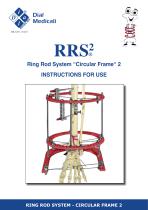
Dial Medicali MILANO - ITALY Ring Rod System “Circular Frame“ 2 INSTRUCTIONS FOR USE RING ROD SYSTEM - CIRCULAR FRAME
Open the catalog to page 1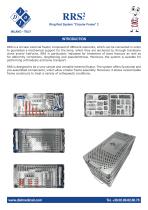
Ring Rod System "Circular Frame" 2 MILANO - ITALY INTRODUCTION RRS is a circular external fixator composed of different elements, which can be connected in order to guarantee a mechanical support for the bone, which they are anchored to, through transbony wires and/or half-pins. RRS is particularly indicated for treatment of bone fracture as well as for deformity corrections, lengthening and pseudarthrosis. Moreover, the system is suitable for performing arthrodesis and bone transport. RRS is designed to be a very simple and versatile external fixator. The system offers functional and pre-assembled...
Open the catalog to page 2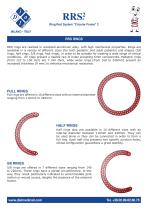
Ring Rod System "Circular Frame" 2 MILANO - ITALY RRS RINGS RRS rings are realized in anodized aluminium alloy, with high mechanical properties. Rings are available in a variety of different sizes (for both pediatric and adult patients) and shapes (full rings, half rings, 5/8 rings, foot rings), in order to be suitable for treating a wide range of clinical conditions. All rings present a double raw of holes accepting 6mm components. Pediatric rings (from 110 to 150 mm) are 7 mm thick, while wider rings (from 160 to 240mm) present an increased thickness (9 mm) to enhance mechanical resistance....
Open the catalog to page 3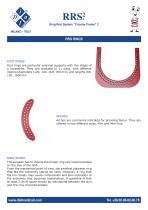
Ring Rod System "Circular Frame" 2 MILANO - ITALY FOOT RINGS Foot rings are particular external supports with the shape of a horseshoe. They are available in 11 sizes, with different internal diameters (120, 140, 160, 180 mm) and lengths (80, 120, 160mm). ARCHES Arches are commonly indicated for proximal femur. They are offered in two different sizes, Mini and Mini Plus. RING SIZING The surgeon has to choose the proper ring size required based on the size of the limb. From the mechanical point of view, the smallest diameter ring that fits the extremity should be used. However, a ring that fits...
Open the catalog to page 4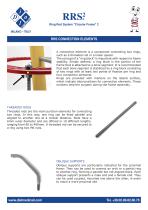
Ring Rod System "Circular Frame" 2 MILANO - ITALY RRS CONNECTION ELEMENTS A connection element is a component connecting two rings, such as a threaded rod or a linear spacer. The concept of a “ring block” is important with respect to frame stability. Simply defined, a ring block is the portion of the frame that is attached to a bone segment. It is recommended that each bone segment is stabilized by a ring block consisting of two rings with at least two points of fixation per ring and four connection elements. Rings are provided with markers on the lateral surface, which indicate ideal positions...
Open the catalog to page 5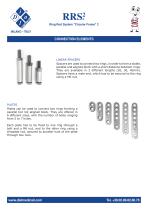
Ring Rod System "Circular Frame" 2 MILANO - ITALY CONNECTION ELEMENTS LINEAR SPACERS Spacers are used to connect two rings, in order to form a stable, parallel and aligned block with a short distance between rings. They are available in 3 different lengths (20, 30, 40mm). Spacers have a male end, which has to be secured to the ring using a M6 nut. PLATES Plates can be used to connect two rings forming a parallel but not aligned block. They are offered in 6 different sizes, with the number of holes ranging from 2 to 7 holes. Each plate has to be fixed to one ring through a bolt and a M6 nut, and...
Open the catalog to page 6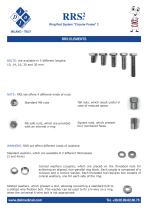
Ring Rod System "Circular Frame" 2 MILANO - ITALY BOLTS: are available in 5 different lengths: 10, 14, 16, 20 and 30 mm. NUTS: RRS set offers 4 different kinds of nuts: Standard M6 nuts Tall nuts, which result useful in case of reduced space M6 safe nuts, which are provided with an internal o-ring Square nuts, which present four numbered faces WASHERS: RRS set offers different kinds of washers: Standard washers, which are available in 2 different thicknesses (2 and 4mm) Conical washers (couple), which are placed on the threaded rods for achieving an aligned, non-parallel ring block. Each couple...
Open the catalog to page 7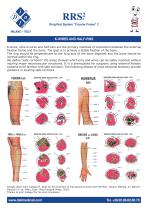
Ring Rod System "Circular Frame" 2 MILANO - ITALY K-WIRES AND HALF-PINS K-wires, olive K-wires and half-pins are the primary methods of connection between the external fixation frame and the bone. The goal is to achieve a stable fixation of the bone. The ring should be perpendicular to the long axis of the bone segment and the bone should be centred within the ring. We define “safe corridors” the areas through which pins and wires can be safely inserted without injuring major neurovascular structures. It is a prerequisite for surgeons using external fixation systems to be familiar with safe corridors....
Open the catalog to page 8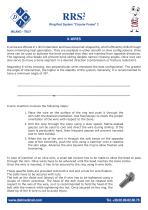
Ring Rod System "Circular Frame" 2 MILANO - ITALY K-WIRES K-wires are offered in 1.8mm diameter and have a bayonet-shaped tip, which efficiently drills through bone minimizing heat generation. They are available in either smooth or olive configurations. Olive wires can be used to buttress the bone provided that they are inserted from opposite directions. The opposing olive beads will prevent bone sliding despite narrow crossing angles. Olive wire can also serve to move a bone segment in a desired direction (compression or fracture reduction). Regarding K-wires crossing, two perpendicular wires...
Open the catalog to page 9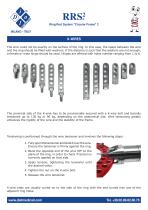
Ring Rod System "Circular Frame" 2 MILANO - ITALY K-WIRES The wire could not be exactly on the surface of the ring. In this case, the space between the wire and the ring should be filled with washers. If the distance is such that the washers are not enough, a female or male hinge should be used. Hinges are offered with holes number ranging from 1 to 6. The proximal side of the K-wire has to be provisionally secured with a K-wire bolt and tipically tensioned up to 130 kg or 90 kg, depending on the anatomical site. Wire tensioning greatly enhances the rigidity of the wire and the stability of the...
Open the catalog to page 10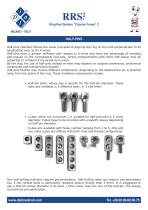
Ring Rod System "Circular Frame" 2 MILANO - ITALY HALF-PINS Half-pins insertion follows the same principles of aligning the ring on the limb perpendicular to its longitudinal axis, as for K-wires. Half-pins have a greater stiffness with respect to K-wires and have the advantage of avoiding soft tissues on the contralateral ring side, where compartments with more soft tissue may be subjected to irritation if traversed by K-wires. By the way, the use of half-pins instead of wires may depend on surgeon preference, anatomical constraints and mechanical principles. Half-pins fixation may involve different...
Open the catalog to page 11