
- Catalogs
- DTR Medical
- The saving s benefits of single-use

The saving s benefits of single-use
The saving s benefits of single-use
The document discusses the advantages of single-use surgical instruments over reusable ones, focusing on benefits such as cost savings, improved safety, and reduced infection rates. DTR Medical, established in 2005, specializes in providing high-quality single-use sterile disposable products, emphasizing customer-driven innovation and strong relationships with clinical staff.
Reprocessing reusable instruments is complex and time-consuming, often causing delays in medical procedures. Single-use instruments eliminate the need for reprocessing, saving time for healthcare professionals and reducing stress for patients. Research indicates significant time is spent by nurses searching for medical devices, costing the NHS over £350 million annually.
Single-use instruments reduce infection risks by eliminating cross-contamination from reusable instruments. This is crucial for preventing diseases like CJD, which are resistant to conventional cleaning methods. The use of disposable instruments can significantly reduce infection rates and associated costs, with surgical site infections costing the UK £758 million annually.
While the initial cost of single-use instruments may seem higher, they eliminate expenses related to reprocessing, such as transportation, manpower, and repairs. The overall cost savings, combined with reduced infection risks, make single-use instruments a financially viable option.
Reusable instruments pose significant contamination risks, as evidenced by incidents where surgeries were canceled due to unclean instruments. Single-use instruments eliminate these risks, ensuring higher patient safety and reducing healthcare-acquired infections (HCAIs).
There is a growing trend towards single-use instruments due to their safety and efficiency. The document advocates for their adoption to improve patient care and operational efficiency, highlighting the need for procurement staff to consider the total cost of ownership when evaluating single-use versus reusable instruments.
The document concludes that single-use disposable instruments offer a safer, more efficient, and cost-effective alternative to reusable instruments. DTR Medical's commitment to innovation and customer satisfaction positions them as a leader in this growing market.
Catalog excerpts

TIME LIFE COST The savings benefits of single-use
Open the catalog to page 1
T L C TIME LIFE COST The savings benefits of single-use In a tough economic climate where purse strings are tightening and resources are limited, realising savings is vital. Reprocessing reusable surgical instruments has long been the standard process, but evidence suggests that single–use instruments, by comparison, can save considerable time, cost and even lives. Time-saving Reprocessing medical instruments is complex and often underestimated. Waiting for instruments to be repaired or reworked can lead to delays in theatre lists and appointments. This not only creates extra administration time,...
Open the catalog to page 2
T L C TIME LIFE The savings benefits of single-use COST In a tough economic climate where purse strings are tightening and resources are limited, realising savings is vital. Reprocessing reusable surgical instruments has long been the standard process, but evidence suggests that single–use instruments, by comparison, can save considerable time, cost and even lives. In this tough economic climate realising savings is vital. Reprocessing Time-saving Reprocessing medical instruments is complex and often underestimated. evidence suggests that single–use surgical instruments is commonplace but Waiting...
Open the catalog to page 3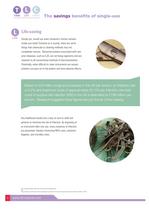
L C T L C T LIFE COST TIME TIME LIFE COST The savings benefits of single-use The savings benefits of single-use In a tough economic climate where purse strings are tightening and resources are In a tough economic climatevital. Reprocessing reusable surgical instruments has long limited, realising savings is where purse strings are tightening and resources are limited, realising savings is vital. Reprocessing reusable surgical instruments has long been the standard process, but evidence suggests that single–use instruments, by been the standardsave considerable time,suggests that single–use instruments,...
Open the catalog to page 4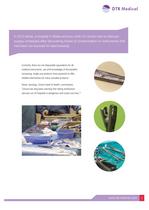
In 2010 alone, a hospital in Wales and two north of London had to interrupt surgery schedules after discovering traces of contamination on instruments that had been out-sourced for reprocessing4. Currently, there are not disposable equivalents for all medical instruments, yet with knowledge of the benefits increasing, single-use products have potential to offer reliable alternatives for many reusable products. Karen Jennings, Unison head of health, commented, ‘Unison has long been warning that taking sterilisation services out of hospitals is dangerous and could cost lives.’5 5
Open the catalog to page 5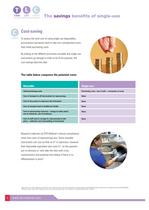
L C T L C T LIFE COST TIME TIME LIFE COST The savings benefits of single-use The savings benefits of single-use In a tough economic climate where purse strings are tightening and resources are In a tough economic climatevital. Reprocessing reusable surgicaland resources arelong limited, realising savings is where purse strings are tightening instruments has limited, realising savings is vital. evidence suggests thatsurgical instruments has long been the standard process, but Reprocessing reusable single–use instruments, by been the standardsave considerable time,suggests that single–use instruments,...
Open the catalog to page 6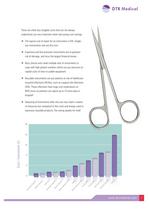
There are other less tangible costs that are not always understood, but very important when discussing cost savings: l The typical cost of repair for an instrument is £50. Singleuse instruments rule out this cost l Expensive and fine precision instruments are at greatest risk of damage, and incur the largest financial losses l Busy clinical units need multiple sets of instruments to cope with high patient numbers which can put pressure on capital costs of new re-usable equipment l Reusable instruments can put patients at risk of healthcareacquired infections (HCAIs), such as surgical site infections...
Open the catalog to page 7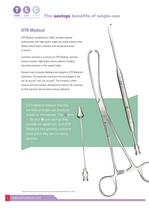
L C T L C T LIFE COST TIME TIME LIFE COST The savings benefits of single-use The savings benefits of single-use In a tough economic climate where purse strings are tightening and resources are In a tough economic climatevital. Reprocessing reusable surgical instruments has long limited, realising savings is where purse strings are tightening and resources are limited, realising savings is vital. Reprocessing reusable surgical instruments has long been the standard process, but evidence suggests that single–use instruments, by been the standardsave considerable time,suggests that single–use instruments,...
Open the catalog to page 8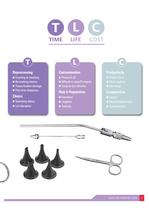
TIME LIFE COST • Counting & checking • Re-working returns • Tissue fixation damage • First time sharpness • Searching delays • List disruption • Surgical site infection Risk & Reputation • Theatre time • Clinic capacity
Open the catalog to page 9
We operate our own UK production facilities equipped with ISO class 7 cleanrooms. Our company is fully accredited to ISO9001:2008, Matching reusable standards We benchmark our products against the following reusable British and international standards: BS 5194-1:1991 - (Inc ISO 7153 -1:2001) Surgical Instruments - (Metallic Materials and Stainless Steel) BS 5194-2:1989 - Specification for Instruments with Pivot Joints BS 5194-3:1985 - Specification for Dissecting Forceps BS 5194-4:1985 - Specification for Scissors, Shears and other Jointed Instruments 17 Clarion Court, Enterprise Park, Swansea,...
Open the catalog to page 12All DTR Medical catalogs and technical brochures
 THE ‘PRO’FILE
2 Pages
 ENT/MAXFAX
44 Pages
 Gynaecology
20 Pages
 Neurosurgical
20 Pages
 General Surgery
36 Pages
 Orthopaedic
32 Pages
 Ophthalmic
16 Pages


