
- Catalogs
- Dukon Medical
- TDCS transcranial electrical stimulator DK-501 TFUS transcranial ultrasound stimulator DK-TUED-03S


- Company
- Products
- Catalogs
- News & Trends
- Exhibitions
TDCS transcranial electrical stimulator DK-501 TFUS transcranial ultrasound stimulator DK-TUED-03S
1 /1Page
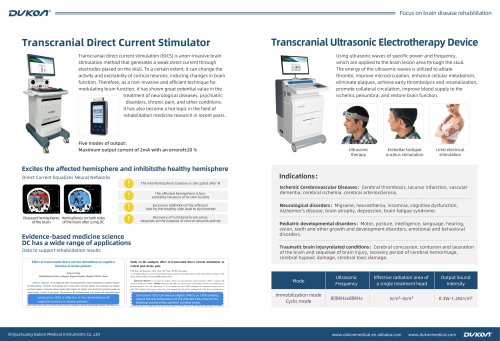
TDCS transcranial electrical stimulator DK-501 TFUS transcranial ultrasound stimulator DK-TUED-03S
1 /1Page
Catalog excerpts
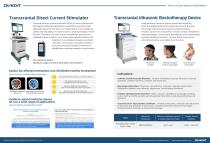
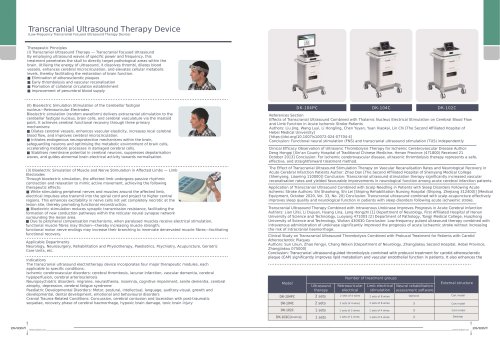
Focus on brain disease rehabilitation Transcranial Direct Current Stimulator Transcranial Ultrasonic Electrotherapy Device Transcranial direct current stimulation (tDCS) is anon-invasive brain stimulation method that generates a weak direct current through electrodes placed on the skull. To a certain extent, it can change the activity and excitability of cortical neurons, inducing changes in brain function. Therefore, as a non-invasive and efficient technique for modulating brain function, it has shown great potential value in the treatment of neurological diseases, psychiatric disorders, chronic pain, and other conditions. It has also become a hot topic in the field of rehabilitation medicine research in recent years. Five modes of output:Maximum output current of 2mA with an errorof±20 % Using ultrasonic waves of specific power and frequency, which are applied to the brain lesion area through the skull. The energy of the ultrasonic waves is utilized to ablate thrombi, improve microcirculation, enhance cellular metabolism, eliminate plaques, achieve early thrombolysis and recanalization, promote collateral circulation, improve blood supply to the ischemic penumbra, and restore brain function. Erebellar fastigial nucleus stimulation Limb electrical stimulation Excites the affected hemisphere and inhibitsthe healthy hemisphere Direct Current Equalizes Neural Networks Ischemic Cerebrovascular Diseases: Cerebral thrombosis, lacunar infarction, vascular dementia, cerebral ischemia, cerebral arteriosclerosis. Neurological disorders: Migraine, neurasthenia, insomnia, cognitive dysfunction, Alzheimer's disease, brain atrophy, depression, brain fatigue syndrome. Evidence-based medicine science DC has a wide range of applications Data to support rehabilitation results Pediatric developmental disorders: Motor, posture, intelligence, language, hearing, vision, teeth and other growth and development disorders, emotional and behavioral disorders. Effect of transcranial direct current stimulation on cognitive function of stroke patients llong-yin Song (Rehabilitation Division. Shanghai Tongren Hospital. Shanghai 200336. China) Abstract: Objective To investigate the effect of transcranial direct current stimulation on cognitive function of stroke patients. Methods From January 2017 to June 2017, 30 stroke patients were selected in our hospital as clinical subjects. Using the random number table method, the patients were divided into treatment group and control group. 15 cases in each group. The patients in the treatment group were treated with transcranial direct Conclusion: tDCS is effective in the rehabilitation of cognitive function in stroke patients. MoC'A total score, scores of executive pow er, memory, orientation, attention and language naming. Fugl-Mcyer score Study on the analgesic effect of transcranial direct current stimulation on central post-stroke pain TAN Juan1. Ll-Xiao-niin' . GOl Chen'.Dl1 Ying'.WANG Xiao-tiling' (I. The Affiliated Hospital of \orth Sichuan Medical College* Institute of \eundogical Diseases • North Sichuan Medical College * 2. North Sichuan Medical College. \anchong 637000. Sichuan * China) [Abstract] Objective:To inv»*>tigat«- th«* analgesic efficacy of tranx-rania) direct current stimulation (tDCS) in patients with central post -stroke pain (CI*SP). Methods: 40 |Mlif*nt<* with CPSP were selected a* the research object* .and they were divided into cx-|M*rimcntal group (n = 19) and control group (n =21) according to the time of TDCS stimulation. The experimental group received a-nodic tDCS stimulation of the primary motor cortex on the tlamagcd Imiin *i«le.and the urMlamaged side «>f the brain contralateral supra-orbil Conclusion: tDCS can exert analgesic effects on CPSP patients, reduce the skin temperature of the affected side,enhance the electrical activity of the patients' cerebral cortex. experimental group were significantly lower than pre-intervention l/><0. 05) . and were lower than the control group (/'<0. 05). 4 Traumatic brain injuryrelated conditions: Cerebral concussion, contusion and laceration of the brain and sequelae of brain injury, recovery period of cerebral hemorrhage, cerebral hypoxic damage, cerebral toxic damage. Shijiazhuang Dukon Medical Instruments Co.,Ltd
Open the catalog to page 1All Dukon Medical catalogs and technical brochures
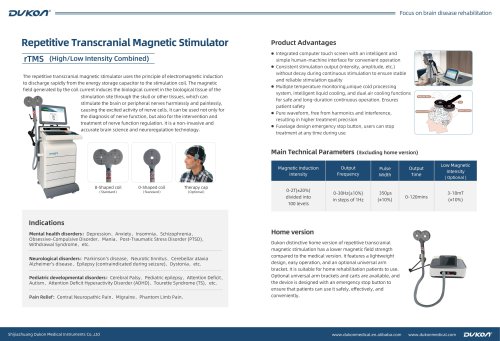



- Electric stimulator
- TENS physiotherapy
- Rehabilitation system
- EMS physiotherapy
- Robotic rehabilitation system
- Transcranial stimulator
- Magnetic therapy unit
- Continuous passive motion device
- Body massager
- Gait rehabilitation system
- Hand-held body massager
- Magnetic transcranial magnetic stimulator
- Transcranial magnetic stimulator
- Limbs mobility rehabilitation system
- Lower limb continuous passive motion device
- Rehabilitation sling
- Rehabilitation staircase
- Neurostimulator
- Knee continuous passive motion device
- TMS + rTMS transcranial magnetic stimulator