
- Catalogs
- Dukon Medical
- TFUS transcranial ultrasound stimulator DK-TUED-03S


- Company
- Products
- Catalogs
- News & Trends
- Exhibitions
TFUS transcranial ultrasound stimulator DK-TUED-03S
1 /1Page
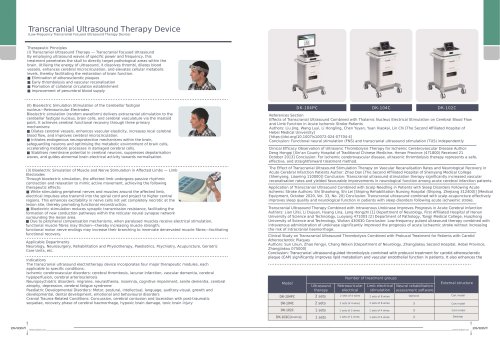
TFUS transcranial ultrasound stimulator DK-TUED-03S
1 /1Page
Catalog excerpts
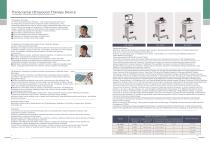
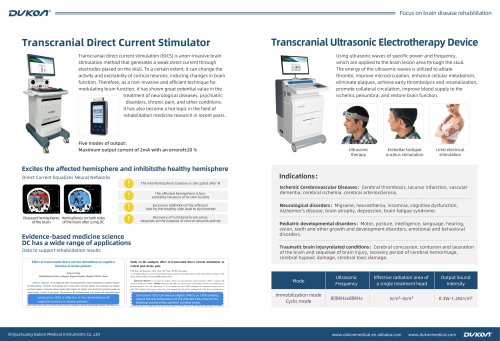
(Low-Frequency Transcranial Focused Ultrasound Therapy Device) Therapeutic Principles (I) Transcranial Ultrasound Therapy — Transcranial Focused Ultrasound By employing ultrasound waves of specific power and frequency, this treatment penetrates the skull to directly target pathological areas within the brain. Utilising the energy of ultrasound, it dissolves thrombi, dilates blood vessels, enhances cerebral microcirculation, and elevates cellular metabolic levels, thereby facilitating the restoration of brain function. ■ Elimination of atherosclerotic plaques ■ Early thrombolysis and vascular recanalisation ■ Promotion of collateral circulation establishment ■ Improvement of penumbral blood supply (II) Bioelectric Simulation Stimulation of the Cerebellar fastigial nucleus—Retroauricular Electrodes Bioelectric simulation (random waveform) delivers extracranial stimulation to the cerebellar fastigial nucleus, brain cells, and cerebral vasculature via the mastoid point. It achieves cerebral functional recovery through three primary mechanisms: ■ Dilates cerebral vessels, enhances vascular elasticity, increases local cerebral blood flow, and improves cerebral microcirculation. ■ Initiates endogenous neuroprotective mechanisms within the brain, safeguarding neurons and optimising the metabolic environment of brain cells, accelerating metabolic processes in damaged cerebral cells. ■ Stabilises membrane potential in cerebral neurons, suppresses depolarisation waves, and guides abnormal brain electrical activity towards normalisation. (3) Bioelectric Simulation of Muscle and Nerve Stimulation in Affected Limbs — Limb Electrodes Through bioelectric simulation, the affected limb undergoes passive rhythmic contraction and relaxation to mimic active movement, achieving the following therapeutic effects: ■ While stimulating peripheral nerves and muscles around the affected limb, electrical impulses also transmit into the spinal cord and project to higher central regions. This enhances excitability in nerve cells not yet completely necrotic at the lesion site, thereby promoting functional reconstruction. ■ Bioelectric stimulation reduces synaptic transmission resistance, facilitating the formation of new conduction pathways within the reticular neural synapse network surrounding the lesion area. ■ Due to peripheral compensation mechanisms, when paralysed muscles receive electrical stimulation, functional muscle fibres may thicken—thereby increasing muscle strength; functional motor nerve endings may increase their branching to innervate denervated muscle fibres—facilitating functional recovery. Applicable Departments Neurology, Neurosurgery, Rehabilitation and Physiotherapy, Paediatrics, Psychiatry, Acupuncture, Geriatric Care Units, etc. The transcranial ultrasound electrotherapy device incorporates four major therapeutic modules, each applicable to specific conditions. Ischemic cerebrovascular disorders: cerebral thrombosis, lacunar infarction, vascular dementia, cerebral hypoperfusion, cerebral arteriosclerosis Neuropsychiatric disorders: migraine, neurasthenia, insomnia, cognitive impairment, senile dementia, cerebral atrophy, depression, cerebral fatigue syndrome Paediatric Developmental Disorders: Motor, postural, intellectual, language, auditory-visual, growth and developmental, dental development, emotional and behavioural disorders Cranial Trauma-Related Conditions: Concussion, cerebral contusion and laceration with post-traumatic sequelae, recovery phase of cerebral haemorrhage, hypoxic brain damage, toxic brain injury References Section Effects of Transcranial Ultrasound Combined with Thalamic Nucleus Electrical Stimulation on Cerebral Blood Flow and Limb Function in Acute Ischemic Stroke Patients Authors: Liu Jing, Wang Luyi, Li Hongling, Chen Yuyan, Yuan Xiaokai, Lin Chi [The Second Affiliated Hospital of Hebei Medical University] Conclusion: Functional neural stimulation (FNS) and transcranial ultrasound stimulation (TUS) independently Clinical Efficacy Observation of Ultrasonic Thrombolysis Therapy for Ischemic Cerebrovascular Disease Author: Deng Hongqi [Xin'an County Hospital of Traditional Chinese Medicine, Henan Province (471800) Received 21 October 2013] Conclusion: For ischemic cerebrovascular disease, ultrasonic thrombolysis therapy represents a safe, effective, and straightforward treatment method. The Effect of Transcranial Ultrasound Stimulation Therapy on Vascular Recanalisation Rates and Neurological Recovery in Acute Cerebral Infarction Patients Author: Zhao Dan [The Second Affiliated Hospital of Shenyang Medical College (Shenyang, Liaoning 110000)] Conclusion: Transcranial ultrasound stimulation therapy significantly increased vascular recanalisation rates and yielded favourable improvements in neurological function among acute cerebral infarction patients. Application of Transcranial Ultrasound Combined with Scalp Needling in Patients with Sleep Disorders Following Acute Ischemic Stroke Authors: Shi Shaohong, Shi Lei [Shiping Rehabilitation Nursing Hospital (Shiping, Zhejiang 312400)] [Medical Equipment, October 2020, Vol. 33, No. 20] Conclusion: Transcranial ultrasound combined with scalp acupuncture effectively improves sleep quality and neurological function in patients with sleep disorders following acute ischaemic stroke. Transcranial Ultrasound Therapy Combined with Intravenous Urokinase Improves Prognosis in Acute Cerebral Infarction Authors: Lian Lifei, Li Dujuan, Huang Lina, Lang Hongzhi [1] Department of Neurology, First Affiliated Hospital of Henan University of Science and Technology, Luoyang 471003 [2] Department of Pathology, Tongji Medical College, Huazhong University of Science and Technology, Wuhan 430030 Conclusion: Low-frequency pulsed ultrasound therapy combined with intravenous administration of urokinase significantly improved the prognosis of acute ischaemic stroke without increasing the risk of intracranial haemorrhage. Clinical Study on Transcranial Ultrasound Thrombolysis Combined with Probucol Treatment for Patients with Carotid Atherosclerotic Plaques Authors: Sun Likun, Zhao Fengyi, Chang Weixin [Department of Neurology, Zhangjiakou Second Hospital, Hebei Province, Zhangjiakou 075000] Conclusion: Transcranial ultrasound-guided thrombolysis combined with probucol treatment for carotid atherosclerotic plaque (CAP) significantly improves lipid metabolism and vascular endothelial function in patients. It also enhances the
Open the catalog to page 1All Dukon Medical catalogs and technical brochures



- Electric stimulator
- TENS physiotherapy
- Rehabilitation system
- EMS physiotherapy
- Robotic rehabilitation system
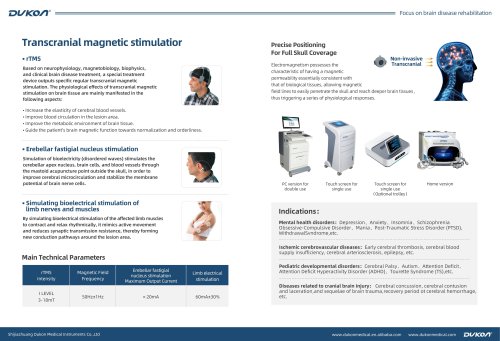
- Transcranial stimulator
- Magnetic therapy unit
- Continuous passive motion device
- Body massager
- Gait rehabilitation system
- Hand-held body massager
- Magnetic transcranial magnetic stimulator
- Transcranial magnetic stimulator
- Limbs mobility rehabilitation system
- Lower limb continuous passive motion device
- Rehabilitation sling
- Rehabilitation staircase
- Neurostimulator
- Knee continuous passive motion device
- TMS + rTMS transcranial magnetic stimulator